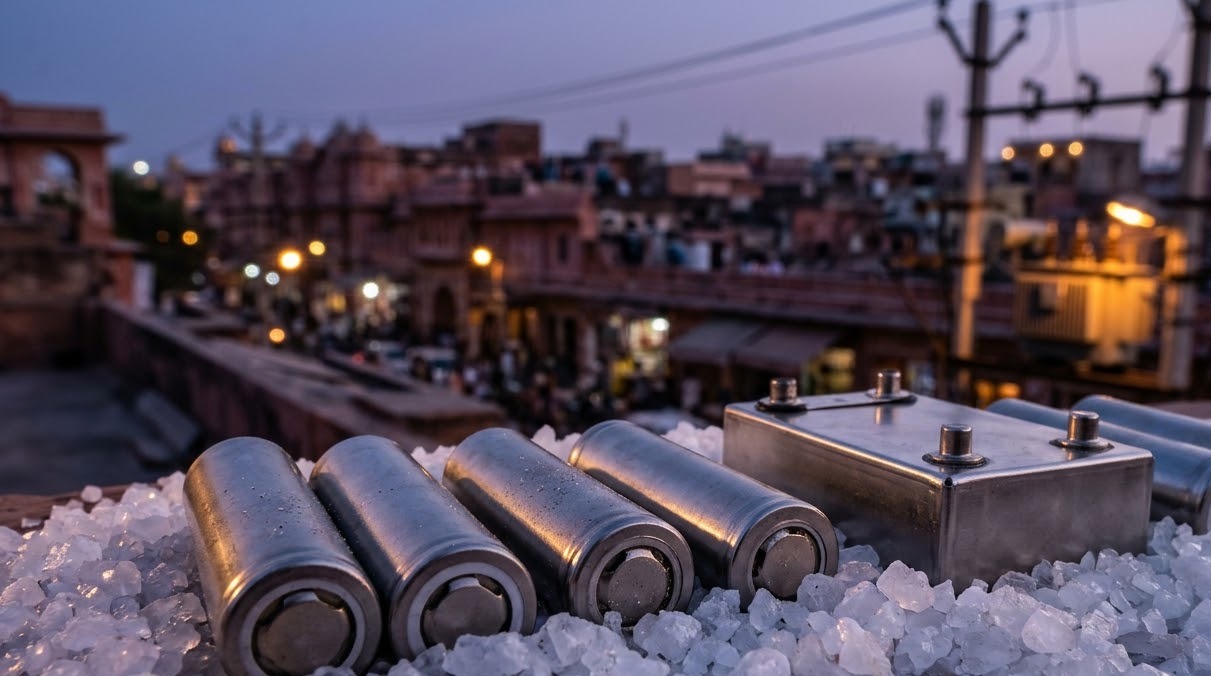
Sodium-ion battery storage is about to get a real test on an Indian street. In late October 2026, Jaipur’s power distribution company agreed to pilot a sodium-ion battery right next to a local transformer. Here is what the project is, how it works and why it matters for our grid.
What it is
Jaipur Vidyut Vitran Nigam Ltd (JVVNL) signed an MoU with the Global Energy Alliance for People and Planet (GEAPP). The plan is a 250 kW / 250 kWh battery at K.L. Saini Stadium in Jaipur. GEAPP calls it the first sodium-ion system in India at the distribution-transformer level. After the MoU, the partners issued a tender at the Distribution Utility Meet 2026.
It helps to be precise about the stage. Right now, this is an agreement and a tender, not a working plant. The partners have not yet named a supplier, a cost or a start date.
Each partner has a clear role. JVVNL will provide the site, a project team and operating data. GEAPP will support system design and monitoring, and it will train JVVNL engineers. Both plan to share the findings with other distribution companies.
How it works
Most grid batteries today use lithium-ion cells. Sodium-ion cells follow the same basic idea, but sodium carries the charge instead of lithium. As the IEA explains, they need no lithium or graphite at all.
In this pilot, the battery sits close to homes and shops. It can soak up spare power, for example from rooftop solar at midday. Later, it can release that power when demand peaks in the evening. At full output, a 250 kW / 250 kWh unit runs for about one hour.
GEAPP lists three goals. First, cut the peak load on the transformer. Second, make better use of rooftop solar. Third, possibly delay costly network upgrades.
Why sodium-ion battery storage matters for India
India needs a lot of storage, and soon. The Central Electricity Authority’s National Electricity Plan put the need at 47.24 GW / 236.22 GWh of battery storage by 2031-32, as Energy-Storage.news reported. That is a steep climb in under a decade.
Much of that storage will sit at large solar parks. However, stress often appears much closer to home. Rajasthan’s Energy Secretary Arti Dogra said the strain “shows first at the local transformer.” So a small battery at the right spot could ease a real bottleneck.
Sodium-ion battery storage also offers a hedge on supply. The IEA notes that lithium prices sit about 70% below their 2022 peak. Yet they roughly doubled over the past year. A second chemistry gives utilities more choice when prices swing.
Heat is another test. The pilot will check how the battery copes with a Rajasthan summer. According to the IEA, the latest sodium-ion cells can operate at up to 70 °C. They also keep about 90% of capacity at -40 °C.
Limits and open questions
First, there are no results yet. GEAPP says the pilot will compare cost, wear, lifetime value and safety with lithium-ion and with standard network upgrades. It does not assume either option will win.
Second, energy density is lower. IEA figures put sodium-ion at up to about 175 Wh/kg, against up to 205 Wh/kg for LFP lithium-ion. Weight matters less for a fixed battery than for a car. Still, space and cost count.
Third, scale is thin. In 2025, global sodium-ion output was under 1% of lithium-ion output, says the IEA. China also holds over 95% of planned 2030 capacity. So India could swap one import risk for another unless local making grows.
Finally, the price case is unclear. The IEA says current lithium prices are not high enough for sodium-ion to beat LFP in most uses. That is exactly why a clear, public pilot is useful.
Key takeaways
- Jaipur’s discom plans a 250 kW / 250 kWh sodium-ion battery at a local transformer, with GEAPP support.
- The project is at the tender stage, so no vendor, cost or start date is public yet.
- It will test peak load relief, rooftop solar use and performance in Rajasthan’s heat.
- Sodium-ion battery storage avoids lithium and graphite, but it has lower energy density and a young supply chain.
- The real value will be honest, shared data that other discoms can use.
You can find more notes on clean energy, waste and impact on my blog. To know more about my work, visit the about page.
Sources:
Leave a Reply