Category: Sustainable Tech

  • Electric Three-Wheelers: What India’s Earthshot Win Shows

    Electric Three-Wheelers: What India’s Earthshot Win Shows

    Electric three-wheelers just put India on the global climate stage. On 17 November 2026, Mahindra Last Mile Mobility won the Earthshot Prize for “Clean our Air”. The awards night took place in Mumbai. The prize carries £1 million. But the bigger story is the humble rickshaw itself, and what its quiet switch to electric can teach us.

    What it is: electric three-wheelers built for daily work

    The winner makes electric rickshaws and small cargo vehicles for short city trips. These are the vehicles that carry school children, vegetables and parcels across Indian towns. According to its Earthshot profile, the company has sold more than 400,000 electric last-mile vehicles. Over 100,000 of them were sold in a single year.

    The other winners were Bhutan, the Niue Ocean Wide Trust, the PFAS-Free France campaign and the offshore wind company Ørsted. Each also receives £1 million, as the official Earthshot announcement confirms. In other words, an Indian street vehicle now stands beside forests, oceans and offshore wind.

    How it works on the street

    The idea is simple. A battery and an electric motor replace the petrol, diesel or CNG engine. Drivers charge overnight or at public points. As a result, there is no exhaust pipe on the street.

    The Earthshot profile says the company has over 900 sales and service outlets. It also says drivers can reach more than 10,000 public charging points. In addition, the company reports that it has trained 500 women to drive and repair these vehicles.

    Running costs matter most to drivers. The profile claims that take-home income can rise by 25 to 30 per cent because running costs fall. Independent work points the same way. For example, a 2025 CEEW study put the total cost of an electric three-wheeler at INR 1.28 per km. By contrast, it put a petrol one at INR 3.21 per km.

    Why electric three-wheelers matter for India

    India is already the world’s largest market for this vehicle. The IEA Global EV Outlook 2026 says over two-thirds of India’s three-wheeler sales in 2025 were electric. Sales also rose 15 per cent to almost 800,000 units that year.

    Policy helped too. The Union Cabinet approved the PM E-DRIVE scheme in September 2024. Its support for larger electric autos ended on 26 December 2025. By then, that part had met its target, as the government factsheet notes. Meanwhile, support for e-rickshaws and e-carts continues until March 2028.

    Clean air is the bigger gain. Three-wheelers run all day in crowded streets. So every electric one cuts exhaust right where people walk, shop and wait. NITI Aayog has also made this point. Because so many of them serve as shared transport, electric three-wheelers offer bigger gains in cleaner air and lower fuel imports.

    What can others learn from this? First, start where demand already exists. Lower running costs give drivers a clear reason to switch. Second, build service before you chase sales. A vehicle that breaks down far from a workshop loses trust fast. Third, train people, not just sell products. The 500 women trained to drive and repair are a reminder that skills travel further than machines.

    Jobs matter as well. A rickshaw is not just a vehicle. For many families, it is the main source of daily income. Therefore, a cheaper ride to run can mean a little more money at home.

    Limits and open questions

    However, the prize does not settle every question. First, think about batteries. India’s Battery Waste Management Rules, 2022 cover EV batteries and make producers responsible for collection and recycling. The company mentions plans for battery recycling, but that work is still to scale.

    Second, think about money. Many drivers rent their vehicles or borrow at high rates. The company plans to bring banks into lower-cost driver finance. Yet the profile gives no numbers for these plans.

    Third, read the figures with care. The data on sales, emissions avoided and income come from the company’s own reporting. Even its Earthshot profile gives two different shares for electric sales in the segment. So treat them as claims, not audited results.

    Finally, the grid still runs partly on coal. The full climate benefit will grow as India adds more clean power.

    Key takeaways on electric three-wheelers

    • Electric three-wheelers won India an Earthshot Prize on 17 November 2026, worth £1 million.
    • India leads the world here, with over two-thirds of 2025 sales electric, according to the IEA.
    • Lower running costs can lift driver incomes, but finance and battery recycling still need work.
    • Company figures are useful signals, not audited proof.

    Climate solutions do not always look futuristic. Sometimes they look like the rickshaw at your gate. For more notes like this, visit my blog. You can also take the free SQ Test to see where your own habits stand.

    Sources:

  • Solar Cold Storage: What a Pulwama Farm Group Shows

    Solar Cold Storage: What a Pulwama Farm Group Shows

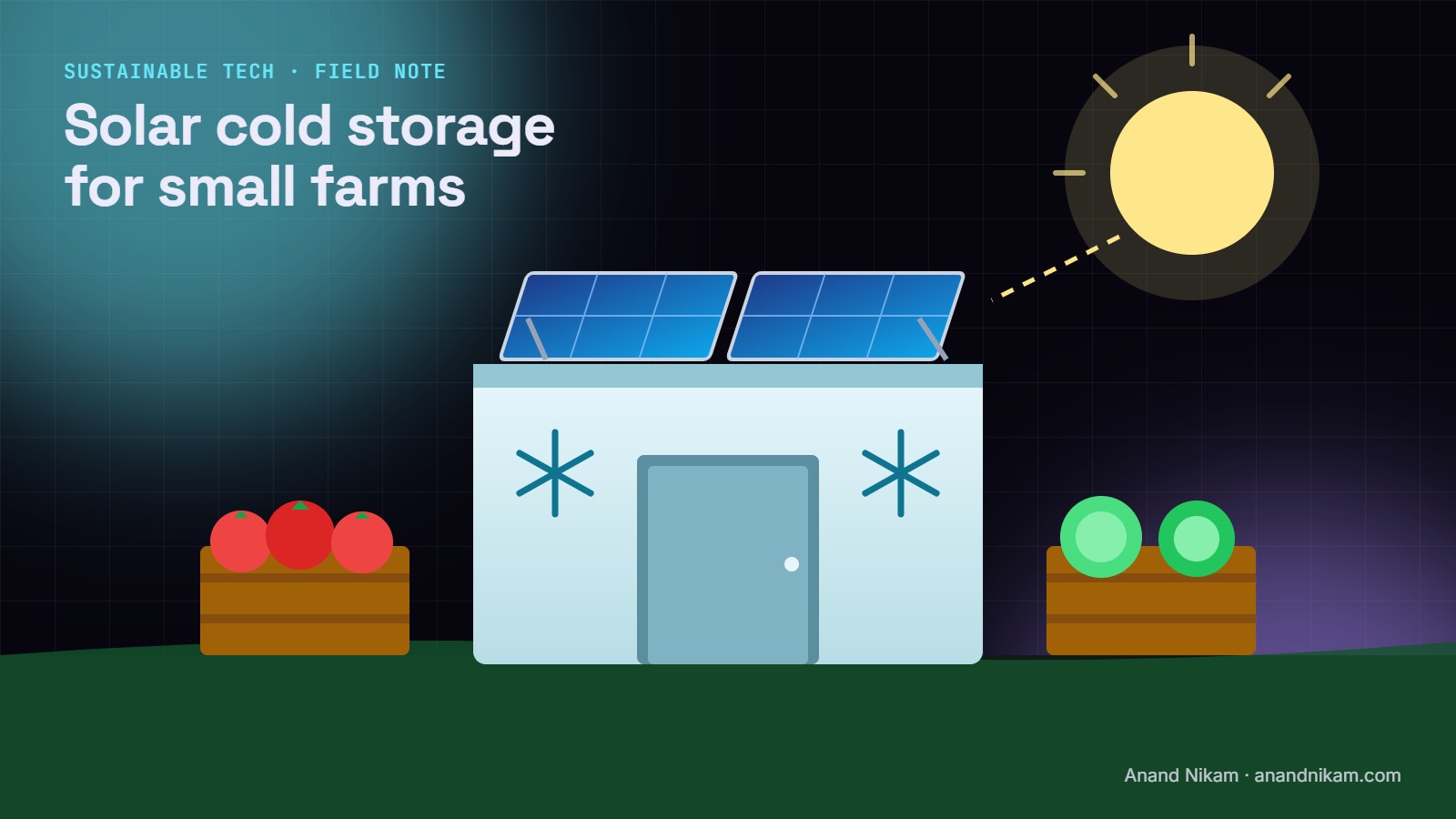
    Solar cold storage is now reaching small farms in India, and a new unit in south Kashmir shows why it matters. A farmer in Pulwama has set up a 10-tonne mini cold store that runs on solar power. As a result, 30 growers can now hold their vegetables until prices improve.

    This post explains what the unit is, how solar cold storage works, and why it matters for India. It also looks at the limits, because one unit is a start, not a solution.

    What it is: a 10-tonne solar cold storage unit in Pulwama

    Farooq Ahmad lives in the Tahab area of Pulwama district. According to a KNO report published by Kashmir Thunder on 7 November 2026, he turned his orchard land back into vegetable fields. He also brought 29 other farmers into a Farmers Interest Group (FIG).

    The key step is a 10-metric-tonne mini cold storage unit on his farm. An organic foundation provided it free of cost, says the report. It runs on solar energy, and locals call it the first such facility in the area.

    The idea is simple. Instead of selling the whole harvest on the day it is picked, group members can store it. Then they can release it when demand and prices are better, especially in the off-season.

    How solar cold storage works

    The report does not give the technical design of this unit. So here is how such systems work in general. Solar panels on or near the store make electricity during the day. That power runs a cooling unit, much like a large fridge.

    The sun does not shine at night, of course. For this reason, most designs store the cold, not just the power. Some use batteries. Others use thermal storage, such as ice or a special liquid that freezes during the day and keeps the room cool after sunset. Thick insulation helps the room hold its temperature.

    Small units like this one sit close to the field. That matters. Fresh vegetables start to lose quality soon after harvest. Therefore, a cold room a few steps away is worth more than a big one far away on a highway.

    Why it matters for India

    India loses a real share of its food after harvest. A study commissioned by the Ministry of Food Processing Industries and done by NABCONS (2022) measured these losses. As PIB reported in August 2024, losses ranged from 4.87% to 11.61% for vegetables. For fruits, the range was 6.02% to 15.05%.

    Some crops lose even more. The same table shows an average loss of 11.61% for tomato and 8.15% for cabbage. In contrast, milk showed a loss of just 0.87%, partly because the dairy sector has a strong cold chain.

    Price is the other side of the story. When every farmer sells on the same day, prices fall. Farooq said the unit will help growers supply markets “when demand and prices are favourable.” In short, storage gives a small farmer time, and time gives bargaining power.

    Solar power adds a third benefit. Many villages face power cuts, and diesel generators are costly and polluting. A solar cold store can run where the grid is weak. It also avoids the fuel bill that often makes small cold rooms hard to run.

    Government support already exists for cold chains. For example, the Mission for Integrated Development of Horticulture offers a credit-linked subsidy of 35% of project cost in general areas. In hilly and scheduled areas, the rate is 50%, according to the same PIB release. The Agriculture Infrastructure Fund also offers loans for post-harvest projects.

    Limits and open questions

    We should be honest about what we do not know. The report gives no figures for cost, power use, or how many days the produce stays fresh. It also does not say which foundation supplied the unit, or who will pay for repairs.

    Maintenance is the big test. Panels need cleaning, batteries wear out, and cooling parts fail. Many rural assets stop working because nobody owns the repair plan. A group of 30 farmers will need clear rules on who uses how much space, and how they share the costs.

    Storage alone also does not fix markets. Farmers still need transport, buyers, and fair price information. Kashmir’s winters bring their own challenge, since cold weather changes how much cooling a store needs. Finally, a single unit is a pilot. We will only know its value after a full season of real use.

    Key takeaways on solar cold storage

    • A 10-tonne solar cold storage unit now serves a 30-member farmer group in Pulwama, J&K.
    • The aim is to let growers hold produce and sell when prices are better.
    • Official data shows vegetable losses of 4.87% to 11.61% after harvest in India.
    • Existing schemes offer 35% to 50% subsidy support for cold storage.
    • Repair plans, fair sharing rules and market links will decide if it lasts.

    I write about practical sustainability ideas like this every week. You can read more on my blog, or check your own habits with the free SQ Test.

    Sources:

  • Hydrogen Train India: What the Jind Line Teaches

    Hydrogen Train India: What the Jind Line Teaches

    India’s first hydrogen train began its run on the Jind–Sonipat line in Haryana four months ago. For anyone tracking the hydrogen train India story, now is a good moment to look past the headlines. What does this train actually do, and what can the rest of us learn from it?

    I worked on last-mile energy delivery for years, so I read rail and fuel news with one question in mind. Will it work on an ordinary weekday, for ordinary people? Here is what the official record tells us so far.

    Hydrogen train India: what it is

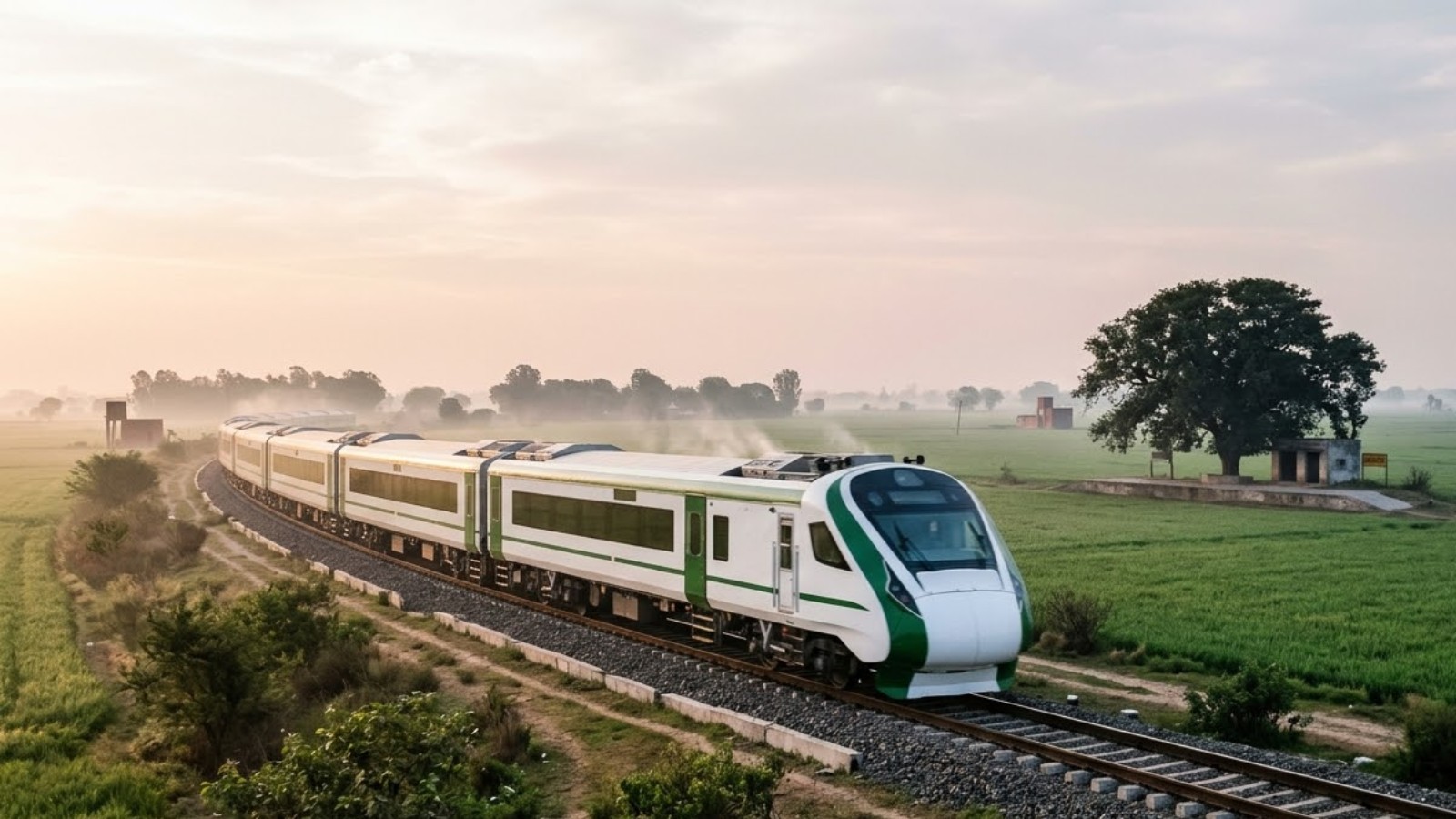
    Prime Minister Narendra Modi flagged off the train at Jind on 17 July 2026. According to the PIB backgrounder, it is a 10-car trainset. Two driving power cars carry the fuel cells, batteries and hydrogen tanks. Eight trailer coaches carry the passengers.

    The train runs on a 1,200 kW hydrogen fuel cell system. It can carry around 2,600 passengers. Its design speed is 110 kmph, but the approved top speed on this line is 75 kmph. As reported by Telangana Today, PTI put the route at 89 km. The trip takes about two hours, with 12 stops.

    PIB also stresses that Indian teams designed and developed the train, from the first drawings to the prototype. RDSO, the Railways’ standards body, prepared the design approval and the technical specifications.

    How India’s hydrogen train works

    The idea is simple, even if the engineering is not. A fuel cell mixes hydrogen with oxygen from the air. That reaction makes electricity, and the electricity drives the motors. The only by-products are water vapour and heat.

    The fuel cells here are the proton exchange membrane type. Lithium iron phosphate batteries sit beside them. In simple terms, the batteries give a burst of power when needed. They store energy when it is not. So the fuel cells can work at a steadier pace.

    Fuel comes from a refuelling site at Jind. PIB calls it the country’s largest railway hydrogen storage and refuelling facility. It can hold nearly 3,000 kg of hydrogen at a time. PESO, the national explosives safety body, has licensed it. TÜV SÜD of Germany carried out an independent safety check. In addition, the site has leak and flame detectors and an automatic hydrogen cut-off.

    • Power: 1,200 kW fuel cell system with LFP batteries
    • Size: 10 cars, about 2,600 passengers
    • Speed: 75 kmph approved, 110 kmph design
    • Fuel store: nearly 3,000 kg of hydrogen at Jind

    Why the hydrogen train matters for India

    First, it proves that Indian teams can design, certify and run a hydrogen trainset. Only a small group of countries do this today. PIB names Germany, Japan, China and the United States.

    Second, it gives early field data. News On AIR reported on 25 July 2026 that the train had run more than 1,200 km. It said this replaced more than 3,000 litres of diesel. Small numbers, yes. But real kilometres teach more than any slide deck.

    Third, it links rail to the National Green Hydrogen Mission. A train is a steady, predictable buyer of fuel. That kind of demand can help a local hydrogen supply chain grow. Many lines in India still run diesel trains on short, quiet routes. Those are the routes where a hydrogen train India builds at home could matter most.

    Finally, it builds skills. Safety codes, licences, refuelling drills and maintenance routines now exist on paper and in practice. The maintenance base is at Shakurbasti in Delhi. Every future project can build on that groundwork.

    Limits and open questions

    Hydrogen is only as clean as the way we make it. The official backgrounder does not say how much of the fuel comes from renewable power. That one detail decides the real climate benefit.

    Cost is the next question. No public figure covers the cost per km against diesel or electric trains. Without it, nobody outside the system can judge value for money. On busy lines, overhead electric traction is still the simpler choice. Hydrogen makes more sense where wiring a line does not pay.

    Then there is daily life. At launch, PTI reported that the date for regular commercial service was still awaited. Passengers also raised small issues, like stains from seat covers, and officials said they would fix them. These details sound minor. Yet they decide whether people choose the train again.

    Lastly, one line is a pilot, not a fleet. The real test is the next five lines. Officials have said trials on a Delhi route will begin soon.

    What we can learn from it

    Whether you run an NGO, a start-up or a CSR team, the Jind line holds a lesson. New technology needs boring things to succeed. It needs safety approvals, a trained crew, a fuel plan and honest data.

    So when you pitch a clean-tech pilot, plan for those boring things first. Show your licences, your maintenance plan and how you will measure results. That is what makes a pilot worth funding. You can read about my own work on the about page. Or check your own habits with the free SQ Test.

    Key takeaways

    • The hydrogen train India flagged off on 17 July 2026 runs 89 km between Jind and Sonipat.
    • It uses a 1,200 kW fuel cell system and emits only water vapour and heat.
    • Early runs passed 1,200 km and replaced over 3,000 litres of diesel.
    • Open questions remain on green hydrogen supply, cost per km and regular service.

    Which route in your state would you test a hydrogen train on, and why? More posts like this are on my blog.

    Sources:
    PIB Backgrounder, “India’s First Hydrogen-Powered Train: Advancing Green Rail Mobility”, 16 July 2026: pib.gov.in (PRID 2285268)
    Telangana Today (PTI), “PM Modi flags off India’s first hydrogen-powered train from Haryana’s Jind”, 17 July 2026: telanganatoday.com
    Telangana Today (PTI), “Commercial run of India’s first hydrogen train to begin soon”, 17 July 2026: telanganatoday.com
    News On AIR, “India’s first hydrogen-powered train completes over 1,200 km of successful operations”, 25 July 2026: newsonair.gov.in

  • Solar-Powered Desalination: BITS Hyderabad’s Dual System

    Solar-Powered Desalination: BITS Hyderabad’s Dual System

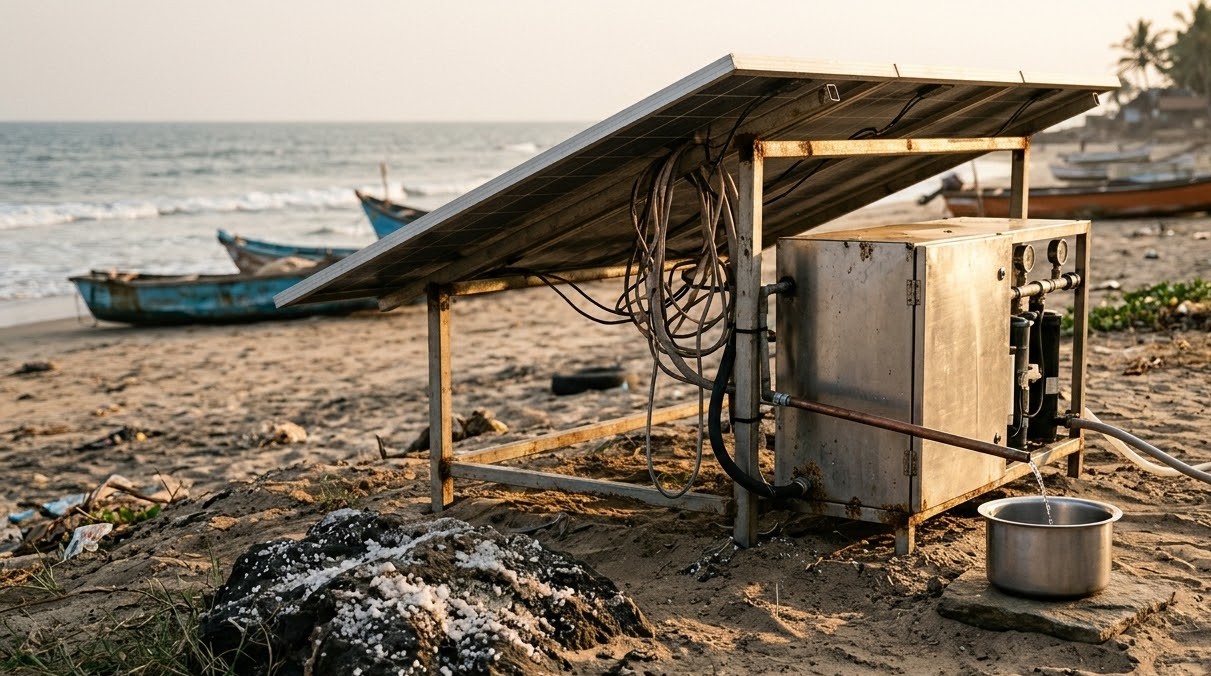
    Solar-powered desalination usually brings to mind big coastal plants. A team at BITS Pilani’s Hyderabad campus is testing something much smaller. Their unit turns salty water into drinking water and gives out cool air at the same time.

    The team holds an Indian patent for the design. It is still a lab prototype, not a product. Still, the idea speaks to two problems many coastal and island homes face together: scarce fresh water and rising heat.

    What it is

    According to Telangana Today, the system holds Indian Patent No. 558052. The patent covers a portable apparatus that desalinates water and cools a space at once. Prof Sandip S Deshmukh and Prof Santanu Prasad Datta of the mechanical engineering department lead the work. Research scholar K Sai Sandeep has worked on the later research and the prototype.

    The team built and tested the prototype on the Hyderabad campus across different seasons. Deccan Chronicle reports that the results appeared in the journal Applied Thermal Engineering in 2026.

    How solar-powered desalination works here

    The method is called humidification-dehumidification. Think of how a cold glass “sweats” on a humid day. The unit copies that effect on purpose.

    • First, air passes through a humidifier and picks up moisture from salty or brackish water.
    • Next, the system cools this moist air, so the vapour condenses into fresh water.
    • As a result, the salt stays behind, because only water vapour travels with the air.
    • Finally, the cool, dry air that leaves the unit can cool a room or a small store.

    The design also combines refrigeration and thermal energy storage in one box. On top of that, solar energy runs the whole process. That makes the unit a good fit for places with strong sun and weak grid supply.

    What the lab tests show

    The reported numbers are promising, but they come from lab conditions. Here is what the two news reports say:

    • Water: up to about 12.4 litres an hour in a double-stage setup with water heating, under high-humidity conditions.
    • Cooling: a capacity of up to 6.57 kW, with outlet air as cold as 14°C.
    • Cost: the lowest estimate during the experiments was around 30 paise a litre.
    • Design goal: roughly 200 litres of fresh water a day.

    Deccan Chronicle also describes one proposed use. A single unit could supply about 200 litres a day and keep around 50 kg of seafood cool, serving 10 families. That is a design idea, not a field result.

    Why it matters for India

    India has a long coastline and many island communities. Many villages also draw brackish groundwater. In such places, safe drinking water and cold storage are often separate struggles. Today, families buy water. Meanwhile, fishers lose catch to heat. Small clinics need both water and cooling.

    A single unit that does both jobs could cut the number of machines a village must buy and maintain. Besides, it could run where diesel is costly or the grid is unreliable. The researchers name island communities, rural settlements with brackish groundwater, small food stores and field hospitals as possible users.

    There is a wider lesson too. Climate adaptation does not always need a mega project. Sometimes it needs a small, well-designed box that a community can own and repair. In my own work on clean technology, I see that the last mile decides whether an idea helps anyone. You can read more about that work on my about page.

    Limits of solar-powered desalination today

    We should read these results with care. The researchers themselves say that output changed with the setup and the weather. For example, the 12.4 litres an hour figure needed favourable high humidity. Similarly, the 30 paise figure was the lowest estimate, and real costs will depend on location, energy needs, installation and upkeep.

    So several questions remain open. How will the unit perform in dry, hot months? What happens to the leftover brine? Who will service it in a remote village? And what will a unit cost to build at scale? The team plans field trials and wants to adapt the design to different climates. Those trials will tell us far more than lab numbers can.

    What NGOs and local bodies can do now

    You do not need to wait for a finished product to prepare. If you work with coastal or island communities, start by mapping the need. How much water does a household buy each week? What does it cost? How much catch or produce spoils for lack of cooling?

    Also, that baseline data helps in two ways. It shows whether a solar-powered desalination unit would really help. It also makes your case stronger when you approach researchers for a pilot, or a company for CSR support. Good data turns a hopeful idea into a fundable project.

    Key takeaways

    • A BITS Pilani Hyderabad team has patented a small unit that makes fresh water and cool air from sunlight.
    • It uses humidification-dehumidification, plus refrigeration and thermal storage, in one system.
    • Lab tests reported up to 12.4 litres an hour and up to 6.57 kW of cooling, under favourable conditions.
    • It is still a prototype, so field trials will decide its real value.

    I will keep tracking how this solar-powered desalination work moves from lab to village. For more stories like this, visit the blog.

    Sources

  • Sodium-Ion Battery Storage: What Jaipur’s Pilot Tests

    Sodium-Ion Battery Storage: What Jaipur’s Pilot Tests

    Sodium-ion battery storage is about to get a real test on an Indian street. In late October 2026, Jaipur’s power distribution company agreed to pilot a sodium-ion battery right next to a local transformer. Here is what the project is, how it works and why it matters for our grid.

    What it is

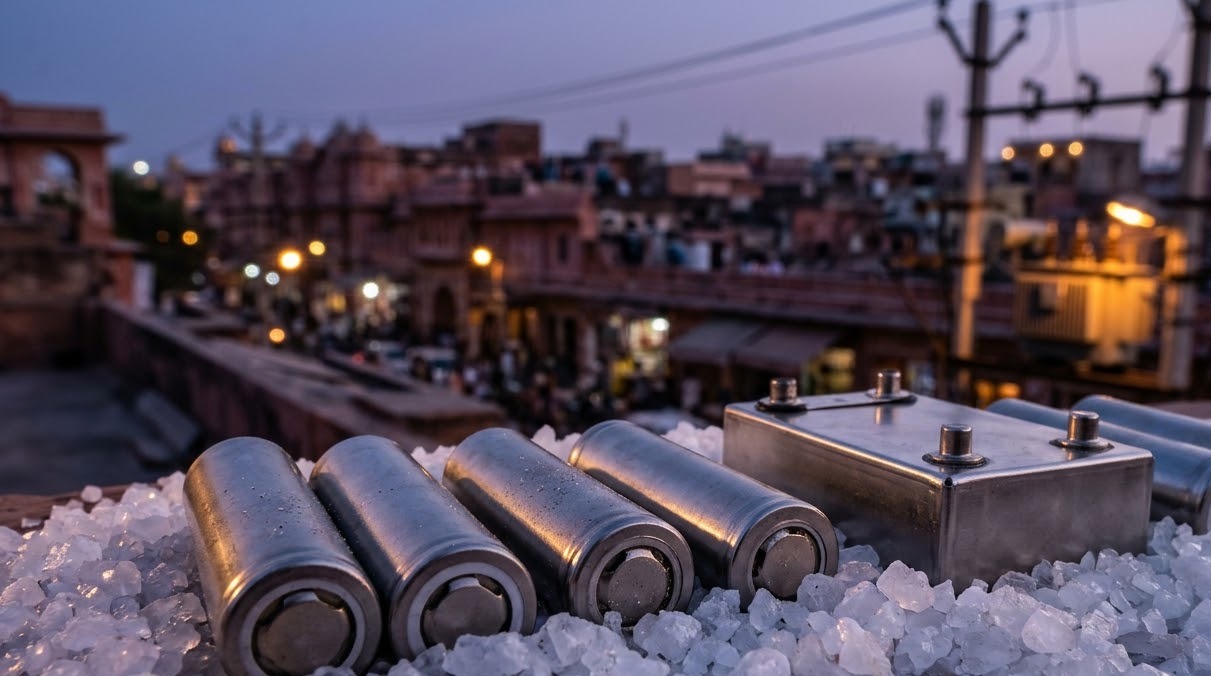
    Jaipur Vidyut Vitran Nigam Ltd (JVVNL) signed an MoU with the Global Energy Alliance for People and Planet (GEAPP). The plan is a 250 kW / 250 kWh battery at K.L. Saini Stadium in Jaipur. GEAPP calls it the first sodium-ion system in India at the distribution-transformer level. After the MoU, the partners issued a tender at the Distribution Utility Meet 2026.

    It helps to be precise about the stage. Right now, this is an agreement and a tender, not a working plant. The partners have not yet named a supplier, a cost or a start date.

    Each partner has a clear role. JVVNL will provide the site, a project team and operating data. GEAPP will support system design and monitoring, and it will train JVVNL engineers. Both plan to share the findings with other distribution companies.

    How it works

    Most grid batteries today use lithium-ion cells. Sodium-ion cells follow the same basic idea, but sodium carries the charge instead of lithium. As the IEA explains, they need no lithium or graphite at all.

    In this pilot, the battery sits close to homes and shops. It can soak up spare power, for example from rooftop solar at midday. Later, it can release that power when demand peaks in the evening. At full output, a 250 kW / 250 kWh unit runs for about one hour.

    GEAPP lists three goals. First, cut the peak load on the transformer. Second, make better use of rooftop solar. Third, possibly delay costly network upgrades.

    Why sodium-ion battery storage matters for India

    India needs a lot of storage, and soon. The Central Electricity Authority’s National Electricity Plan put the need at 47.24 GW / 236.22 GWh of battery storage by 2031-32, as Energy-Storage.news reported. That is a steep climb in under a decade.

    Much of that storage will sit at large solar parks. However, stress often appears much closer to home. Rajasthan’s Energy Secretary Arti Dogra said the strain “shows first at the local transformer.” So a small battery at the right spot could ease a real bottleneck.

    Sodium-ion battery storage also offers a hedge on supply. The IEA notes that lithium prices sit about 70% below their 2022 peak. Yet they roughly doubled over the past year. A second chemistry gives utilities more choice when prices swing.

    Heat is another test. The pilot will check how the battery copes with a Rajasthan summer. According to the IEA, the latest sodium-ion cells can operate at up to 70 °C. They also keep about 90% of capacity at -40 °C.

    Limits and open questions

    First, there are no results yet. GEAPP says the pilot will compare cost, wear, lifetime value and safety with lithium-ion and with standard network upgrades. It does not assume either option will win.

    Second, energy density is lower. IEA figures put sodium-ion at up to about 175 Wh/kg, against up to 205 Wh/kg for LFP lithium-ion. Weight matters less for a fixed battery than for a car. Still, space and cost count.

    Third, scale is thin. In 2025, global sodium-ion output was under 1% of lithium-ion output, says the IEA. China also holds over 95% of planned 2030 capacity. So India could swap one import risk for another unless local making grows.

    Finally, the price case is unclear. The IEA says current lithium prices are not high enough for sodium-ion to beat LFP in most uses. That is exactly why a clear, public pilot is useful.

    Key takeaways

    • Jaipur’s discom plans a 250 kW / 250 kWh sodium-ion battery at a local transformer, with GEAPP support.
    • The project is at the tender stage, so no vendor, cost or start date is public yet.
    • It will test peak load relief, rooftop solar use and performance in Rajasthan’s heat.
    • Sodium-ion battery storage avoids lithium and graphite, but it has lower energy density and a young supply chain.
    • The real value will be honest, shared data that other discoms can use.

    You can find more notes on clean energy, waste and impact on my blog. To know more about my work, visit the about page.

    Sources: