Author: anandnikam

  • International Grants for NGOs: 4 Calls Open Now

    International Grants for NGOs: 4 Calls Open Now

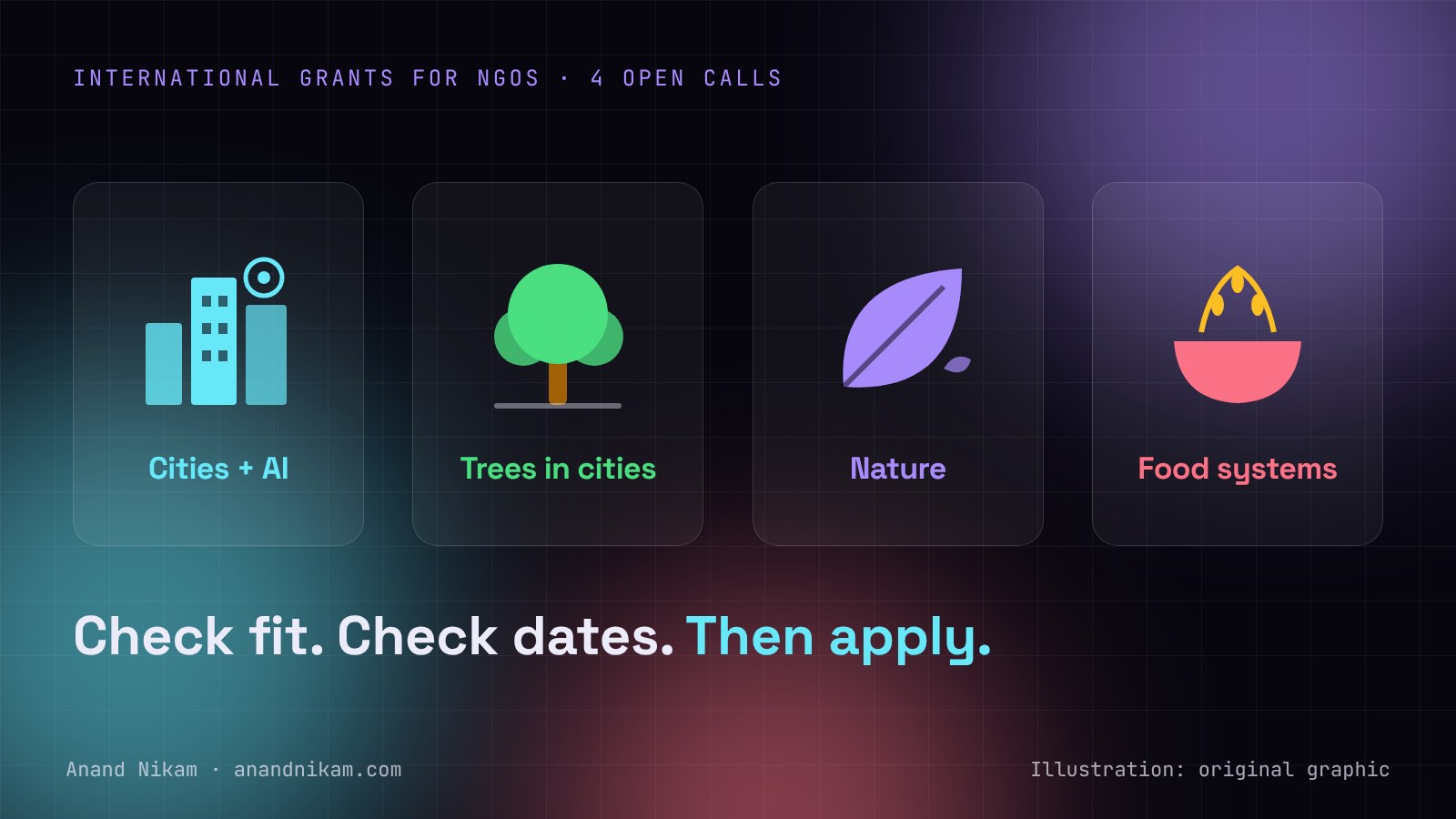
    Indian applicants can apply for these international grants for NGOs right now. I checked each one on the funder’s own website on 26 November 2026. Three close within days, so read the dates first. The fourth opens on 1 January 2027 and gives you time to prepare.

    Before you apply for international grants for NGOs

    Please note one thing before you start. The funder sets the eligibility rules and deadlines, and they can change. Always confirm every detail on the official page before you apply.

    1. Cities Deliver: AI Solutions for Public Services (The Rockefeller Foundation)

    This call funds 24-month projects that put AI to work in city services. Also, each project must work with a city government and serve underserved communities. The focus areas are public health, economic mobility, environmental resilience and civic engagement. However, the call excludes voting and elections.

    • Who can apply: a nonprofit (including university labs and fiscally sponsored groups) or a public benefit corporation. For-profits qualify only in limited cases. Governments cannot apply directly. Instead, every bid needs a city partner of at least 50,000 people, plus a letter of intent from that city. Cities in all regions are eligible.
    • What you get: Seed grants of USD 500,000 to under USD 1 million, or Scale grants of USD 1 million to 2 million.
    • Key dates: Round 1 closes on 29 November 2026 at 11:59 pm US Eastern Time (about 10:29 am IST on 30 November). Interviews follow in January 2027. Invited full proposals are due on 1 March 2027.
    • How to apply: read the FAQs and terms, then apply on the official Cities Deliver page.

    Indian NGOs should also check their FCRA status before taking any foreign grant.

    2. Terre de Femmes International Award 2027 (Fondation Yves Rocher)

    Meanwhile, this award backs women who lead nature projects. The 2027 theme is “Trees in the City”, so projects should put trees at the heart of urban life.

    • Who can apply: any adult woman, or a group of women, leading a concrete tree-related project in any country. The project must run through a non-profit that is at least one year old. All nationalities can apply.
    • What you get: two winners worldwide, each with a EUR 10,000 grant.
    • Key dates: applications close on Monday, 30 November 2026 at midnight. The page does not state a time zone, so apply early.
    • How to apply: use the “Apply now” link on the official award page.

    3. KNCF Grant Program FY2027 (Keidanren Nature Conservation Fund)

    Next, this Japanese fund supports nature and biodiversity conservation. It also values work on related social issues, the SDGs and skills. Projects should support the Kunming-Montreal Global Biodiversity Framework.

    • Who can apply: groups working mainly in developing countries in the Asia-Pacific region, or in Japan. You need legal status, or equal social credibility, and at least three years of nature conservation work. The guideline does not say clearly whether groups based outside Japan can apply, so email the fund to confirm.
    • What you get: Basic Grant A for first-time applicants, up to JPY 1 million. Standard Grants go up to JPY 10 million. Collaboration Grants for two or more NGOs go up to JPY 20 million a year.
    • Key dates: applications close on 1 December 2026 at 5 pm Japan time (1:30 pm IST).
    • How to apply: register online first, then submit through the fund’s system. Gmail addresses are not accepted. Details are on the official KNCF programme page.

    4. Seeding The Future Global Food System Challenge 2027

    Finally, this challenge looks for food system ideas, mainly for the Global South. Welthungerhilfe runs it for the Seeding The Future Foundation. A strong entry links safe, nutritious food with sustainable practice and fair access. Cutting food loss and waste also counts.

    • Who can apply: NGOs from most countries, academic and research teams, and early-stage social enterprises or companies. Individuals cannot apply alone, and the call excludes sanctioned countries.
    • What you get: up to eight Seed Grants of USD 25,000 each. There are also up to three Growth Grants of USD 100,000 and up to two Grand Prizes of USD 250,000.
    • Key dates: the call opens on 1 January 2027 and closes on 15 February 2027. However, the page gives no closing time. The funder expects to share results in June and July 2027.
    • How to apply: read the questions and criteria, then prepare your plan, budget and documents. Start on the official challenge page.

    How to choose international grants for NGOs

    First, check fit before effort. Read the eligibility list line by line, and stop if you miss a hard rule. Next, match your evidence to the funder’s focus. A tree project fits Terre de Femmes, while a food waste idea fits Seeding The Future.

    Then, plan your time honestly. A short deadline suits a team with documents ready. If you need more time, start on the February call today. Finally, keep one master file with your registration papers, audited accounts and project data. That file saves days on every application.

    International grants for NGOs often need extra steps in India, such as FCRA approval. So check your compliance early. If you also want to understand Indian corporate funding, my ebook CSR Funding in India: The Essentials is a useful next read. You can find more calls on the blog.

    Disclaimer: I am not linked to any funder listed here. Each funder sets its own eligibility, amounts and deadlines, and these may change. So confirm everything on the official page before you apply.

    Sources:
  • Packaging EPR Fees: What the UK’s New Plan Signals

    Packaging EPR Fees: What the UK’s New Plan Signals

    Packaging EPR fees in the UK may soon rise faster for packs that are hard to recycle. PackUK, the body that runs the UK scheme, has put out a draft plan. In short, the worst-rated packaging would pay about double the base fee from 2027-28.

    What happened

    On 20 November 2026, Circular Online reported a draft policy from PackUK. It changes how quickly packaging EPR fees climb for the least recyclable packs. EPR stands for Extended Producer Responsibility. Under EPR, the companies that put packaging on the market pay for what happens to it as waste.

    The UK rates each pack red, amber or green. It uses a tool called the Recyclability Assessment Methodology, or RAM. Green packs are the easiest to recycle, and red packs are the hardest. Amber packs pay the base fee for their material.

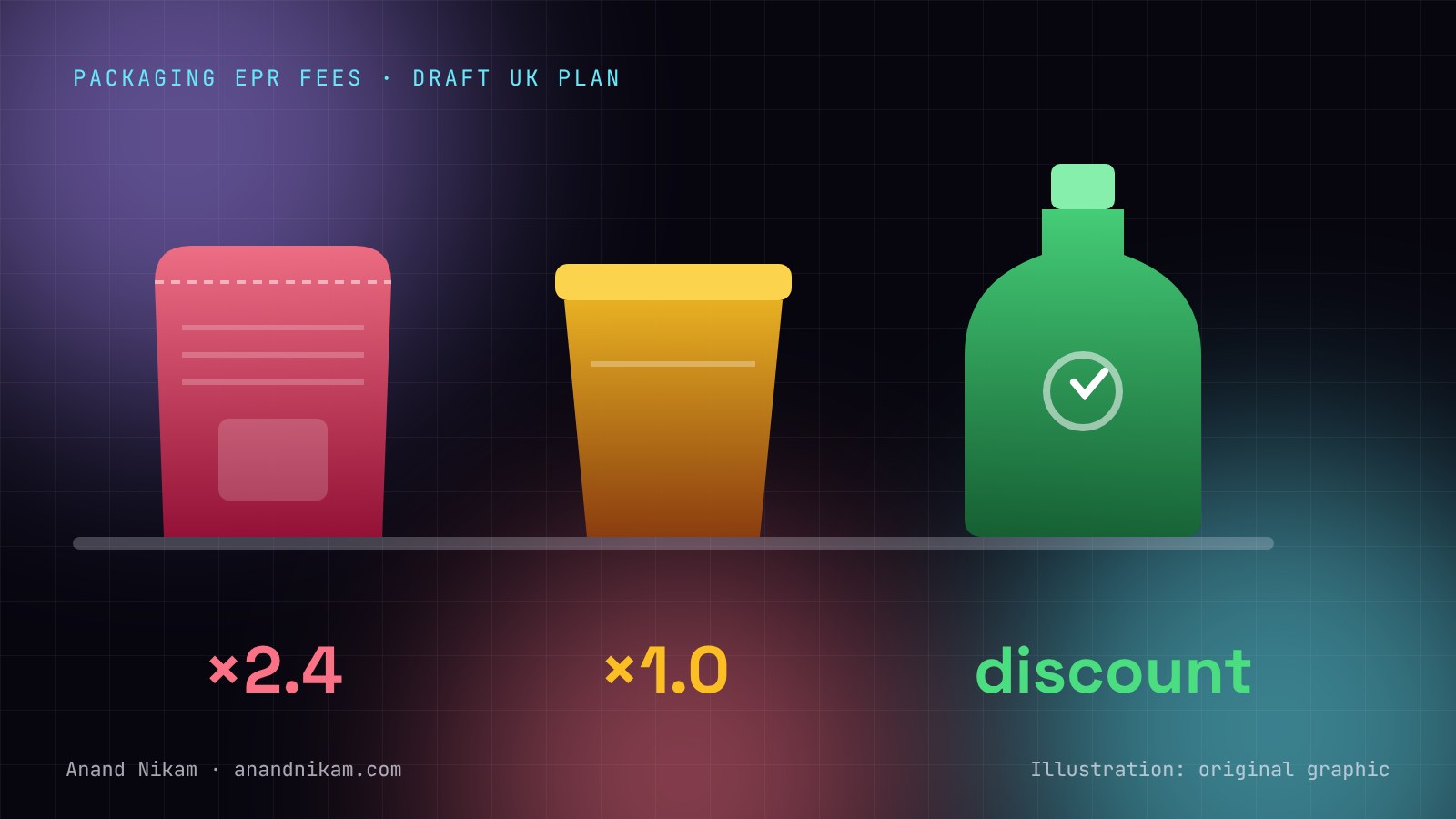
    Here is the core change. For red-rated household packaging, the fee is a multiple of the amber base fee:

    • 2026-27: 1.2 times the base fee, the same as before.
    • 2027-28: 2.0 times under the draft, up from 1.6 in the current timetable.
    • 2028-29: 2.4 times under the draft, up from 2.0.

    Importantly, the plan does not raise the total amount collected. Instead, the extra money from red packs funds bigger discounts for green packs. So a brand that switches to a better pack pays less. Meanwhile, a brand that keeps a poor pack pays more.

    The draft also treats some medical packaging differently from 2028-29. For example, packaging that touches medicines or medical devices would pay the amber base fee, even with a red rating. In addition, PackUK plans a call for evidence in early 2027 on the future of fee changes. These are still proposals, and nothing is final yet.

    Not everyone agrees. The Alliance for Fibre-Based Packaging criticised the faster timetable. Its co-chairs said ministers should work with industry on “a stable, evidence-based approach”, as Circular Online reported. They also warned that frequent changes make business planning harder.

    Why packaging EPR fees matter

    At first glance, this looks like a dry fee table. However, it shows how a circular economy policy can steer design choices with money. Packaging EPR fees work best when they reward good design and penalise poor design. A flat fee does neither.

    There are three lessons here. First, the signal must be large enough to matter. A small gap between red and green fees rarely changes a packaging decision. A fee that doubles gets the attention of finance teams, not only sustainability teams.

    Second, the signal must be fair. Because the plan keeps the total collected the same, it is a shift, not a new tax. As a result, producers who invest in better packs gain directly.

    Third, the signal must be predictable. This is where the critics have a point. Businesses plan packaging changes years ahead. When fee timetables move, some firms may wait rather than act. Good EPR design balances ambition with stability.

    What packaging EPR fees could mean for India

    India already has EPR for plastic packaging. The guidelines came into force in February 2022 under the Plastic Waste Management Rules, 2016. That is according to a 2022 government reply in the Lok Sabha shared by PIB. They group plastic packaging into four categories:

    • Rigid plastic packaging sits in Category I.
    • Flexible packaging, including carry bags, sachets and pouches, is Category II.
    • Multilayered packaging with at least one non-plastic layer forms Category III.
    • Compostable plastic sheets and carry bags make up Category IV.

    The same release lists rising recycling targets. For rigid packaging, the share rises from 50% in 2024-25 to 80% from 2027-28 onwards. For flexible and multilayered packaging, it rises from 30% to 60% over the same years. Producers who miss their targets pay environmental compensation, based on the polluter pays principle.

    So India’s system sets targets and penalties. What it can learn from the UK plan is the idea of linking cost to recyclability. Multilayered sachets are among the hardest packs to recycle in India. A design-based fee signal could push brands towards simpler, single-material packs.

    Of course, India’s context is different. Our recycling depends heavily on informal waste pickers and small recyclers. Any fee change must protect their income and fit how waste actually moves here. Also, India would need reliable data on which packs recyclers truly process, not just collect. Without that data, ratings can become a paper exercise.

    For brands, the practical step is simple. Start mapping your packs by how easy they are to recycle today. Then ask which packs would cost you more if fees ever followed design. For NGOs and recyclers, this is a chance to share field evidence on what really gets recycled.

    Key takeaways

    • PackUK’s draft would make the worst-rated packs pay 2 times the base fee in 2027-28 and 2.4 times in 2028-29.
    • The total collected stays the same, so green packs get bigger discounts.
    • Critics warn that changing timetables can hurt business planning.
    • India’s plastic EPR already sets recycling targets, and design-linked packaging EPR fees could be a useful next idea to study.
    • Good EPR needs a strong, fair and stable signal, backed by honest data.

    If you want to check where your own habits stand on waste, try my free SQ Test. You can also read more posts on the blog.

    Sources:

  • Fellowships and Grants: 4 Calls Open to Indians

    Fellowships and Grants: 4 Calls Open to Indians

    Fellowships and grants can give a young changemaker or a small team the time and money to test an idea. This week I checked four calls that are open now or open soon. Indian applicants can use all of them. Each one has a deadline after 1 December 2026. As always, the funder sets the rules, so confirm every detail on the official page before you apply.

    Fellowships and grants open this week

    Here are the four calls, with the India-based ones first.

    1. Ashoka-EDF Climate Corps India Fellowship (Phase II)

    The Climate Corps places fellows with organisations that run climate and sustainability projects in India. Then fellows work for three or six months between April and September 2027.

    • Who can apply: postgraduate students in fields such as business, engineering, sustainability, policy, finance or law, or early-career professionals who graduated on or after 1 July 2022. In addition, you need at least two years of relevant work experience and must be able to work full-time in India.
    • What you get: a fixed stipend of Rs 50,000 a month, plus a relocation allowance of up to Rs 30,000 paid after you complete the fellowship, against receipts.
    • Key dates: Phase II (early-career) runs from 4 December 2026 to 3 January 2027, 11:59 pm IST. However, Phase I has closed. After that, training runs from January to March 2027.
    • How to apply: apply in the phase that matches your status. However, the page does not show a portal link yet. So check it again on 4 December or write to climatecorpsindia@ashoka.edu.in.

    Official page: EDF+Business, India Fellowship programme details

    2. AIF Banyan Impact Fellowship, Service in India

    The American India Foundation runs this fully funded service fellowship. In short, it places young professionals with development organisations across India for a full programme year.

    • Who can apply: Indian citizens, US citizens or US permanent residents aged 21 to 35 by the 1 October start date, with a bachelor’s degree. Also, you must speak fluent English and serve in India for the full term.
    • What you get: a stipend, travel and health insurance. The stipend amount is not published, so check the official page.
    • Key dates: applications open on Friday, 4 December 2026 and close on Sunday, 28 February 2027. The page does not state a closing time. Then interviews follow in spring.
    • How to apply: fill in the online form with short essays, and name two recommenders. Questions go to fellowship@aif.org.

    Official page: AIF, Apply for Service in India

    3. Bayer Foundation Women Entrepreneurs Award 2027

    This award backs women-led ventures in health or food security that help low- and middle-income communities. The Bayer Foundation runs it with the Impact Hub network.

    • Who can apply: a woman founder, co-founder or senior leader with decision-making power. The venture must operate in Asia, Latin America, Africa or the Middle East, show traction and earn up to USD 1 million a year. Also, the company must have registered on or before 1 December 2025. Registered charities, sole traders and idea-stage concepts are not eligible.
    • What you get: EUR 25,000 in non-dilutive cash, a matched business advisor and a sponsored trip to Berlin in June 2027. Finally, the jury picks 15 awardees from 30 finalists.
    • Key dates: applications opened on 24 November 2026 and close on 25 January 2027 at 23:59 (CEST, as the page states). Online info sessions run on 9 December 2026 and 13 January 2027; session times are not published.
    • How to apply: apply through the grants portal linked on the award website.

    Official pages: Women Entrepreneurs Award and Bayer Foundation

    4. Conservation, Food & Health Foundation grants

    This US foundation funds applied research, pilots, training and technical help in conservation, food and agriculture, and health. Within health, it also focuses on reproductive health and family planning. It prefers issues and regions that get little funding.

    • Who can apply: local, state or regional organisations in Asia, Africa, Latin America, the Caribbean or the Middle East, including NGOs, community groups and universities. However, government bodies can join only as partners. One proposal per organisation per year.
    • What you get: there is no fixed range, but most grants fall between USD 25,000 and 50,000 a year, for one or two years. However, it does not fund overheads, buildings or general operating costs.
    • Key dates: the concept window closes on 22 December. The official page gives no year or time, because cycles repeat. A University of Colorado funding page lists it as 22 December 2026. After that, invited full proposals are due on 15 February.
    • How to apply: submit a short concept online. The How to Apply page explains the login steps.

    Official page: CFH Foundation, How to Apply

    How to choose the right fellowships and grants

    Fellowships and grants work best when they fit your stage. So start with fit, not size. A small grant that matches your work beats a big prize you barely qualify for. Next, read the eligibility list twice and tick each line. Then mark every date in your calendar, including info sessions. Finally, write a one-page summary of your project before you open any form. As a result, you will save hours.

    If you also plan to approach companies, my ebook CSR Funding in India: The Essentials explains how CSR budgets work. You can find more funding round-ups on my blog.

    Disclaimer: Eligibility, amounts and deadlines are set by each funder and can change. Always confirm on the official page before you apply. I am not linked to these funders.

    Sources:

  • Electric Three-Wheelers: What India’s Earthshot Win Shows

    Electric Three-Wheelers: What India’s Earthshot Win Shows

    Electric three-wheelers just put India on the global climate stage. On 17 November 2026, Mahindra Last Mile Mobility won the Earthshot Prize for “Clean our Air”. The awards night took place in Mumbai. The prize carries £1 million. But the bigger story is the humble rickshaw itself, and what its quiet switch to electric can teach us.

    What it is: electric three-wheelers built for daily work

    The winner makes electric rickshaws and small cargo vehicles for short city trips. These are the vehicles that carry school children, vegetables and parcels across Indian towns. According to its Earthshot profile, the company has sold more than 400,000 electric last-mile vehicles. Over 100,000 of them were sold in a single year.

    The other winners were Bhutan, the Niue Ocean Wide Trust, the PFAS-Free France campaign and the offshore wind company Ørsted. Each also receives £1 million, as the official Earthshot announcement confirms. In other words, an Indian street vehicle now stands beside forests, oceans and offshore wind.

    How it works on the street

    The idea is simple. A battery and an electric motor replace the petrol, diesel or CNG engine. Drivers charge overnight or at public points. As a result, there is no exhaust pipe on the street.

    The Earthshot profile says the company has over 900 sales and service outlets. It also says drivers can reach more than 10,000 public charging points. In addition, the company reports that it has trained 500 women to drive and repair these vehicles.

    Running costs matter most to drivers. The profile claims that take-home income can rise by 25 to 30 per cent because running costs fall. Independent work points the same way. For example, a 2025 CEEW study put the total cost of an electric three-wheeler at INR 1.28 per km. By contrast, it put a petrol one at INR 3.21 per km.

    Why electric three-wheelers matter for India

    India is already the world’s largest market for this vehicle. The IEA Global EV Outlook 2026 says over two-thirds of India’s three-wheeler sales in 2025 were electric. Sales also rose 15 per cent to almost 800,000 units that year.

    Policy helped too. The Union Cabinet approved the PM E-DRIVE scheme in September 2024. Its support for larger electric autos ended on 26 December 2025. By then, that part had met its target, as the government factsheet notes. Meanwhile, support for e-rickshaws and e-carts continues until March 2028.

    Clean air is the bigger gain. Three-wheelers run all day in crowded streets. So every electric one cuts exhaust right where people walk, shop and wait. NITI Aayog has also made this point. Because so many of them serve as shared transport, electric three-wheelers offer bigger gains in cleaner air and lower fuel imports.

    What can others learn from this? First, start where demand already exists. Lower running costs give drivers a clear reason to switch. Second, build service before you chase sales. A vehicle that breaks down far from a workshop loses trust fast. Third, train people, not just sell products. The 500 women trained to drive and repair are a reminder that skills travel further than machines.

    Jobs matter as well. A rickshaw is not just a vehicle. For many families, it is the main source of daily income. Therefore, a cheaper ride to run can mean a little more money at home.

    Limits and open questions

    However, the prize does not settle every question. First, think about batteries. India’s Battery Waste Management Rules, 2022 cover EV batteries and make producers responsible for collection and recycling. The company mentions plans for battery recycling, but that work is still to scale.

    Second, think about money. Many drivers rent their vehicles or borrow at high rates. The company plans to bring banks into lower-cost driver finance. Yet the profile gives no numbers for these plans.

    Third, read the figures with care. The data on sales, emissions avoided and income come from the company’s own reporting. Even its Earthshot profile gives two different shares for electric sales in the segment. So treat them as claims, not audited results.

    Finally, the grid still runs partly on coal. The full climate benefit will grow as India adds more clean power.

    Key takeaways on electric three-wheelers

    • Electric three-wheelers won India an Earthshot Prize on 17 November 2026, worth £1 million.
    • India leads the world here, with over two-thirds of 2025 sales electric, according to the IEA.
    • Lower running costs can lift driver incomes, but finance and battery recycling still need work.
    • Company figures are useful signals, not audited proof.

    Climate solutions do not always look futuristic. Sometimes they look like the rickshaw at your gate. For more notes like this, visit my blog. You can also take the free SQ Test to see where your own habits stand.

    Sources:

  • Small Grants: 4 Open Calls for Indian Changemakers

    Small Grants: 4 Open Calls for Indian Changemakers

    Small grants can help a young idea take its first real step. This week I found four small grants that Indian researchers, founders and grassroots groups can apply for. Each one comes with its own rules and dates, so please check the official page before you start.

    Ignite Field Research Enabling Grant: small grants for field biology

    The Ignite Life Science Foundation runs this call. It is also called the Ignite Ancillary Grant for Field Biology. It covers the practical gaps that often slow field work in India.

    • Who can apply: Researchers in ecology, evolution, conservation, natural history or related fields. You must work at a recognised national, state or private institute or university in India. You also need an existing field project that needs support.
    • What you get: Up to Rs 2 lakh a year for one to two years. Overheads can be at most 10%. The money can cover field staff, local travel, stay, equipment, consumables and community work.
    • Key dates: The deadline is 13 December 2026. The foundation has not published a closing time, so submit early. Info sessions: not published — check the official page.
    • How to apply: Register on the Ignite grant portal and submit from your dashboard. You will need a short proposal, details of existing funding and a budget with reasons. Read the official call document.

    D-Prize Challenge: seed money to launch a proven idea

    D-Prize funds new ventures that take a proven anti-poverty idea to more people. Its list includes water filters, reading glasses, childcare and treatment for child diarrhoea. You can also propose your own idea if evidence backs it.

    • Who can apply: Founders anywhere in the world, including India. Winners must live and work in the country where they run the venture. It mainly suits new organisations. Ventures with more than 18 months of full-time work, or more than USD 30,000 raised, usually do not qualify.
    • What you get: Up to USD 20,000 to launch.
    • Key dates: The extension deadline is 6 December 2026, midnight Pacific Time. You must register in advance for this round. The earlier rounds have closed.
    • How to apply: Round 1 needs a two-page concept note and CVs. Top entries then answer written questions, and finalists have an interview. Start at the D-Prize website.

    Allianz MoveNow Social Innovation Challenge 2026

    Allianz runs this challenge with Social Shifters. It backs youth-led ventures in three areas. These are money confidence in the digital economy, fair health systems, and climate resilience led by communities.

    • Who can apply: The founder or main leader must be 18 to 30 years old. Young people must hold at least 51% of the venture and lead its decisions. Ventures do not need to register. Registered ones must be no more than five years old. India is eligible, and entry is free.
    • What you get: A total pool of USD 90,000. Each area has one USD 10,000 award and four USD 5,000 awards. Finalists also get a business mentor from Allianz.
    • Key dates: Entries close on 18 December 2026 at 5:00 pm UTC, which is 10:30 pm IST. The organisers say they will not extend it.
    • How to apply: Submit one project in English on the official platform. If you use AI tools, you must say so. Read the full rules on the official challenge page.

    The Pollination Project Seed Grants

    The Pollination Project gives seed grants to people doing good work with their own time. It has no narrow theme. However, it does not fund political campaigns, single-use plastics or animal agriculture.

    • Who can apply: Individuals, informal groups and small nonprofits anywhere in the world. Volunteers must lead the project, with no paid staff, and it must already be running. You must be a first-time grantee. The total project budget must be under USD 10,000, or the group’s budget under USD 50,000. International applicants need a referee.
    • What you get: Amount not published — check the official page.
    • Key dates: Applications are rolling. The 2026 window closes on 30 November at 11:59 pm US Eastern time. It reopens on 1 January 2027. Decisions take about 6 to 12 weeks.
    • How to apply: Fill the online form in English. Payment comes by wire or PayPal in US dollars. See the official apply page.

    How to choose the right call among these small grants

    Not every call fits every team. So start with three plain questions.

    First, are you eligible on paper? Check age, location, registration and stage. For example, D-Prize wants new ventures, while Ignite needs a live research project.

    Second, can you meet the date with a good draft? A rushed form rarely does justice to good work. If 6 December feels too close, plan for a later round instead.

    Third, does the money match the need? A small grant can pay for one clear next step. It will not cover a full programme, so name that one step in your budget.

    Also, keep a simple folder ready. Put your one-page summary, budget, registration papers and two short impact stories in it. Then each new call takes hours, not days.

    For help with CSR proposals, my book page on CSR funding in India has more reading. You can also find past funding roundups on my blog.

    Please note: each funder sets its own eligibility, amounts and deadlines, and these can change. Always confirm every detail on the official page before you apply.

    Which of these calls fits your work best?

    Sources:

  • Plastic Waste Exports: What the EU Ban Means for India

    Plastic Waste Exports: What the EU Ban Means for India

    Plastic waste exports from the European Union to countries outside the OECD stopped on 21 November 2026. The ban runs until at least May 2029. For India, which closed its own door to solid plastic waste in 2019, the move is a useful mirror. It also asks a hard question: who should handle the plastic a society makes?

    What happened: the EU ends plastic waste exports to non-OECD countries

    The European Commission announced the step on 20 November 2026. From the next day, EU firms can no longer send plastic waste to countries outside the OECD. The rule comes from the EU Waste Shipment Regulation, which entered into force in May 2024.

    The ban will last until at least 21 May 2029. After that date, a non-OECD country can apply to receive this waste again. To do so, it must show that it can manage the waste in a sound way.

    The EU generates around 40 million tonnes of plastic waste a year. It exports between 1 and 1.5 million tonnes of it. In 2025, about half of these exports went to OECD members and half went elsewhere.

    The top buyers in 2025 were Türkiye, Malaysia, Indonesia, Vietnam and the United Kingdom. Türkiye alone took about 510,000 tonnes. Malaysia took about 276,000 tonnes and Indonesia about 215,000 tonnes. Three of these five countries sit outside the OECD, so the ban hits them first.

    Shipments to OECD countries can still continue. However, the Commission now watches them more closely. In September 2026 it published a review of exports to Türkiye.

    The regulation goes further than plastic. As a general rule, the EU will stop sending any waste to non-OECD countries from 21 May 2027. A country can still ask to keep receiving certain non-hazardous waste. In that case, it must prove it can handle that waste well. The Commission plans to publish the first list of approved countries by the end of 2026.

    Why it matters for the circular economy

    For decades, rich economies treated export as a quiet way to deal with waste. Much of it ended up in places with weak systems for sorting and recycling. Some of it burned in open fires or sat in dumps near rivers and coasts.

    The EU itself now says this model is not sustainable. Its own news release calls export to non-OECD countries likely to cause serious harm there. That is a clear shift in tone from a major economy.

    The ban also changes the maths at home. If European firms cannot ship low-grade plastic abroad, they must sort it, recycle it or avoid making it. That should raise demand for better design, cleaner collection and recycled material. In fact, the Commission linked the ban to its December 2025 plan to grow the market for recycled plastics.

    In short, this is the core idea of a circular economy. Keep materials in use, and do not push waste onto someone else.

    Still, a ban on plastic waste exports is not the same as less plastic. The real test is what happens to those tonnes now that they must stay in Europe.

    What it means for India

    India took a similar step much earlier. In March 2019, the environment ministry amended the Hazardous and Other Wastes Rules. The change stopped imports of solid plastic waste into India, including into SEZs and export units. The aim was to boost the collection and recycling of plastic waste within the country.

    India did ease the rule for one material. In November 2021, the rules changed to let authorised PET recyclers import some PET waste. The government said recyclers faced a raw material shortage. Yet India collects more than 90% of its PET waste at home. Only recyclers with a valid licence can import, and only to fill a capacity gap.

    So what does the EU ban mean for us? First, it confirms that India’s 2019 choice was in line with where the world is heading. Second, it reminds us that the harder work is at home. A ban on imports protects our land and water. But it does not sort a single bottle in our cities.

    Third, the EU step points to the value of good data. The Commission could name each buyer and the tonnes it took. India’s Extended Producer Responsibility (EPR) rules for plastic packaging aim for the same kind of tracking. Under a 2022 amendment, producers, importers and brand owners must recycle a minimum share of the plastic they collect.

    Fourth, there is a lesson for Indian exporters and recyclers. As Europe keeps more plastic at home, demand for good-quality recycled material there may rise. Firms that can prove clean sourcing and honest records may find new openings. Yet this is a possibility, not a promise, and each firm should study the rules for its own market.

    Finally, every time we refuse a needless wrapper, we reduce what someone must collect later. That is why I care about habits, and why I built the free SQ Test.

    Limits and open questions

    Some questions remain open. Waste might take illegal routes if checks are weak. Nearby OECD members, such as Türkiye, may receive more plastic. The Commission says it will watch these flows, and we should watch the results too. It is also unclear how fast Europe can build enough recycling capacity to handle what it once shipped.

    Key takeaways on plastic waste exports

    • From 21 November 2026, the EU bans plastic waste exports to non-OECD countries until at least May 2029.
    • The EU exports 1 to 1.5 million tonnes of plastic waste a year, so this is a real shift.
    • India stopped solid plastic waste imports in 2019, with a limited PET exception from 2021.
    • Bans move the problem closer to the source. Good design, collection and EPR records must do the rest.
    • For more stories like this, browse my blog or my research page.

    What do you think: should every country handle its own plastic waste inside its borders?

    Sources:

  • Grant Deadlines: 3 Calls Open to Indian Applicants

    Grant Deadlines: 3 Calls Open to Indian Applicants

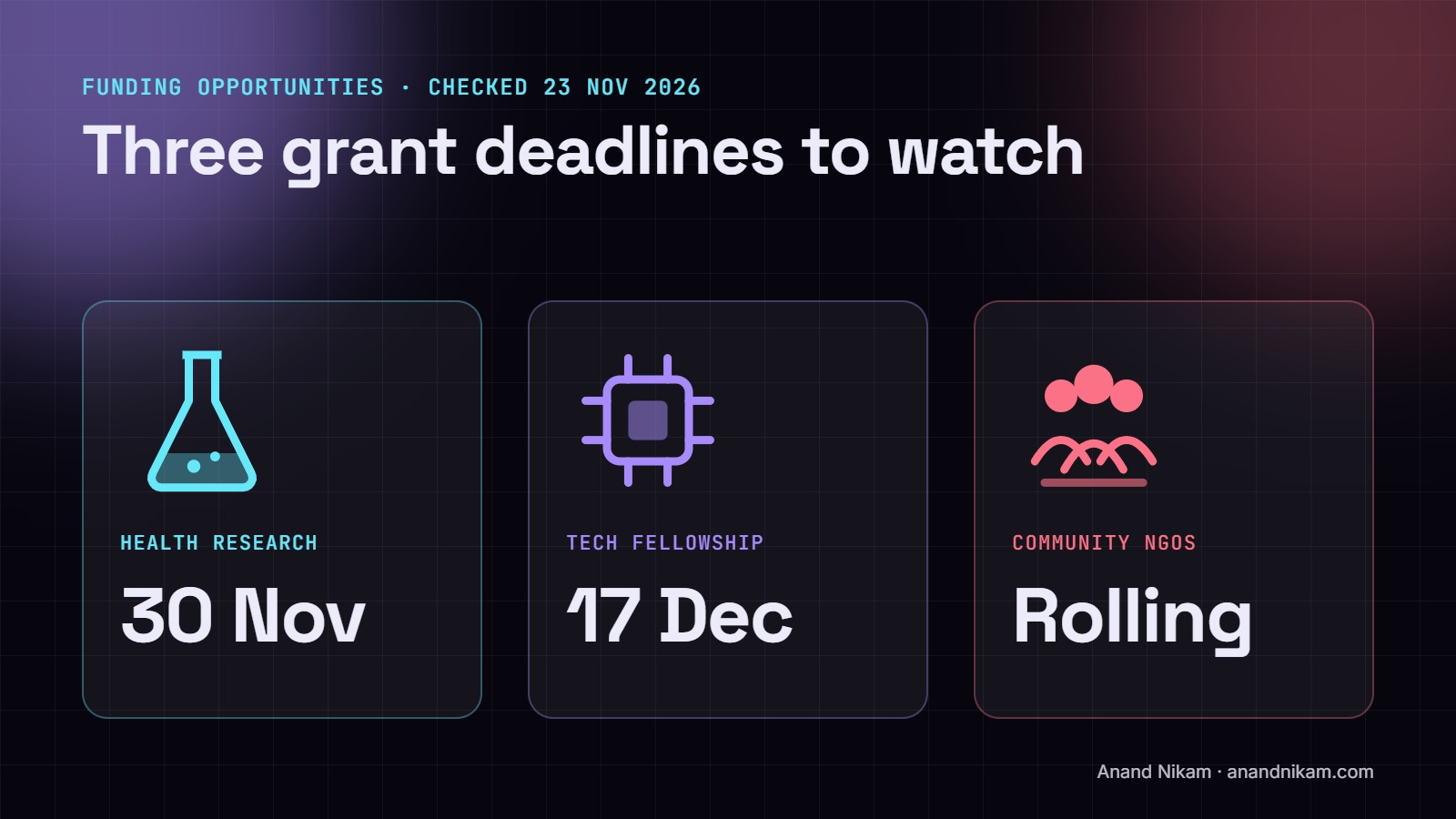
    Grant deadlines can slip past quietly, so here are three live calls worth a look this week. One closes on 30 November, one in mid-December, and one stays open all year. I checked each detail on the funder’s own page on 23 November 2026.

    Please note one thing first. Each funder sets its own rules and dates, and they can change. So always confirm on the official page before you apply.

    1. ICMR First in the World Challenge Grants (2026)

    The Indian Council of Medical Research funds “high risk, high reward” health research here. The goal is a first-of-its-kind vaccine, drug, diagnostic or intervention. Small, step-by-step gains do not qualify.

    • Who can apply: scientists at government medical colleges, universities, ICMR institutes and recognised R&D labs. DSIR-registered private institutions and NGOs can apply too, and NGOs must also be on NITI Aayog’s NGO DARPAN portal. Indian startups, MSMEs and industry are also eligible. Each proposal needs one PI and at least one Co-PI from the same institute.
    • What you get: up to Rs 1 crore for proof of concept (up to 2 years), up to Rs 4 crore for a prototype (up to 3 years), or up to Rs 8 crore for a final product (up to 4 years). Funding is released in stages, linked to deliverables.
    • Key dates: last date 30 November 2026, 5:30 PM. Results are expected on 31 December 2026, as per the call.
    • How to apply: only through ICMR’s e-PMS portal. Choose “First in the World Challenge, ICMR” under Proposal Submission. Official call page.

    With only a week left, this call suits teams that already have strong early data. ICMR also advises applicants to submit well before the last date.

    2. Mozilla Foundation Fellowship 2027–2028

    Mozilla Foundation will award 10 Fellowships for 2027–28. It backs individuals who build technology that serves people, from open AI tools to community-owned infrastructure. Focus areas include energy and compute, sovereign AI, and security tools for small organisations.

    • Who can apply: individuals only, not teams. Projects should be mainly technical, except for one Creative Advocacy spot. Selected Fellows must be able to receive funds from a US-based 501(c)(3) organisation, so read Mozilla’s eligibility guidelines.
    • What you get: Embedded Fellows receive USD 100,000 in total. Independent Fellows receive USD 125,000 in total. Both include a USD 25,000 project budget, and the Fellowship runs for 12 months from 1 June 2027.
    • Key dates: Letter of Intent due 17 December 2026, 11:59 PM Pacific (UTC-8). Shortlisted applicants hear on 16 February 2027. Full applications are due 12 March 2027.
    • How to apply: submit a Letter of Intent online. Official call page.

    Mozilla says it will not accept late entries. Also, the Letter of Intent is the main review stage, so treat it with care.

    3. Paul Hamlyn Foundation India Fund

    This UK foundation funds small Indian NGOs that work with the most vulnerable communities. It supports community-led work with groups such as tribal and Dalit communities, disabled people, women and families in extreme poverty.

    • Who can apply: local Indian NGOs with FCRA registration. The Fund does not accept prior permission. Work must be in its priority states, such as Madhya Pradesh, Chhattisgarh, Odisha, Jharkhand, Bihar and the North East, or regions like Vidarbha and Bundelkhand. Micro-level partners usually have an annual outlay under Rs 1.5 crore.
    • What you get: Rs 10 lakh to Rs 40 lakh for 1 to 2 years.
    • Key dates: rolling, with no call for proposals. Applications are assessed twice a year, in March and October.
    • How to apply: apply directly through the online portal, not through consultants. Official fund page.

    Because review happens in March, an application sent in the coming weeks has time to be ready for that round. Even so, the exact cut-off date for each round is not published — check the official page.

    How to choose the right call before grant deadlines

    Start with fit, not size. A large grant you do not qualify for wastes weeks. First, check the basics: legal status, FCRA, geography and age limits. Next, match your stage to the call. ICMR wants a clear technical leap, while Paul Hamlyn wants deep community work.

    Keep one simple tracker for grant deadlines. List the call, the last date, the time zone and the documents it needs. Then mark a personal cut-off three days earlier. Portals slow down near the last day, and late entries are rarely accepted.

    Then work back from each date. Block time for documents, budgets and sign-offs, since these often take longer than the writing. Finally, read the funder’s exclusions list. It saves more time than any template.

    Beyond grant deadlines: CSR funding

    If you are also preparing for Indian CSR funding, my guide CSR Funding in India: The Essentials covers the basics. You can find more posts on my blog.

    Disclaimer: Eligibility, amounts and deadlines are set by each funder and may change. Please confirm every detail on the official page before you apply. This post is for information only.

    Sources:

  • Solar Cold Storage: What a Pulwama Farm Group Shows

    Solar Cold Storage: What a Pulwama Farm Group Shows

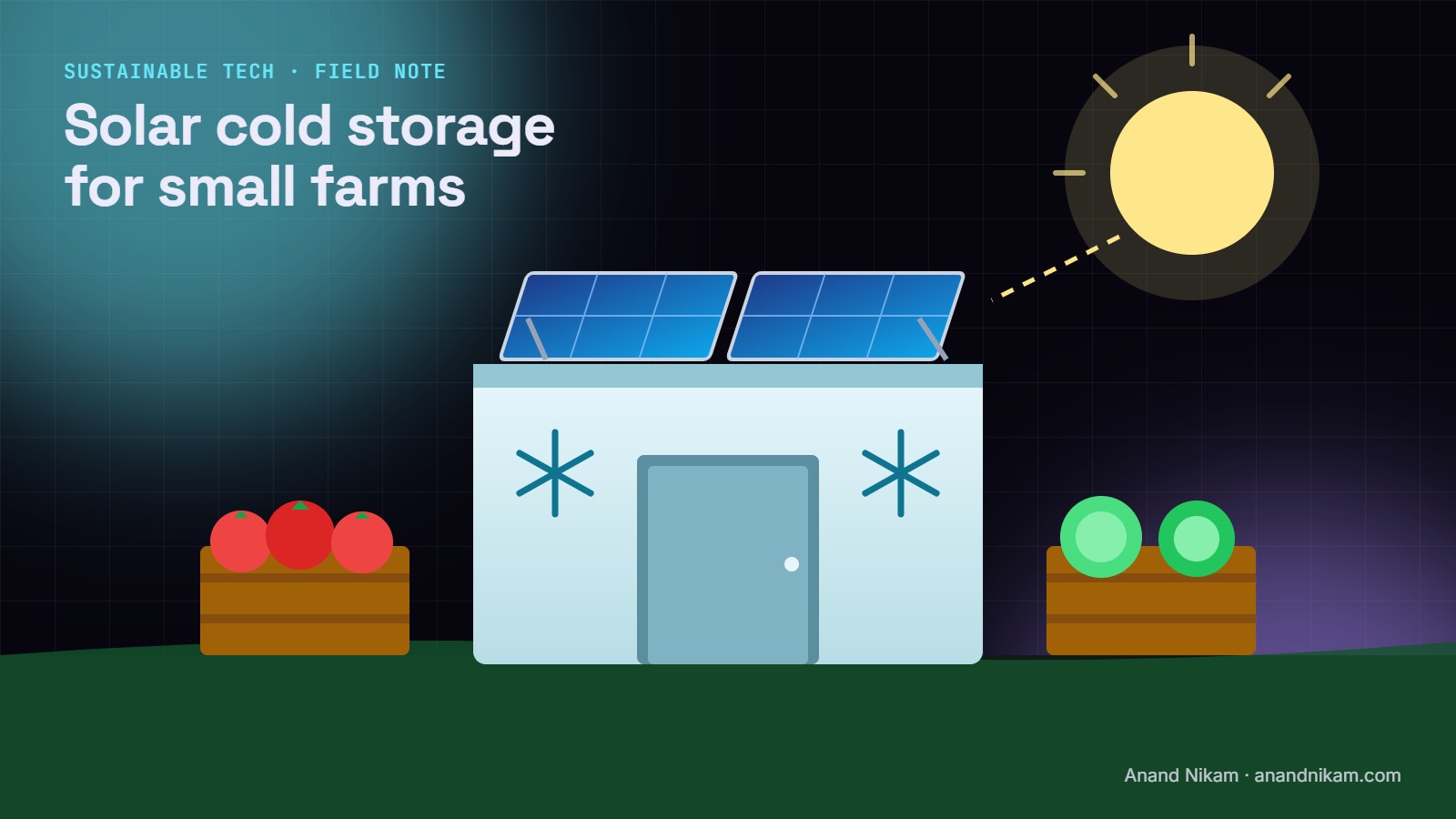
    Solar cold storage is now reaching small farms in India, and a new unit in south Kashmir shows why it matters. A farmer in Pulwama has set up a 10-tonne mini cold store that runs on solar power. As a result, 30 growers can now hold their vegetables until prices improve.

    This post explains what the unit is, how solar cold storage works, and why it matters for India. It also looks at the limits, because one unit is a start, not a solution.

    What it is: a 10-tonne solar cold storage unit in Pulwama

    Farooq Ahmad lives in the Tahab area of Pulwama district. According to a KNO report published by Kashmir Thunder on 7 November 2026, he turned his orchard land back into vegetable fields. He also brought 29 other farmers into a Farmers Interest Group (FIG).

    The key step is a 10-metric-tonne mini cold storage unit on his farm. An organic foundation provided it free of cost, says the report. It runs on solar energy, and locals call it the first such facility in the area.

    The idea is simple. Instead of selling the whole harvest on the day it is picked, group members can store it. Then they can release it when demand and prices are better, especially in the off-season.

    How solar cold storage works

    The report does not give the technical design of this unit. So here is how such systems work in general. Solar panels on or near the store make electricity during the day. That power runs a cooling unit, much like a large fridge.

    The sun does not shine at night, of course. For this reason, most designs store the cold, not just the power. Some use batteries. Others use thermal storage, such as ice or a special liquid that freezes during the day and keeps the room cool after sunset. Thick insulation helps the room hold its temperature.

    Small units like this one sit close to the field. That matters. Fresh vegetables start to lose quality soon after harvest. Therefore, a cold room a few steps away is worth more than a big one far away on a highway.

    Why it matters for India

    India loses a real share of its food after harvest. A study commissioned by the Ministry of Food Processing Industries and done by NABCONS (2022) measured these losses. As PIB reported in August 2024, losses ranged from 4.87% to 11.61% for vegetables. For fruits, the range was 6.02% to 15.05%.

    Some crops lose even more. The same table shows an average loss of 11.61% for tomato and 8.15% for cabbage. In contrast, milk showed a loss of just 0.87%, partly because the dairy sector has a strong cold chain.

    Price is the other side of the story. When every farmer sells on the same day, prices fall. Farooq said the unit will help growers supply markets “when demand and prices are favourable.” In short, storage gives a small farmer time, and time gives bargaining power.

    Solar power adds a third benefit. Many villages face power cuts, and diesel generators are costly and polluting. A solar cold store can run where the grid is weak. It also avoids the fuel bill that often makes small cold rooms hard to run.

    Government support already exists for cold chains. For example, the Mission for Integrated Development of Horticulture offers a credit-linked subsidy of 35% of project cost in general areas. In hilly and scheduled areas, the rate is 50%, according to the same PIB release. The Agriculture Infrastructure Fund also offers loans for post-harvest projects.

    Limits and open questions

    We should be honest about what we do not know. The report gives no figures for cost, power use, or how many days the produce stays fresh. It also does not say which foundation supplied the unit, or who will pay for repairs.

    Maintenance is the big test. Panels need cleaning, batteries wear out, and cooling parts fail. Many rural assets stop working because nobody owns the repair plan. A group of 30 farmers will need clear rules on who uses how much space, and how they share the costs.

    Storage alone also does not fix markets. Farmers still need transport, buyers, and fair price information. Kashmir’s winters bring their own challenge, since cold weather changes how much cooling a store needs. Finally, a single unit is a pilot. We will only know its value after a full season of real use.

    Key takeaways on solar cold storage

    • A 10-tonne solar cold storage unit now serves a 30-member farmer group in Pulwama, J&K.
    • The aim is to let growers hold produce and sell when prices are better.
    • Official data shows vegetable losses of 4.87% to 11.61% after harvest in India.
    • Existing schemes offer 35% to 50% subsidy support for cold storage.
    • Repair plans, fair sharing rules and market links will decide if it lasts.

    I write about practical sustainability ideas like this every week. You can read more on my blog, or check your own habits with the free SQ Test.

    Sources:

  • Indian Carbon Market: Who Has Registered, State by State

    Indian Carbon Market: Who Has Registered, State by State

    The Indian carbon market is no longer just a policy on paper. Its official registry now shows 243 compliance registrations and 84 offset registrations. In this post, I look at where those registrations sit, state by state, and what the pattern tells us.

    What the Indian carbon market registry shows

    The Bureau of Energy Efficiency (BEE) runs the Indian Carbon Market portal. When I checked it on 20 November 2026, the home page listed 243 compliance registrations and 84 offset registrations. Behind those totals, there is also a state-wise map.

    I added up the map data myself. Two states, Andhra Pradesh and Chhattisgarh, appear under two state codes each, so I combined them. As a result, the state numbers match the national totals exactly.

    A quick thanks here to Greenated Clima Tech. Their infographic on this topic prompted me to dig into the registry data.

    How the Indian carbon market works

    First, a short refresher. The government notified the Carbon Credit Trading Scheme (CCTS) in 2023. In short, it sets the framework for the Indian carbon market.

    The scheme runs on two tracks, as per the Ministry of Environment’s January 2026 release:

    • Compliance mechanism. Emission-intensive industries, called obligated entities, must meet greenhouse gas emission intensity targets. Those that beat their targets can earn Carbon Credit Certificates. Then they can sell them to entities that fall short.
    • Offset mechanism. This is the voluntary track. Here, other entities can register projects that cut or avoid emissions.

    So the compliance numbers tell us about heavy industry. The offset numbers, on the other hand, tell us who is building projects by choice.

    Where compliance registrations sit

    Compliance registrations follow India’s industrial map. Here are the top five states on the registry:

    • Gujarat: 29
    • Andhra Pradesh: 27
    • Tamil Nadu: 25
    • Rajasthan: 21
    • Karnataka: 17

    Next come Maharashtra and Telangana with 14 each. Odisha and Madhya Pradesh follow with 13 each. Together, the top five account for 119 of the 243 compliance registrations, close to half.

    In fact, this makes sense. The first sectors under targets were aluminium, cement, chlor-alkali, and pulp and paper. Later, refineries, petrochemicals, textiles and secondary aluminium joined. Naturally, these plants cluster in a handful of states.

    Where offset registrations sit

    The offset picture looks different. Here, Uttar Pradesh and Maharashtra lead with 10 each. Tamil Nadu has 8 and Delhi has 7. Rajasthan and Bihar have 6 each.

    Delhi is the clearest example of the gap between the two tracks. For instance, it has zero compliance registrations but 7 offset registrations. In other words, project developers and service firms can sit far from the factories.

    Meanwhile, Telangana shows the opposite. It has 14 compliance registrations and no offset registrations yet.

    Why the Indian carbon market data matters

    Now compare two numbers. The government says the compliance mechanism covers 490 obligated entities after the January 2026 notification. By contrast, the registry shows 243 compliance registrations today.

    I would not read too much into that gap. Registrations and notified entities are not always the same unit, and timelines vary by sector. Still, it suggests the registry is still filling up.

    For the offset side, 84 registrations is a modest start for a country this size. However, that is also an opening. After all, many states have zero or one offset registration. Credible projects in clean energy, waste and agriculture could change that.

    How to read the registry yourself

    The portal is public, and you do not need a login to see the totals. Open the home page and scroll to the map. Then hover over a state to see its counts.

    Keep two things in mind. First, the numbers change as new entities register, so note the date you checked. Second, some states appear under more than one code, as I found with Andhra Pradesh and Chhattisgarh. So add them up before you compare states.

    What this means for you

    Of course, not everyone needs to trade carbon credits. Even so, the shift affects many people.

    • If you work in a heavy industry, your plant may now have an emissions intensity target. Ask your team how it plans to meet it.
    • If you run a sustainability project, read how the offset mechanism works before you promise anyone carbon credits.
    • If you are a student or job seeker, carbon accounting and verification are fast-growing skills.
    • If you advise NGOs, be careful. A project only earns credits through the official process, not through good intentions.

    You can also start with yourself. My free SQ Test is a self-assessment of how sustainability shows up in your choices. It is not a rating, but it is a useful first mirror.

    Indian carbon market registry by state: 243 compliance and 84 offset registrations, top 10 states led by Gujarat, Tamil Nadu and Andhra Pradesh
    Chart: Anand Nikam, data from indiancarbonmarket.gov.in (BEE), accessed 20 Nov 2026

    Key takeaways on the Indian carbon market

    • The Indian carbon market registry lists 243 compliance and 84 offset registrations as of 20 November 2026.
    • Gujarat, Andhra Pradesh and Tamil Nadu lead on compliance registrations.
    • Uttar Pradesh and Maharashtra lead on offset registrations, and Delhi shows offsets without compliance.
    • The government has notified targets for 490 obligated entities, so the registry is likely to keep growing.
    • Always check the official portal, because the numbers change as new entities register.

    For more on climate policy and practice, browse the blog.

    Sources:

  • Social Impact Grants: 4 Calls Open to India

    Social Impact Grants: 4 Calls Open to India

    Looking for social impact grants that are still open? This week I checked four calls on their official pages. Two are research grants with an India focus, one is a global prize for young tech leaders, and one is a rolling grant for conservation. Eligibility and deadlines are set by each funder, so please confirm every detail on the official page before you apply.

    1. UTIF Research Catalyst Grants 2027–28

    The University of Toronto India Foundation and the School of Cities fund research on Indian cities. Topics include air quality, housing, water and sanitation, energy, mobility, waste and urban planning. Social science and humanities work is also welcome. Projects run from April 2027 to March 2028.

    • Who can apply: A pair of co-principal investigators. One must work for a not-for-profit Indian partner, such as a university, research centre, NGO, foundation or government body. The other must be from the University of Toronto. For-profit companies cannot apply.
    • What you get: INR 9–15 lakh per grant, with 8–10 grants planned. Admin costs are capped at 7% and equipment at 5%.
    • Key dates: Deadline 15 February 2027, 11:59 PM IST. The information webinar already took place on 27 October 2026.
    • How to apply: Find a University of Toronto co-PI first. Then download the proposal template and budget sheet, and submit through the form linked on the official UTIF call page.

    2. India–EU call on extreme climate events

    The Ministry of Earth Sciences (MoES) co-funds Indian partners in a Horizon Europe research call. The topic is understanding, modelling and predicting extreme events in a changing climate. Its EU code is HORIZON-CL5-2027-01-D1-07.

    • Who can apply: Indian academic and research institutions, private R&D bodies with at least three years of experience, and NGOs, trusts or foundations whose core mandate is research. Industry, start-ups and foreign-owned entities are not eligible. Indian teams join an EU consortium of at least three entities from three countries.
    • What you get: MoES covers 100% of approved costs for Indian partners, up to Rs 2 crore per project over three to four years. Overheads are capped at 10%.
    • Key dates: The call opened on 17 November 2026. The EU portal deadline is 4 March 2027, 17:00 CET. Indian partners must then send their documents to MoES within seven working days.
    • How to apply: Each partner registers on the EU Funding and Tenders Portal. Next, the EU coordinator submits the proposal. Finally, the Indian lead sends one consolidated PDF and a rupee budget to MoES, as the MoES call document explains. The deadline for the hard copy is not published — check the official page.

    3. Global Citizen Prize: 2027 Cisco Youth Leadership Award

    Global Citizen and Cisco reward young people who use technology to help end extreme poverty. This is a prize for individuals who already run an organisation.

    • Who can apply: People aged 18 to 35 by 31 December 2026, from any country except those under US OFAC sanctions. So Indian applicants qualify. You need a registered legal entity, such as a non-profit, for-profit or social enterprise. Only self-applications count; nominations are not accepted.
    • What you get: Three prizes of USD 250,000 each. That is USD 225,000 unrestricted plus USD 25,000 in Cisco products. Winners report every quarter for three years.
    • Key dates: Deadline 18 December 2026, 5 PM US Eastern Time. Finalists hear back around 8 February 2027. Information sessions are not published — check the official page.
    • How to apply: Create an account on the application portal. Then complete four sections, including a short pitch video and your organisation documents. Start from the official award page.

    4. Rufford Small Grants for Nature Conservation

    The Rufford Foundation funds early-career conservationists. Projects must focus on nature conservation and take place in an eligible country. India is on that list.

    • Who can apply: Early-career conservationists, mainly current master’s or PhD students and recent graduates. Undergraduates are not funded.
    • What you get: Grants of £7,000 to £18,000, in staged tiers. You can move from a first grant to a second grant, and then to Booster and Completion grants.
    • Key dates: There is no deadline, as applications are open all year. If you are unsuccessful, you can reapply after 12 months.
    • How to apply: Read the criteria, check the eligibility list, then create an account and fill in the online form on the Rufford application site.

    How to choose social impact grants that fit

    Four calls can feel like a lot. So start with fit, not size. A Rs 2 crore research grant is no use if your NGO does not do research. Similarly, a youth prize is no use if you are 36.

    Here is a quick filter I use:

    • Mission fit: Does the call fund what you already do well?
    • Eligibility: Do you meet every rule, including age, legal status and partners?
    • Capacity: Can you finish the application well before the deadline?
    • Reporting: Can you handle the reports the funder asks for later?

    Also, look at the effort-to-reward ratio. The Rufford grant has no deadline, so you can apply when you are ready. The Global Citizen award, on the other hand, closes in less than a month. If you want it, start today.

    What to prepare for social impact grants

    Most social impact grants ask for the same basics. Therefore, it pays to keep them ready in one folder:

    • Your legal registration and governance documents
    • A one-page summary of the problem you solve
    • Budget templates in INR and in one foreign currency
    • Two or three short case studies with real, verified numbers
    • CVs of your core team

    For CSR funding in India, the logic is similar, but the rules differ. If that is your next step, my guide CSR Funding in India: The Essentials explains how it works. You can also browse more calls in the blog.

    Disclaimer: I am not linked to any funder listed here. Eligibility, amounts and deadlines are set by each funder and may change, so always confirm on the official page before you apply.

    Sources: