Author: anandnikam

  • Reuse Economy: What COP31’s New Toolkit Means

    Reuse Economy: What COP31’s New Toolkit Means

    The reuse economy got a clearer rulebook at COP31 this week. On 16 November 2026, two global civil society networks launched a toolkit that defines what reuse really means. For India, where reuse is an old habit but rarely a system, this matters more than it first seems.

    What happened in the reuse economy at COP31

    Break Free From Plastic (BFFP) and GAIA released “Everything Reuse: A Toolkit for Understanding, Implementing and Scaling Reuse”. They launched it at a COP31 session called “Scaling Up the Reuse Economy” in Antalya, Türkiye. The BFFP press release calls it a multi-part toolkit. Its first part covers terminology, a taxonomy and guiding principles.

    The authors work across Asia and beyond. They include Pinky Chandran of BFFP Asia Pacific, along with Ambily Adithyan and Froilan Grate of GAIA. The Inquirer reported on 18 November that the groups want waste cut at its source. In their view, better collection and recycling alone cannot fix the problem.

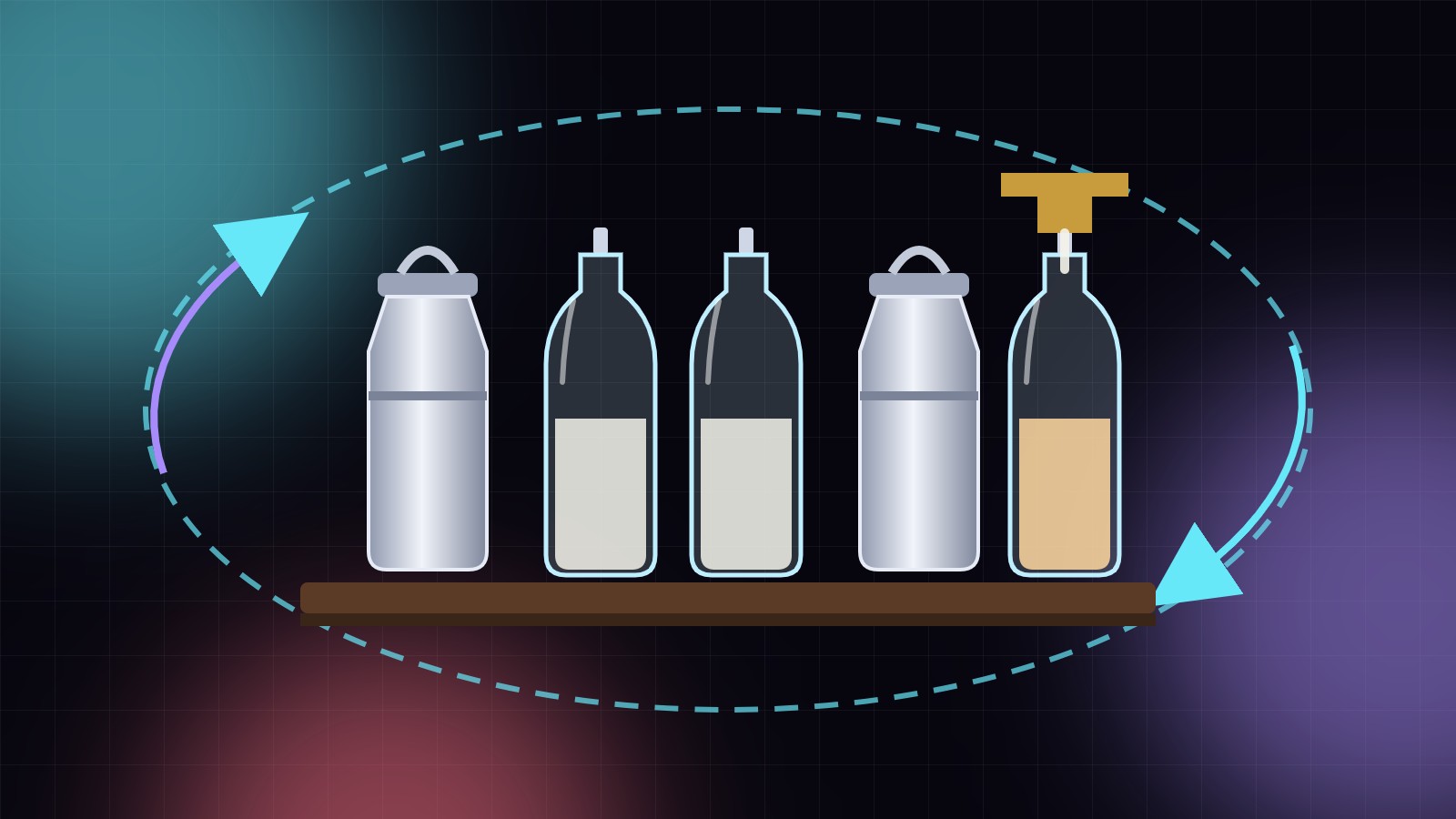
    So what does the toolkit actually say? First, it gives a simple definition. Reuse means using a product or package again for the same purpose it was made for. Repair or reconditioning in between still counts. However, using a jar as a pen stand does not, because the jar no longer does its original job.

    Next, it sorts reuse along two lines. One line asks what is being reused: a product or its packaging. The other asks how the next use happens. The toolkit names three pathways:

    • System-retained reuse, where the item stays within an organised return system.
    • User-retained reuse, where the user keeps the item and reuses it.
    • Ownership transfer, where a product moves to a new owner for the same use.

    Together, these pathways create five categories of reuse. Finally, the toolkit sets out five guiding principles:

    • Safe and non-toxic reuse systems
    • Producer responsibility and accountability
    • Justice and inclusion
    • Local contexts and realities
    • System and material efficiency

    Why a shared reuse economy language matters

    Words decide what gets counted. Today, a brand can call a bag “reusable” even if most people use it once. Meanwhile, a returnable bottle that makes dozens of trips gets the same label. Without clear terms, policymakers cannot set targets, and buyers cannot compare claims.

    That is the gap this toolkit tries to fill. As Chandran put it in the release, a common language “shapes what we recognise, value and support.” In other words, if a city cannot name a practice, it will not fund it.

    There is also a deeper point. Recycling deals with waste after we make it. Reuse, on the other hand, avoids making that waste at all. Both matter, but reuse sits higher up the waste hierarchy. A shared language helps move money and attention up that ladder.

    What the reuse economy means for India

    India does not need to import the idea of reuse. In fact, the toolkit itself uses Indian examples. It describes a milk supplier who delivers unpackaged milk to homes. It also describes a returnable beer bottle system where waste pickers collect the bottles. Along the way, it credits Indian groups such as SWaCH and KKPKP, Hasiru Dala and the Alliance of Indian Wastepickers.

    Our policy base is also in place. According to the Press Information Bureau, India banned identified single-use plastic items from 1 July 2022. Thin carry bags under 120 microns were banned from 31 December 2022. In addition, India’s EPR guidelines for plastic packaging include reuse obligations for rigid plastic packaging.

    Still, habit is not the same as a system. The steel tiffin, the glass milk bottle and the kirana refill all exist. Yet they often survive on goodwill, not on design. A clear taxonomy can help cities, companies and CSR teams see these practices as infrastructure worth funding.

    Here is where I see real openings:

    • Cities can map existing reuse systems before they plan new ones.
    • Brands can test deposit-return pilots for rigid packaging under EPR.
    • CSR programmes can back refill and repair hubs in schools and housing societies.
    • Waste picker groups can lead collection and washing, with fair pay.

    Limits and open questions

    The toolkit is a framework, not a law. It does not set targets or deadlines. Also, I could not find any cost figures in it, so the business case still needs local numbers.

    Safety is another question. Reuse needs clean washing, safe materials and good tracking. These cost money, especially in food and healthcare. Finally, a just transition matters. Chandran stresses that reuse must protect the workers and communities who already run informal loops. If big systems push them out, we lose both jobs and know-how.

    What you can do this month

    You do not need a policy role to start. First, notice one item at home that you throw away every week. Then ask whether a refill or return option exists nearby. If you run an organisation, list the packaging you buy and pick one item to switch to a returnable format.

    You can also check your own habits. My free SQ Test includes a section on consumption and waste. It takes about eight minutes. For more posts like this, visit my blog.

    Key takeaways

    • The reuse economy now has a shared vocabulary, launched at COP31 on 16 November 2026.
    • Reuse means the same purpose again, with repair allowed in between.
    • Three pathways and five principles give cities and companies a common map.
    • India already runs many reuse loops, and they deserve design and funding.
    • Waste pickers and local groups must stay at the centre of the shift.

    Sources:

  • Grants and Prizes 2027: 4 Calls Open to India

    Grants and Prizes 2027: 4 Calls Open to India

    These grants and prizes are open to Indian applicants right now, and each one has a deadline you can plan for. I checked every detail below on the funder’s own official page on 21 November 2026.

    The four calls cover very different work: early learning, climate tech for hot cities, research careers in India and species conservation. So pick the one that truly fits your work. Then, read the official rules twice before you write a word.

    Grants and prizes at a glance

    • XPRIZE Accelerate Learning: Moonshot entry by 15 February 2027, Core by 15 March 2027
    • The Liveability Challenge 2027: submissions close in February 2027
    • ANRF Ramanujan Fellowship: nominations until 31 December 2026, 5:00 pm
    • Mohamed bin Zayed Species Conservation Fund: window from 4 to 31 January 2027

    1. XPRIZE Accelerate Learning

    XPRIZE runs this US$6 million competition on early reading and maths for first-graders. Importantly, India is one of two focus regions, along with Sub-Saharan Africa. In addition, the British Asian Trust is the partner for the India Core Track.

    • Who can apply: individuals and legal entities of any nationality, including start-ups, nonprofits and universities. Each team picks one region per track and must follow India’s rules on approvals and data protection.
    • What you get: the Core Track ($5 million) has up to 8 finalists at $125,000 each, then prizes of $2.5 million, $1 million and $500,000. The Last Mile Moonshot Track ($1 million) offers $500,000 per region.
    • Key dates: Moonshot registration and qualifying submission by 15 February 2027, 19:00 UTC. Core Track by 15 March 2027, 19:00 UTC. Public comments on the guidelines are open until 11 December 2026. XPRIZE says all dates are preliminary.
    • How to apply: register on the competition page, then use the XPRIZE team portal. The fee ($700 Core, $300 Moonshot) is waived for teams headquartered in India. Official page: xprize.org/prizes/accelerate-learning

    2. The Liveability Challenge 2027

    Temasek Foundation presents this challenge, and Eco-Business organises it. In short, it backs proven, deep-tech ideas for hot, crowded cities in the tropics. Overall, there are three tracks: decarbonisation, heat resilience (“Cool Earth”) and oceans.

    • Who can apply: teams based anywhere in the world, aged 18 or above. Your solution must be at technology readiness level 6 or higher. It must also fit Singapore and other tropical cities.
    • What you get: a grant of up to S$1 million for the top solution in each track. Besides, there is extra development funding and some equity for selected ventures. Winners pilot in Singapore or South-East Asia.
    • Key dates: the FAQ lists 12 February 2027, 23:59 (GMT+8). A banner on the site mentions an extension to 18 February, so confirm the final date. The shortlist comes in March 2027 and the finale in May 2027.
    • How to apply: fill in the online form. You can save a draft and edit it later. The organisers say there is no cost to take part. Official page: theliveabilitychallenge.org/participate

    3. ANRF Ramanujan Fellowship

    The Anusandhan National Research Foundation runs this fellowship. In particular, it helps Indian scientists and engineers working abroad return to research posts in India. Note that I could not find a deadline on this page earlier this week. However, it now shows one.

    • Who can apply: Indian or Indian-origin researchers under 40 who work abroad when nominated. You need a PhD or higher degree and no permanent post in India. Your PhD guide or PhD institute cannot nominate you.
    • What you get: Rs 1,35,000 a month for five years, a research grant of Rs 7 lakh a year and Rs 60,000 a year as overhead.
    • Key dates: nominations close on 31 December 2026 at 5:00 pm. The page does not state a time zone, so assume IST and submit early.
    • How to apply: register on anrfonline.in, fill the form and upload a proposal of up to five pages. Then send it to your nominator, who submits it. Official page: serb.gov.in awards and fellowships

    4. Mohamed bin Zayed Species Conservation Fund

    This fund gives small grants to protect plants, animals and fungi. Above all, it focuses on species that are critically endangered, endangered or data deficient. Also, it says it works without bias by region or species.

    • Who can apply: conservation projects worldwide. Rules for each type of applicant sit in the fund’s Application Criteria and FAQ, so read those first.
    • What you get: a small grant. The amount was not published on the pages I read — check the official page.
    • Key dates: the January window opens on 4 January 2027 and closes on 31 January 2027. Moreover, the fund uses GMT and calls its deadlines inflexible. It expects to respond in late April 2027.
    • How to apply: read the criteria, then apply on the fund’s online portal once the window opens. Official page: speciesconservation.org/grants/timetable

    How to choose the right grants and prizes

    Start with fit, not size. After all, a large prize that does not match your work will cost you weeks for nothing. So ask three plain questions before you apply.

    • Do I meet every rule, or only most of them?
    • Can I show proof, such as pilot data, readiness level or field results?
    • Do I have the time and team to finish a strong application?

    Next, put every date in your calendar with a buffer of one week. That is because portals slow down near deadlines. Also keep one master file with your registration papers, budget and impact data. As a result, you will reuse it for many grants and prizes.

    If you also plan to approach companies, my guide CSR Funding in India: The Essentials explains how CSR funding works. You can find more calls like these on my blog.

    Disclaimer: the funders set all eligibility rules and deadlines, and they may change them. Always confirm every detail on the official page before you apply. I am not linked to any of these funders.

    Sources:
    XPRIZE Accelerate Learning: xprize.org and Guidelines v1.0 (PDF)
    The Liveability Challenge: participate page and submission FAQ
    ANRF Ramanujan Fellowship: serb.gov.in
    Mohamed bin Zayed Species Conservation Fund: timetable and application portal

  • Hydrogen Train India: What the Jind Line Teaches

    Hydrogen Train India: What the Jind Line Teaches

    India’s first hydrogen train began its run on the Jind–Sonipat line in Haryana four months ago. For anyone tracking the hydrogen train India story, now is a good moment to look past the headlines. What does this train actually do, and what can the rest of us learn from it?

    I worked on last-mile energy delivery for years, so I read rail and fuel news with one question in mind. Will it work on an ordinary weekday, for ordinary people? Here is what the official record tells us so far.

    Hydrogen train India: what it is

    Prime Minister Narendra Modi flagged off the train at Jind on 17 July 2026. According to the PIB backgrounder, it is a 10-car trainset. Two driving power cars carry the fuel cells, batteries and hydrogen tanks. Eight trailer coaches carry the passengers.

    The train runs on a 1,200 kW hydrogen fuel cell system. It can carry around 2,600 passengers. Its design speed is 110 kmph, but the approved top speed on this line is 75 kmph. As reported by Telangana Today, PTI put the route at 89 km. The trip takes about two hours, with 12 stops.

    PIB also stresses that Indian teams designed and developed the train, from the first drawings to the prototype. RDSO, the Railways’ standards body, prepared the design approval and the technical specifications.

    How India’s hydrogen train works

    The idea is simple, even if the engineering is not. A fuel cell mixes hydrogen with oxygen from the air. That reaction makes electricity, and the electricity drives the motors. The only by-products are water vapour and heat.

    The fuel cells here are the proton exchange membrane type. Lithium iron phosphate batteries sit beside them. In simple terms, the batteries give a burst of power when needed. They store energy when it is not. So the fuel cells can work at a steadier pace.

    Fuel comes from a refuelling site at Jind. PIB calls it the country’s largest railway hydrogen storage and refuelling facility. It can hold nearly 3,000 kg of hydrogen at a time. PESO, the national explosives safety body, has licensed it. TÜV SÜD of Germany carried out an independent safety check. In addition, the site has leak and flame detectors and an automatic hydrogen cut-off.

    • Power: 1,200 kW fuel cell system with LFP batteries
    • Size: 10 cars, about 2,600 passengers
    • Speed: 75 kmph approved, 110 kmph design
    • Fuel store: nearly 3,000 kg of hydrogen at Jind

    Why the hydrogen train matters for India

    First, it proves that Indian teams can design, certify and run a hydrogen trainset. Only a small group of countries do this today. PIB names Germany, Japan, China and the United States.

    Second, it gives early field data. News On AIR reported on 25 July 2026 that the train had run more than 1,200 km. It said this replaced more than 3,000 litres of diesel. Small numbers, yes. But real kilometres teach more than any slide deck.

    Third, it links rail to the National Green Hydrogen Mission. A train is a steady, predictable buyer of fuel. That kind of demand can help a local hydrogen supply chain grow. Many lines in India still run diesel trains on short, quiet routes. Those are the routes where a hydrogen train India builds at home could matter most.

    Finally, it builds skills. Safety codes, licences, refuelling drills and maintenance routines now exist on paper and in practice. The maintenance base is at Shakurbasti in Delhi. Every future project can build on that groundwork.

    Limits and open questions

    Hydrogen is only as clean as the way we make it. The official backgrounder does not say how much of the fuel comes from renewable power. That one detail decides the real climate benefit.

    Cost is the next question. No public figure covers the cost per km against diesel or electric trains. Without it, nobody outside the system can judge value for money. On busy lines, overhead electric traction is still the simpler choice. Hydrogen makes more sense where wiring a line does not pay.

    Then there is daily life. At launch, PTI reported that the date for regular commercial service was still awaited. Passengers also raised small issues, like stains from seat covers, and officials said they would fix them. These details sound minor. Yet they decide whether people choose the train again.

    Lastly, one line is a pilot, not a fleet. The real test is the next five lines. Officials have said trials on a Delhi route will begin soon.

    What we can learn from it

    Whether you run an NGO, a start-up or a CSR team, the Jind line holds a lesson. New technology needs boring things to succeed. It needs safety approvals, a trained crew, a fuel plan and honest data.

    So when you pitch a clean-tech pilot, plan for those boring things first. Show your licences, your maintenance plan and how you will measure results. That is what makes a pilot worth funding. You can read about my own work on the about page. Or check your own habits with the free SQ Test.

    Key takeaways

    • The hydrogen train India flagged off on 17 July 2026 runs 89 km between Jind and Sonipat.
    • It uses a 1,200 kW fuel cell system and emits only water vapour and heat.
    • Early runs passed 1,200 km and replaced over 3,000 litres of diesel.
    • Open questions remain on green hydrogen supply, cost per km and regular service.

    Which route in your state would you test a hydrogen train on, and why? More posts like this are on my blog.

    Sources:
    PIB Backgrounder, “India’s First Hydrogen-Powered Train: Advancing Green Rail Mobility”, 16 July 2026: pib.gov.in (PRID 2285268)
    Telangana Today (PTI), “PM Modi flags off India’s first hydrogen-powered train from Haryana’s Jind”, 17 July 2026: telanganatoday.com
    Telangana Today (PTI), “Commercial run of India’s first hydrogen train to begin soon”, 17 July 2026: telanganatoday.com
    News On AIR, “India’s first hydrogen-powered train completes over 1,200 km of successful operations”, 25 July 2026: newsonair.gov.in

  • Water and Climate Grants: 3 Calls Open Now

    Water and Climate Grants: 3 Calls Open Now

    Water and climate grants are open right now, and two of them close within weeks. This roundup covers three calls I checked on each funder’s official page this week. However, each one suits a different kind of organisation, so read the eligibility lines first.

    As always, the funder sets the rules and the dates. Please confirm every detail on the official page before you apply.

    1. India Pitch-Pilot-Scale Start-up Challenge (AMRUT 2.0)

    The Ministry of Housing and Urban Affairs (MoHUA) runs this challenge with MyGov. Its focus is start-up solutions to urban water problems. This year, the scope also covers urban air quality and energy use in municipal services. Street lighting, climate resilience and heat are in too.

    • Who can apply: Start-ups recognised by DPIIT. The solution must fit one of the listed thematic areas or problem statements.
    • What you get: Selected start-ups can get a grant of up to ₹20 lakh. It comes in three tranches of ₹5 lakh, ₹7 lakh and ₹8 lakh against milestones. The ministry also lists mentorship and help with scaling through urban local bodies.
    • Key dates: The call runs from 10 November to 15 December 2026.
    • How to apply: Register on Innovate India and upload your proposal. If you address a listed problem statement, quote its ID.
    • Official link: innovateindia.mygov.in/ipps-startup

    In my view, this is one of the more practical water and climate grants for start-ups in India. The problem statements come from real cities, so you can match your pilot to a stated need.

    2. FAO Award for Innovation 2027

    The Food and Agriculture Organization of the United Nations (FAO) runs this award. It recognises innovation in areas under its mandate. For example, that includes food security, nutrition and sustainable use of natural resources.

    • Who can apply: FAO describes the award as open to a broad range of awardees, including Members and non-state partners. Applicants must be 18 or older. Importantly, every application must come from, or carry an endorsement from, an FAO Representative or an FAO Director.
    • What you get: A scroll describing the achievement and a cash prize of USD 10,000.
    • Key dates: Submit by 31 December 2026.
    • How to apply: Fill in the nomination form on the FAO site, or email it to the address given there. Attach the FAO endorsement.
    • Official link: fao.org/fao-awards/innovation/apply-now

    Because the endorsement step takes time, start early. Also, the form asks how you would spend the prize money, so plan that answer before you write.

    3. IKI Medium Grants 2026 (Germany)

    The International Climate Initiative (IKI) of the German environment ministry funds climate and biodiversity projects in developing and emerging economies. Now it has opened the seventh round of its Medium Grants.

    • Who can apply: Non-profit civil society organisations, academic institutions and non-profit companies. The lead applicant must have a permanent establishment in Germany by the first payment. It must partner with one or two local implementing organisations in the project country. So an Indian NGO can take part as a local partner. Country eligibility: not published on the main page — check the official funding announcement.
    • What you get: Between EUR 300,000 and EUR 800,000 per project, for two to three years.
    • Themes this year: Green skills for local climate action, and digital and practical solutions for coastal and marine ecosystems.
    • Key dates: The ideas competition closes on 12 January 2027 at 11:59 am CET.
    • How to apply: Submit a project outline through the IKI site. Shortlisted applicants then submit a full proposal.
    • Official link: IKI Medium Grants 2026

    If your NGO works on green skills or coasts, this is the time to talk to German partners. A strong local partner can make the outline far more credible.

    How to choose the right water and climate grants

    First, check the legal form each call needs. The AMRUT challenge needs a DPIIT-recognised start-up. The IKI call needs a German lead partner. The FAO award needs an FAO endorsement. Therefore, these three calls rarely compete for the same applicant.

    Next, match the size of the money to your stage. A ₹20 lakh milestone grant suits a pilot. On the other hand, a EUR 300,000 project needs a team that can run a multi-year programme.

    Then, count backwards from the deadline. Endorsements, partner letters and budgets always take longer than writing. As a rule, keep at least a week for review.

    Finally, write for the reviewer. For instance, use the funder’s own words for the problem. Then show one clear result you can measure. Also, explain how the work continues after the grant ends.

    What to prepare this week

    Before you open any form, collect these basics in one folder:

    • Registration documents and your latest audited accounts.
    • A one-page summary of the project, with one clear number on reach or results.
    • A simple budget with each major cost explained.
    • Letters from partners, if the call needs them.
    • Two or three photos of your work in the field.

    With this folder ready, each new application takes hours instead of weeks. If your work also depends on company CSR budgets, my ebook CSR Funding in India: The Essentials explains how CSR law works and how to position a project. You can also browse more roundups on the blog.

    Key takeaways on water and climate grants

    • Three water and climate grants are open now. They close on 15 December 2026, 31 December 2026 and 12 January 2027.
    • The AMRUT 2.0 challenge offers up to ₹20 lakh to DPIIT start-ups, paid against milestones.
    • The FAO award offers USD 10,000 but needs an FAO endorsement.
    • IKI Medium Grants fund EUR 300,000 to 800,000 projects led by Germany-based organisations with local partners.

    Disclaimer: each funder sets its own eligibility, amounts and deadlines, and these can change. Always confirm on the official page before applying. This post is information, not a promise of funding.

    Sources:

  • Battery Fires in Waste: The UK’s £2.37bn Warning

    Battery Fires in Waste: The UK’s £2.37bn Warning

    Battery fires in waste are now a measurable cost, not a rare accident. New research from the UK puts a price on the problem: about £2.37 billion a year. For India, where small rechargeable gadgets are everywhere, the lesson is simple and urgent.

    What happened: the UK counts the cost of battery fires in waste

    On 18 November 2026, Circular Online reported new estimates from Material Focus. Material Focus is a non-profit that runs the Recycle Your Electricals campaign in the UK.

    The research estimates 2,839 battery fires in the UK waste system in 2025. That is 135% more than in 2023/24. Bin lorries accounted for 26% of these incidents, up from 19% in the earlier period.

    To get there, the team surveyed 97 local authorities, about a quarter of UK councils. Then they scaled the answers using regional population figures. Of the councils that responded, 91% said battery fires are a growing challenge.

    Moreover, the £2.37 billion figure covers more than burnt trucks. It includes damage to facilities, disrupted services, diverted waste and emergency response. According to the report, a single replacement bin lorry can cost nearly £540,000.

    Why battery fires in waste keep rising

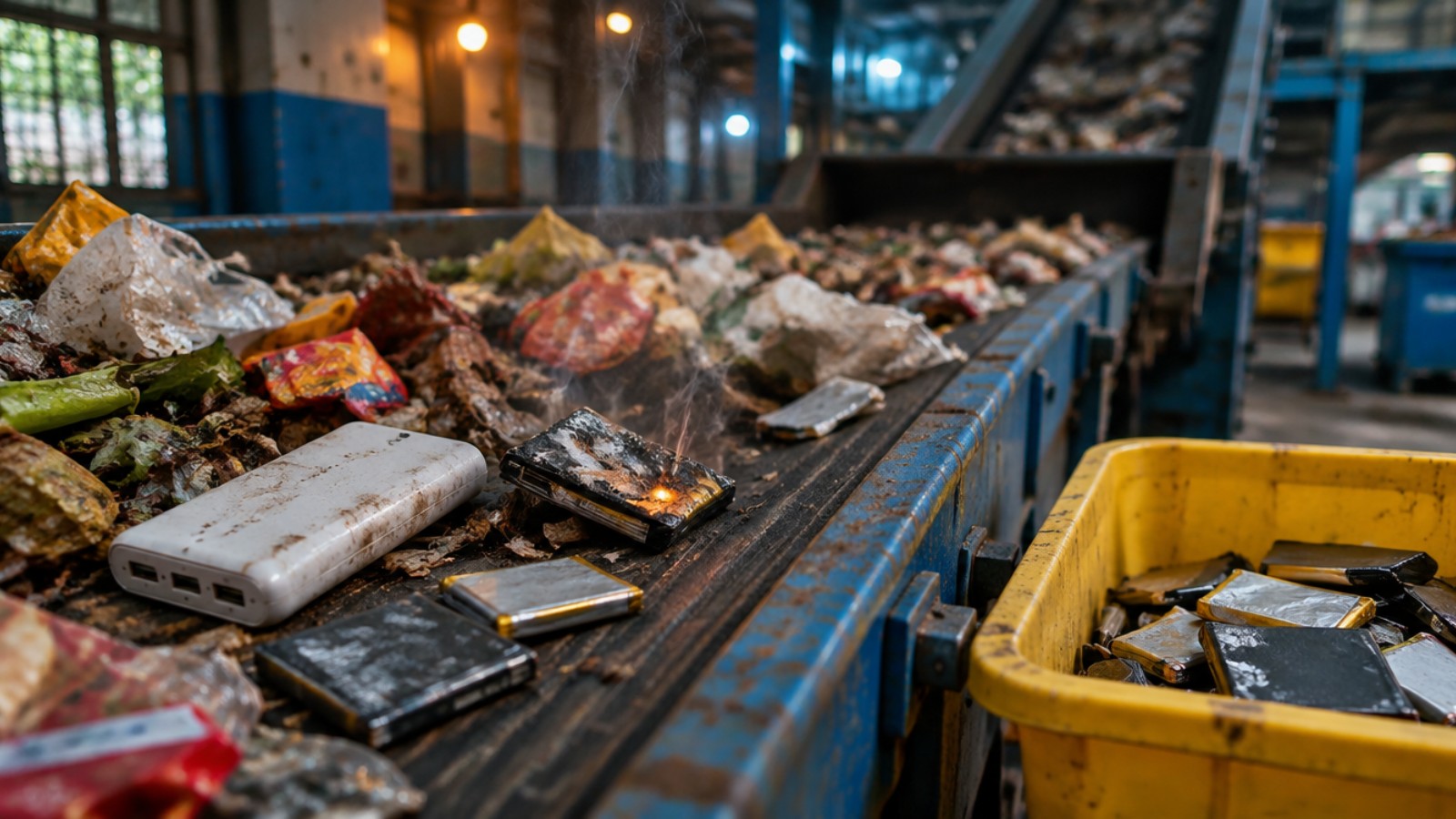
    In fact, the cause is not a mystery. Lithium-ion batteries can catch fire when something crushes, pierces or damages them. That is exactly what happens inside a compactor truck or a shredder.

    Today, these batteries sit inside many small products. Think of electric toothbrushes, power banks and wireless earphones. Yet most of us do not notice that these items carry a battery.

    Once a fire starts, it spreads through the dry waste around it. It can also restart even after it looks finished. As a result, collection crews, plant workers and firefighters face real danger. One fire safety lead quoted in the report called many of these incidents “easily preventable”.

    In short, the problem sits at one point: the moment a person drops a battery into the wrong bin.

    Why this matters for the circular economy

    A circular economy depends on clean material streams. After all, recyclers need sorted inputs to recover value. However, a single hidden battery can damage a sorting line and stop it for days.

    So battery fires in waste hurt circularity in two ways. First, they destroy equipment that recovers materials. Second, they waste the battery itself, which holds lithium, cobalt, nickel and copper that recyclers could recover.

    In addition, fires push up insurance costs for waste operators. In turn, higher costs make recycling less viable, especially for small players.

    What it means for India

    India already has a legal framework for this. The Ministry of Environment, Forest and Climate Change published the Battery Waste Management Rules, 2022 on 24 August 2022.

    Here is what those rules set out, as per the government’s release:

    • The rules cover all battery types: electric vehicle, portable, automotive and industrial.
    • They work on Extended Producer Responsibility (EPR). So producers, including importers, must collect and recycle waste batteries.
    • Landfill and incineration of waste batteries is not allowed.
    • An online portal lets producers and recyclers trade EPR certificates.
    • Recyclers must recover a minimum share of materials, and new batteries must use some recycled content.

    Still, rules on paper need habits on the ground. The UK data shows that even a mature system struggles when households mix batteries with general waste. Therefore, India can learn from this before the volume of small devices grows further.

    Here, I see three practical gaps worth closing:

    • Awareness at home. Most families do not know a power bank needs separate disposal. Simple labels and messages at the point of sale can help.
    • Easy drop-off points. People use collection points when they are close and visible. Housing societies, schools and offices can host them.
    • Safety for waste workers. Informal workers often handle mixed waste by hand. They need training on how to spot and isolate damaged batteries.

    Meanwhile, municipal bodies can add battery questions to their waste segregation drives. Also, CSR teams could support collection and awareness work. Of course, it must fit the activities Schedule VII allows.

    What you can do this week

    Luckily, you do not need a policy role to help. Start with your own home and workplace.

    • Collect used batteries and small electronics in one box, away from heat.
    • Tape the terminals of loose lithium batteries before storing them.
    • Never put a swollen or damaged battery in the household bin.
    • Ask your housing society or office to set up a clearly marked drop-off box.
    • Hand old devices to an authorised e-waste or battery collector, not the general waste stream.

    Want to check how far your own habits support a circular economy? Then try my free SQ Test. It is a self-assessment, not a rating, but it shows where to start.

    Key takeaways

    • Battery fires in waste cost the UK an estimated £2.37 billion a year, according to Material Focus.
    • Estimated incidents rose 135% to 2,839 in 2025, with bin lorries involved in about a quarter.
    • The root cause is simple: lithium-ion batteries thrown into general waste.
    • India has the Battery Waste Management Rules, 2022, built on EPR and a ban on landfilling.
    • Rules work best with daily habits: separate storage, easy drop-off points and trained waste workers.

    In the end, the fix is cheap compared with the cost of one fire. A separate box at home might be the most useful circular economy tool you own. For more stories like this, visit the blog.

    Sources:

  • Climate Innovation Funding: 3 Calls to Act On Now

    Climate Innovation Funding: 3 Calls to Act On Now

    Climate innovation funding often opens and closes before busy founders notice. This week I checked three calls that are open now, each on the funder’s own website. One closes in days, one runs into January, and one gives you until March 2027 to get in line.

    Each call suits a different kind of applicant. One is for energy and climate tech startups. Another is for social entrepreneurs at an early stage. The third is for students aged 13 to 19. Please confirm every detail on the official page before you apply, because the funder sets the rules and can change them.

    1. SET Award 2027 (dena, Germany)

    The German Energy Agency (dena) runs this global competition for energy and climate tech startups. Its terms say Germany’s Federal Ministry for Economic Affairs and Energy funds it. This is the most urgent call on the list.

    • Who can apply: national and international startups founded in August 2016 or later. The company must be registered or in the process of registration. You need more than an idea: at least a proof of concept, plus a client, a partner or a working prototype. Hardware should generally be at TRL 4 or above.
    • What you get: each category winner can receive a cash prize of up to €10,000, equity-free. dena covers finalists’ travel costs, and finalists pitch at the SET Tech Festival in Berlin.
    • Key dates: applications close on 30 November 2026 at 23:59:59 CET. Evaluations begin in early December 2026. The SET List follows in February 2027, and the finalists’ ceremony is likely in March 2027.
    • How to apply: fill in the online form linked on the official page. Write it fully in English, add a pitch deck of up to 15 slides as a PDF, and choose one of five categories.
    • Official link: SET Award 2027

    2. Echoing Green Fellowship via the Talent Platform

    Echoing Green, based in New York, backs early-stage social entrepreneurs. It has changed how people enter its Fellowship. Now only members of its free Talent Platform can apply. So the first step is to join the platform.

    • Who can apply: founders of any nationality, working in any country. Nonprofit, for-profit and hybrid models are all welcome. Your organisation does not need to be incorporated yet.
    • What you get: the official page lists seed funding as a stipend of USD 100,000 over 18 months. For-profit organisations receive it as recoverable grants.
    • Key dates: request to join the Talent Platform by 31 March 2027 to be part of the first submission period. That intake is tentatively planned for April 2027. Echoing Green also plans later windows, tentatively in July and October 2027. It will announce Fellowship selection dates in early 2027.
    • How to apply: submit the Talent Platform request form, which asks three short essay questions. Membership is free and open all year.
    • Official link: Echoing Green Talent Platform

    3. The Earth Prize 2027 (students aged 13 to 19)

    The Earth Foundation, a non-profit in Geneva, runs this environmental competition for teenagers worldwide. If your NGO or school works with young people, this is worth sharing.

    • Who can apply: students aged 13 to 19 who are in school, homeschool or another education programme. They can enter alone or in teams of up to five. Minors need a parent or guardian’s consent.
    • What you get: the 2027 edition offers more than USD 100,000 in total. Seven Regional Winners each receive USD 10,000 to put their ideas into action. Twelve Mentors of the Month each receive USD 500.
    • Key dates: registration is open until 10 January 2027, and submissions close on 31 January 2027. The site lists the awards ceremony for 28 May 2027. Time zone: not published, so check the official page.
    • How to apply: register on the official site, then build your entry in the submissions portal using the Earth Prize Blueprint format.
    • Official link: The Earth Prize 2027

    How to choose the right call

    Do not apply to everything. Instead, match the call to your stage. The SET Award wants a working product or prototype, so it suits startups with early traction. Echoing Green looks for founders with a bold idea, even before registration. Meanwhile, The Earth Prize suits young people with a fresh environmental idea.

    Next, check the deadline against your real capacity. A rushed application rarely wins. If 30 November is too close for a strong SET entry, note it for the next cycle and focus on Echoing Green instead.

    What to prepare for climate innovation funding

    Most climate innovation funding calls ask for the same core material. If you keep it ready, each new form takes hours, not weeks. Here is a simple kit:

    • A one-paragraph problem statement with one or two numbers from a credible source.
    • A clear description of your solution and its current stage.
    • Proof of progress, such as pilot results, users, partners or a prototype.
    • A short pitch deck in English, with your team and your plan for the money.
    • Registration papers and basic financials, if your organisation has them.

    Also, read the eligibility rules twice. Many good applications fail on small points, such as founding date, age or language. If you are an Indian NGO looking at CSR funding as well, my short guide CSR Funding in India: The Essentials covers how companies assess proposals.

    Key takeaways

    • SET Award 2027 closes on 30 November 2026, so climate tech startups must move fast.
    • Echoing Green now takes Fellowship applicants only through its Talent Platform, with a 31 March 2027 date for the first intake.
    • The Earth Prize 2027 gives teenagers until 10 January 2027 to register.

    Disclaimer: the funders set eligibility, amounts and deadlines, and they can change them. Always confirm on the official page before you apply. This post is information, not advice, and I have no link with these funders. For more funding round-ups, visit the blog.

    Sources

  • Solar-Powered Desalination: BITS Hyderabad’s Dual System

    Solar-Powered Desalination: BITS Hyderabad’s Dual System

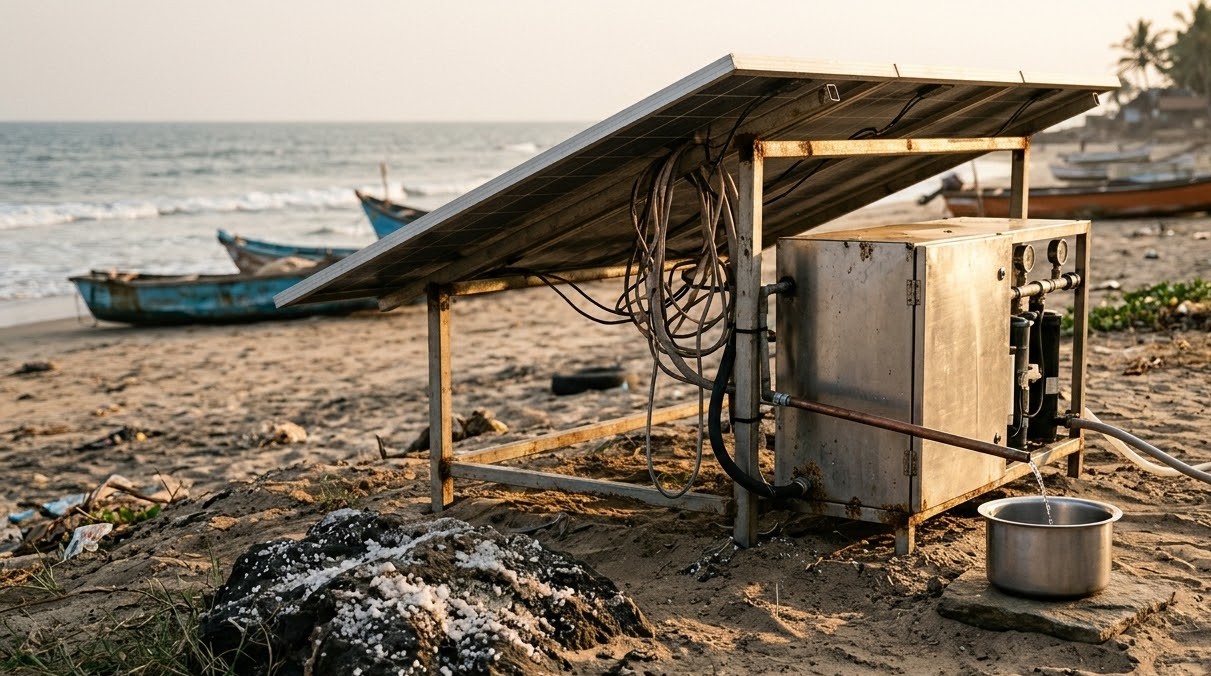
    Solar-powered desalination usually brings to mind big coastal plants. A team at BITS Pilani’s Hyderabad campus is testing something much smaller. Their unit turns salty water into drinking water and gives out cool air at the same time.

    The team holds an Indian patent for the design. It is still a lab prototype, not a product. Still, the idea speaks to two problems many coastal and island homes face together: scarce fresh water and rising heat.

    What it is

    According to Telangana Today, the system holds Indian Patent No. 558052. The patent covers a portable apparatus that desalinates water and cools a space at once. Prof Sandip S Deshmukh and Prof Santanu Prasad Datta of the mechanical engineering department lead the work. Research scholar K Sai Sandeep has worked on the later research and the prototype.

    The team built and tested the prototype on the Hyderabad campus across different seasons. Deccan Chronicle reports that the results appeared in the journal Applied Thermal Engineering in 2026.

    How solar-powered desalination works here

    The method is called humidification-dehumidification. Think of how a cold glass “sweats” on a humid day. The unit copies that effect on purpose.

    • First, air passes through a humidifier and picks up moisture from salty or brackish water.
    • Next, the system cools this moist air, so the vapour condenses into fresh water.
    • As a result, the salt stays behind, because only water vapour travels with the air.
    • Finally, the cool, dry air that leaves the unit can cool a room or a small store.

    The design also combines refrigeration and thermal energy storage in one box. On top of that, solar energy runs the whole process. That makes the unit a good fit for places with strong sun and weak grid supply.

    What the lab tests show

    The reported numbers are promising, but they come from lab conditions. Here is what the two news reports say:

    • Water: up to about 12.4 litres an hour in a double-stage setup with water heating, under high-humidity conditions.
    • Cooling: a capacity of up to 6.57 kW, with outlet air as cold as 14°C.
    • Cost: the lowest estimate during the experiments was around 30 paise a litre.
    • Design goal: roughly 200 litres of fresh water a day.

    Deccan Chronicle also describes one proposed use. A single unit could supply about 200 litres a day and keep around 50 kg of seafood cool, serving 10 families. That is a design idea, not a field result.

    Why it matters for India

    India has a long coastline and many island communities. Many villages also draw brackish groundwater. In such places, safe drinking water and cold storage are often separate struggles. Today, families buy water. Meanwhile, fishers lose catch to heat. Small clinics need both water and cooling.

    A single unit that does both jobs could cut the number of machines a village must buy and maintain. Besides, it could run where diesel is costly or the grid is unreliable. The researchers name island communities, rural settlements with brackish groundwater, small food stores and field hospitals as possible users.

    There is a wider lesson too. Climate adaptation does not always need a mega project. Sometimes it needs a small, well-designed box that a community can own and repair. In my own work on clean technology, I see that the last mile decides whether an idea helps anyone. You can read more about that work on my about page.

    Limits of solar-powered desalination today

    We should read these results with care. The researchers themselves say that output changed with the setup and the weather. For example, the 12.4 litres an hour figure needed favourable high humidity. Similarly, the 30 paise figure was the lowest estimate, and real costs will depend on location, energy needs, installation and upkeep.

    So several questions remain open. How will the unit perform in dry, hot months? What happens to the leftover brine? Who will service it in a remote village? And what will a unit cost to build at scale? The team plans field trials and wants to adapt the design to different climates. Those trials will tell us far more than lab numbers can.

    What NGOs and local bodies can do now

    You do not need to wait for a finished product to prepare. If you work with coastal or island communities, start by mapping the need. How much water does a household buy each week? What does it cost? How much catch or produce spoils for lack of cooling?

    Also, that baseline data helps in two ways. It shows whether a solar-powered desalination unit would really help. It also makes your case stronger when you approach researchers for a pilot, or a company for CSR support. Good data turns a hopeful idea into a fundable project.

    Key takeaways

    • A BITS Pilani Hyderabad team has patented a small unit that makes fresh water and cool air from sunlight.
    • It uses humidification-dehumidification, plus refrigeration and thermal storage, in one system.
    • Lab tests reported up to 12.4 litres an hour and up to 6.57 kW of cooling, under favourable conditions.
    • It is still a prototype, so field trials will decide its real value.

    I will keep tracking how this solar-powered desalination work moves from lab to village. For more stories like this, visit the blog.

    Sources

  • Top CSR Spenders in India: What FY 2024-25 Data Means for NGOs

    Top CSR Spenders in India: What FY 2024-25 Data Means for NGOs

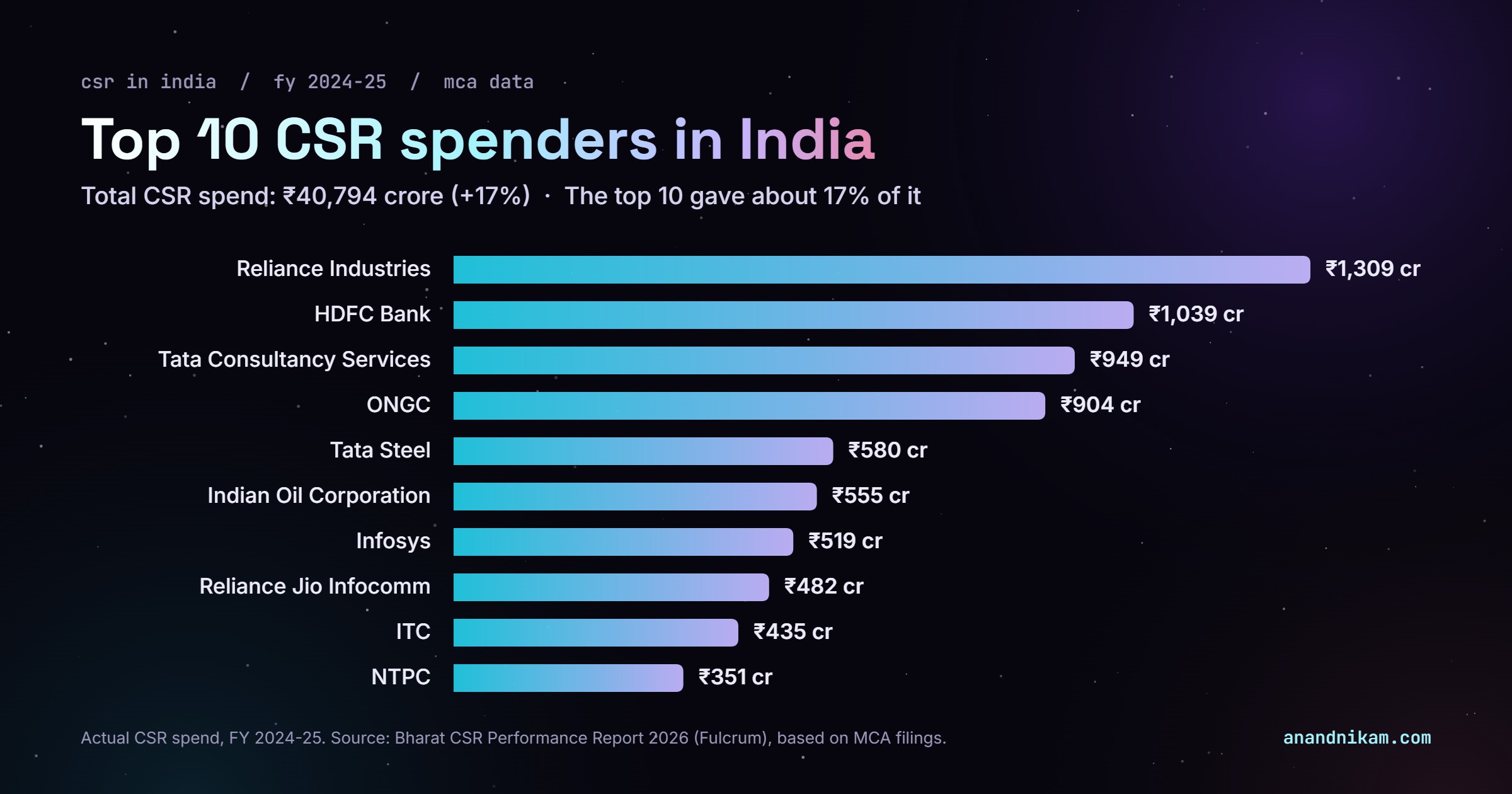
    Indian companies spent a record ₹40,794 crore on CSR in FY 2024-25. That is 17% more than the ₹34,909 crore spent a year earlier. So who are the top CSR spenders in India, and what does the data mean for an NGO or impact startup looking for a partner? Here is a plain reading of the latest numbers.

    The headline numbers

    The figures below come from the Bharat CSR Performance Report 2026 by research firm Fulcrum, which is based on Ministry of Corporate Affairs (MCA) filings.

    • Total CSR spend: ₹40,794 crore, up 17% year on year
    • Companies reporting CSR: 29,546, including 1,012 newly covered by the law
    • Projects: 72,233, up 21%
    • Total since FY 2014-15: more than ₹2.61 lakh crore

    In other words, CSR in India is no longer small change. It is a steady, legally required flow of money into social programmes every year.

    Top 10 CSR spenders in India, FY 2024-25

    RankCompanyActual spend (₹ crore)Prescribed obligation (₹ crore)
    1Reliance Industries1,3091,048
    2HDFC Bank1,0391,060
    3Tata Consultancy Services949953
    4ONGC904908
    5Tata Steel580580
    6Indian Oil Corporation555574
    7Infosys519540
    8Reliance Jio Infocomm482482
    9ITC435461
    10NTPC351383
    Top 10 total7,1236,989

    Together, these ten companies spent ₹7,123 crore, or about 17% of the national total. Reliance Industries spent ₹261 crore more than its prescribed amount. Three public sector companies (ONGC, Indian Oil and NTPC) made the list, contributing about a quarter of the top-10 total.

    Two cautions apply. First, a figure below the obligation is not automatically a breach. The law lets companies move eligible unspent money to an Unspent CSR Account or a government fund. Second, numbers differ by source. Some reports use group-level or foundation spending, so you may see higher figures for the same company. For example, another tally of NSE-listed companies puts HDFC Bank at ₹1,068 crore and TCS at ₹960 crore. Always check the company’s own annual report before you quote a number in a proposal.

    Where the money goes: sectors

    Education and healthcare still take more than half of all CSR money, according to the same national data.

    SectorFY 2024-25 (₹ crore)Share
    Education13,87734%
    Healthcare8,53121%
    Environmental sustainability3,3978%
    Livelihood enhancement2,5486%
    Rural development2,4776%

    The fastest mover is environmental sustainability, which grew 40% in one year. For climate, waste and clean-air projects, that is a useful signal.

    Where the money goes: states

    The top 10 states and union territories received 74% of all CSR spending, up from 61% a year earlier. Maharashtra led with ₹8,631 crore, followed by Gujarat (₹4,549 crore), Karnataka (₹3,395 crore), Delhi (₹2,753 crore) and Tamil Nadu (₹2,738 crore).

    However, part of that jump may be about how spending is recorded. An analysis of MCA’s Lok Sabha replies notes that spending tagged as “PAN India” fell from ₹7,066 crore to about ₹663 crore in a year. Some of it now shows up under individual states instead. So read state rankings with care.

    What this means for NGOs and impact startups

    1. Look beyond the top 10

    The ten biggest spenders get the most attention. Yet roughly ₹33,671 crore, about 83% of the total, came from the other 29,500-plus companies. They averaged about ₹1.14 crore each. Many of these mid-sized companies have no foundation of their own, so they need reliable implementing partners.

    2. Match the company’s footprint

    Section 135 asks companies to give preference to the local areas where they operate. Therefore, start with companies that have plants, offices or customers near your project.

    3. Fit a Schedule VII theme

    Your project must clearly sit under a Schedule VII activity, such as education, health, sanitation or environmental sustainability. A vague “general welfare” pitch is hard for a CSR committee to approve.

    4. Be compliance-ready before you pitch

    Implementing agencies need Form CSR-1 registration with the MCA, and generally 12A and 80G. In addition, companies with an average CSR obligation of ₹10 crore or more must commission impact assessments for projects of ₹1 crore or more. If you can show measurable outcomes, you make that job easier for them.

    5. Use public data to build your list

    The MCA’s National CSR Portal shows company-wise spending by state and sector. Company annual reports also list their CSR projects and partners. Together, they tell you who funds what, and where.

    A note on viral CSR charts

    CSR rankings are popular on social media, but many charts mix up companies, years and figures. Before you use any ranking in a proposal, verify it against MCA data or the company’s annual report. A wrong number in your first email can cost you credibility.

    Key takeaways

    • India’s CSR spending reached a record ₹40,794 crore in FY 2024-25, up 17%.
    • Reliance Industries, HDFC Bank and TCS were the top three spenders.
    • The top 10 companies gave about 17%; the rest came from more than 29,500 others.
    • Education and healthcare took 55%, while environmental sustainability grew fastest.
    • NGOs do best when they match a company’s location, Schedule VII theme and compliance needs.

    Frequently asked questions

    Who was the top CSR spender in India in FY 2024-25?

    Reliance Industries, with ₹1,309 crore, according to the Bharat CSR Performance Report 2026 based on MCA filings. HDFC Bank (₹1,039 crore) and TCS (₹949 crore) followed.

    How much did Indian companies spend on CSR in FY 2024-25?

    ₹40,794 crore in total, a 17% rise over FY 2023-24, across 72,233 projects.

    Which sector receives the most CSR money?

    Education, with ₹13,877 crore or 34% of the total. Healthcare is second at ₹8,531 crore.

    If you want a structured way to prepare your organisation, I cover the law, project positioning and the 10 red flags that get proposals rejected in my book, CSR Funding in India: The Essentials. It is an educational guide and does not guarantee funding. Which company would you approach first, and why?

    Sources:
    India CSR, 22 Jul 2026: CSR Spending: Top 10 Companies Invest ₹7,123 Cr (Bharat CSR Performance Report 2026, Fulcrum)
    India CSR, 18 Jul 2026: India’s CSR Spending Rises 17% to Rs. 40,794 Crore in FY 2024-25
    Asianet Newsable: CSR spending by NSE-listed firms jumps 23% to Rs 22,212 cr in FY25 (PrimeInfobase)
    Oquilia Data Audit: CSR PSU and private split, PAN India spending (Lok Sabha replies, 20 Jul 2026)
    Ministry of Corporate Affairs: National CSR Portal

  • Impact Funding Opportunities: 4 Open Calls (Dec–Jan)

    Impact Funding Opportunities: 4 Open Calls (Dec–Jan)

    Looking for impact funding opportunities that are open right now? I checked each of these four calls on the funder’s own website on 18 November 2026. They cover new NGO founders, schools, climate projects and experienced change leaders.

    Before you apply for impact funding opportunities

    Please note one thing first. Eligibility, amounts and deadlines are set by each funder, and they can change. Always confirm on the official page before you apply.

    1. Azim Premji Foundation Social Startups Programme

    This programme backs people who want to start a new civil society organisation in India. It suits you if you have field experience but have not yet registered an organisation.

    • Who can apply: Applicants up to 40 years (under 35 preferred) with a graduate degree and at least three years of full-time work in the development sector. You must not already run a registered organisation. You must intend to register a new one and relocate to one chosen geography: Bengaluru, Eastern Uttar Pradesh, Odisha or the Northeast.
    • What you get: An eight-month honorarium phase, then conversion to a two-year grant. Amounts: not published — check the official page.
    • Key dates: Applications close 31 December 2026. The page lists an in-person panel in December 2026 and the honorarium and grant phase from January 2027.
    • How to apply: Check the eligibility page, then fill the online form on the official programme site.

    2. Global Schools Prize 2027

    The Varkey Foundation runs this prize for schools that go beyond the usual to deliver quality education. Indian schools, both government and private, can take part.

    • Who can apply: Government-run and privately funded schools that teach students up to the age of 18, in every country, subject to local laws. A school can apply directly or be nominated.
    • What you get: Ten category winners receive US$50,000 each. One of them receives the overall prize of US$500,000 to scale its impact.
    • Key dates: Applications close 16 December 2026 (time not published — check the official page). The top 50 finalists are due in March 2027 and the winner in May 2027.
    • How to apply: Use the Apply or Nominate buttons on the official Global Schools Prize page.

    3. Keeling Curve Prize 2027

    Climate Curve runs this prize for climate projects. The official portal says a project must reduce, remove or replace greenhouse gases.

    • Who can apply: Projects that reduce, remove or replace greenhouse gases. Detailed criteria: listed on the funder’s eligibility page — check it before you start.
    • What you get: Prize amount: not published on the portal pages I checked — check the official page.
    • Key dates: Applications close 15 January 2027 at 11:59 PM IDLW (UTC-12), or earlier if the cap of 500 applications is reached.
    • How to apply: Request an account on the official Keeling Curve Prize portal, complete each tab, then press Submit. Saved drafts do not count.

    4. Atlantic Fellows for Social and Economic Equity

    This funded fellowship sits at the International Inequalities Institute of the London School of Economics. It suits experienced people who work on inequality.

    • Who can apply: People with at least seven years of experience who meet LSE English language rules. The residential track also needs you to qualify for the MSc in Inequalities and Social Science. Country rules: not published — check the official page.
    • What you get: A funded fellowship. Amount: not published — check the official page.
    • Key dates: The deadline is 11 January 2027, 5.00 pm UK time. Interview notices follow in mid-March 2027, and final decisions in mid-April 2027.
    • How to apply: Apply online through the LSE Graduate Application System with two referees. Start on the official AFSEE apply page.

    What to prepare for impact funding opportunities

    Most applications ask for similar basics. So getting them ready early saves stress near the deadline. For example, here is a simple checklist you can adapt to each call.

    • A one-page summary: the problem, who you serve, what you do and what changes because of it.
    • Evidence: a few clear numbers from your work, with dates and the method you used to count them.
    • Documents: registration papers, recent accounts and any compliance papers the funder lists.
    • People: short profiles of your team and two referees who know your work well.

    Also, keep these files in one folder. Then you can reuse and update them for every new call.

    How to choose impact funding opportunities

    Start with fit, not size, when you compare impact funding opportunities. A large prize you do not qualify for wastes weeks. So read the eligibility list first and tick each line honestly.

    Next, check your evidence. Most funders want proof of results, a clear budget and a simple theory of change. If you lack one of these, fix it before you write the application.

    Then plan backwards from the deadline. Give yourself time for references, documents and a final review. Also, note the time zone. A deadline in UK time or UTC-12 falls at a very different hour in India.

    Finally, keep a simple tracker of the impact funding opportunities you plan to apply for. For more on Indian CSR funding, my ebook CSR Funding in India: The Essentials is further reading. You can also find earlier funding round-ups on my blog.

    Disclaimer: This post is for information only. Eligibility, amounts and deadlines are set by each funder and may change. Please confirm every detail on the official page before you apply.

    Sources:
    Azim Premji Foundation Social Startups Programme
    Global Schools Prize, Varkey Foundation and eligibility and criteria
    Keeling Curve Prize application portal
    Atlantic Fellows for Social and Economic Equity, LSE: Apply

  • Zero Waste Report: 149 Billion Tonnes We Could Avoid

    Zero Waste Report: 149 Billion Tonnes We Could Avoid

    A new zero waste report released at COP31 puts a big number on a simple idea. If the world wastes less and uses materials better, it could avoid about 149 billion tonnes of greenhouse gas emissions by 2050. Here is what the report says, and what it could mean for India.

    What the zero waste report found

    On 16 November 2026, Circular Online reported on new research titled Our Zero Waste Future. Eunomia Research & Consulting and the Shape Foundation prepared it. They wrote it for the COP31 Climate High-Level Champion and the Zero Waste Foundation.

    The headline figure is 149 billion tonnes of CO2-equivalent avoided between 2025 and 2050. By 2050, the savings could reach 9.6 billion tonnes a year. However, these are potential savings. They depend on countries and companies actually putting the measures in place.

    The report splits the total into two parts. Better handling of municipal waste accounts for about 37 billion tonnes. Meanwhile, material efficiency in buildings, infrastructure and durable goods accounts for about 112 billion tonnes. In other words, most of the gain lies in how we design, build and use things, not only in the bin.

    Why the zero waste report matters

    First, it links waste to climate in hard numbers. Many climate plans focus on energy and transport. Waste and materials often get a small line at the end. This zero waste report argues they deserve far more attention.

    Second, it reminds us of a basic service gap. The report notes that 2.7 billion people still lack regular waste collection. It also estimates that 845 million tonnes of municipal waste were dumped, openly burned or lost to water in 2025. That harms health and the climate at the same time.

    Third, it sets clear goals for 2035. It asks the world to cut the projected growth in municipal waste by at least half. It also asks to lift circular material use from 6.9% to at least 15%. These targets give cities and companies something to measure against.

    Finally, it makes the idea personal. According to the Circular Online summary, wearing clothes twice as often could cut clothing emissions by around 44%. So small habits, repeated by millions, add up.

    What it means for India

    The report does not focus on India. Still, its message lands at a useful time for us. India’s Solid Waste Management Rules, 2026 came into effect on 1 April 2026. The Ministry of Environment notified them on 27 January 2026, replacing the 2016 rules, as a PIB release explains.

    The new rules ask every household to separate waste into four streams. These are wet waste, dry waste, sanitary waste and special care waste. They also bring Extended Bulk Waste Generator Responsibility, a central online portal to track waste, and environmental compensation based on the polluter pays principle.

    In practice, this is the foundation the report talks about. Clean, separated waste is far easier to compost, recycle or reuse. Mixed waste, on the other hand, often ends up dumped or burned. So the quality of segregation at our doorsteps decides how much value we can recover.

    Textiles offer another link. A government backgrounder says India manages about 7.8 million tonnes of textile waste each year. It adds that more than 70% of it is recovered. That is a strong base. Longer use, repair and resale could push it further, in line with the report’s clothing point.

    For NGOs, startups and CSR teams, the report also hints at where support may flow. Projects that improve collection, segregation and reuse fit the global goals. They also fit India’s new rules. If you work in this space, you can read more on my blog or about my work on the about page.

    What you can do this month

    Big global reports can feel far away from daily life. Still, the first steps are small, local and within our control. Here are a few practical ideas that match both the report and the new rules.

    • At home: Keep four separate bins and agree on what goes where. Start with wet and dry, then add the other two.
    • In your housing society: Ask how your waste is collected and where it goes. A short meeting can fix many mix-ups.
    • At work: Check how much your office buys, uses once and throws away. Repair, reuse and shared items often cost less.
    • For NGOs and CSR teams: Measure simple things first, such as households covered and waste kept out of dumps. Clear data makes a project easier to support.

    None of this needs new technology. It needs habits, a little planning and steady follow-up.

    Limits and open questions

    The numbers are estimates, not promises. They assume strong action across many countries over 25 years. Moreover, the biggest share depends on buildings and durable goods, where change is slow and costly. We should treat 149 billion tonnes as a ceiling of what is possible, not a forecast.

    Key takeaways

    • The zero waste report estimates 149 billion tonnes of emissions could be avoided by 2050.
    • About 112 billion tonnes of that comes from using materials better, not only from waste.
    • India’s SWM Rules, 2026 already require four-stream segregation at source.
    • Good segregation, repair and reuse turn global targets into local action.

    What is one waste habit your city or team could change this year? I would love to hear your ideas.

    Sources:
    Circular Online, 16 Nov 2026: Zero waste measures could avoid 149 billion tonnes of emissions by 2050
    Eunomia Research & Consulting and Shape Foundation, Our Zero Waste Future (Nov 2026)
    PIB, MoEFCC: Solid Waste Management Rules, 2026 (30 Mar 2026)
    PIB Backgrounder: Weaving Sustainability into India’s Textile Future (12 Jul 2026)