Tag: Solar Energy

  • Solar Cold Storage: What a Pulwama Farm Group Shows

    Solar Cold Storage: What a Pulwama Farm Group Shows

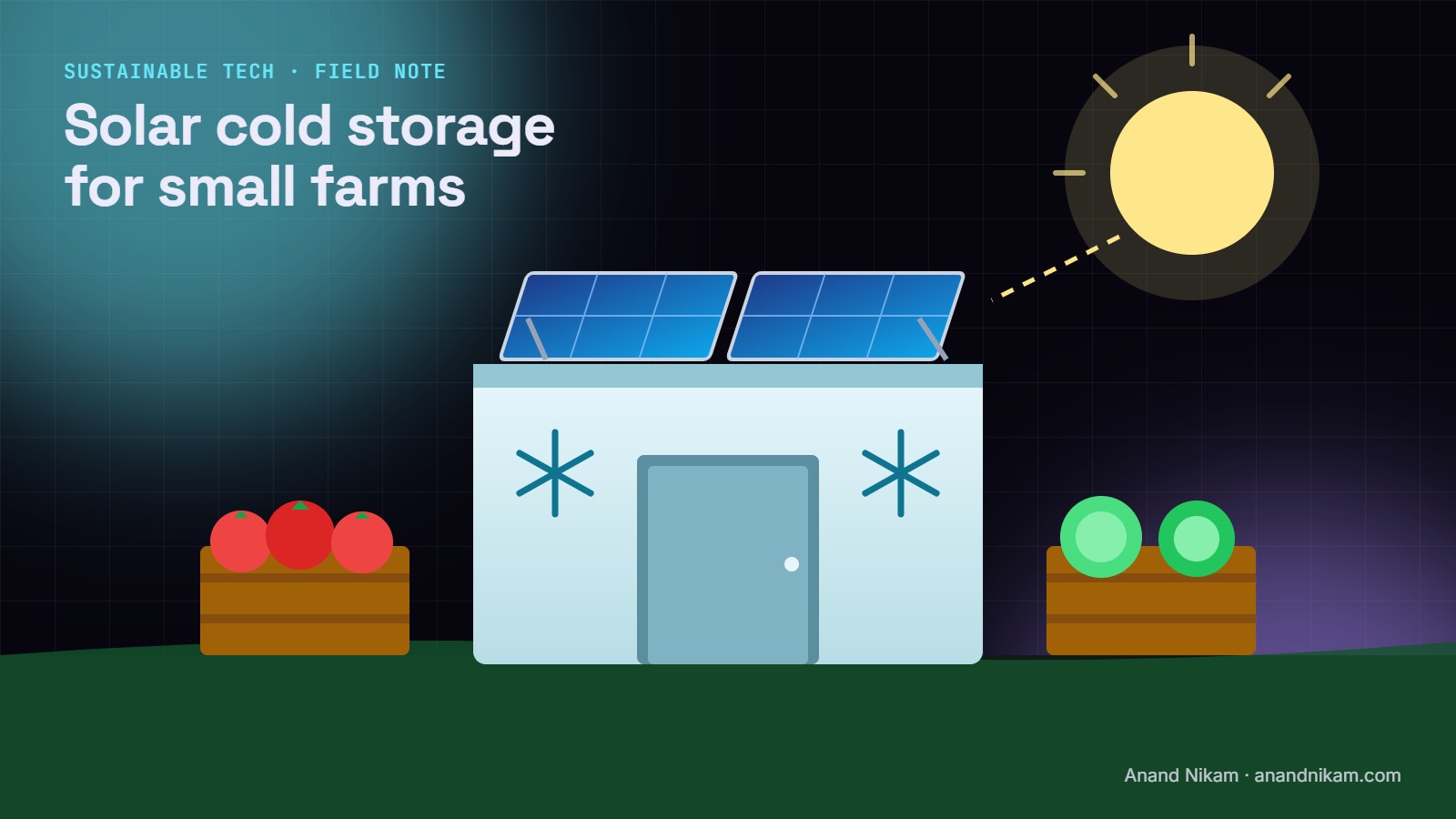
    Solar cold storage is now reaching small farms in India, and a new unit in south Kashmir shows why it matters. A farmer in Pulwama has set up a 10-tonne mini cold store that runs on solar power. As a result, 30 growers can now hold their vegetables until prices improve.

    This post explains what the unit is, how solar cold storage works, and why it matters for India. It also looks at the limits, because one unit is a start, not a solution.

    What it is: a 10-tonne solar cold storage unit in Pulwama

    Farooq Ahmad lives in the Tahab area of Pulwama district. According to a KNO report published by Kashmir Thunder on 7 November 2026, he turned his orchard land back into vegetable fields. He also brought 29 other farmers into a Farmers Interest Group (FIG).

    The key step is a 10-metric-tonne mini cold storage unit on his farm. An organic foundation provided it free of cost, says the report. It runs on solar energy, and locals call it the first such facility in the area.

    The idea is simple. Instead of selling the whole harvest on the day it is picked, group members can store it. Then they can release it when demand and prices are better, especially in the off-season.

    How solar cold storage works

    The report does not give the technical design of this unit. So here is how such systems work in general. Solar panels on or near the store make electricity during the day. That power runs a cooling unit, much like a large fridge.

    The sun does not shine at night, of course. For this reason, most designs store the cold, not just the power. Some use batteries. Others use thermal storage, such as ice or a special liquid that freezes during the day and keeps the room cool after sunset. Thick insulation helps the room hold its temperature.

    Small units like this one sit close to the field. That matters. Fresh vegetables start to lose quality soon after harvest. Therefore, a cold room a few steps away is worth more than a big one far away on a highway.

    Why it matters for India

    India loses a real share of its food after harvest. A study commissioned by the Ministry of Food Processing Industries and done by NABCONS (2022) measured these losses. As PIB reported in August 2024, losses ranged from 4.87% to 11.61% for vegetables. For fruits, the range was 6.02% to 15.05%.

    Some crops lose even more. The same table shows an average loss of 11.61% for tomato and 8.15% for cabbage. In contrast, milk showed a loss of just 0.87%, partly because the dairy sector has a strong cold chain.

    Price is the other side of the story. When every farmer sells on the same day, prices fall. Farooq said the unit will help growers supply markets “when demand and prices are favourable.” In short, storage gives a small farmer time, and time gives bargaining power.

    Solar power adds a third benefit. Many villages face power cuts, and diesel generators are costly and polluting. A solar cold store can run where the grid is weak. It also avoids the fuel bill that often makes small cold rooms hard to run.

    Government support already exists for cold chains. For example, the Mission for Integrated Development of Horticulture offers a credit-linked subsidy of 35% of project cost in general areas. In hilly and scheduled areas, the rate is 50%, according to the same PIB release. The Agriculture Infrastructure Fund also offers loans for post-harvest projects.

    Limits and open questions

    We should be honest about what we do not know. The report gives no figures for cost, power use, or how many days the produce stays fresh. It also does not say which foundation supplied the unit, or who will pay for repairs.

    Maintenance is the big test. Panels need cleaning, batteries wear out, and cooling parts fail. Many rural assets stop working because nobody owns the repair plan. A group of 30 farmers will need clear rules on who uses how much space, and how they share the costs.

    Storage alone also does not fix markets. Farmers still need transport, buyers, and fair price information. Kashmir’s winters bring their own challenge, since cold weather changes how much cooling a store needs. Finally, a single unit is a pilot. We will only know its value after a full season of real use.

    Key takeaways on solar cold storage

    • A 10-tonne solar cold storage unit now serves a 30-member farmer group in Pulwama, J&K.
    • The aim is to let growers hold produce and sell when prices are better.
    • Official data shows vegetable losses of 4.87% to 11.61% after harvest in India.
    • Existing schemes offer 35% to 50% subsidy support for cold storage.
    • Repair plans, fair sharing rules and market links will decide if it lasts.

    I write about practical sustainability ideas like this every week. You can read more on my blog, or check your own habits with the free SQ Test.

    Sources:
  • Solar-Powered Desalination: BITS Hyderabad’s Dual System

    Solar-Powered Desalination: BITS Hyderabad’s Dual System

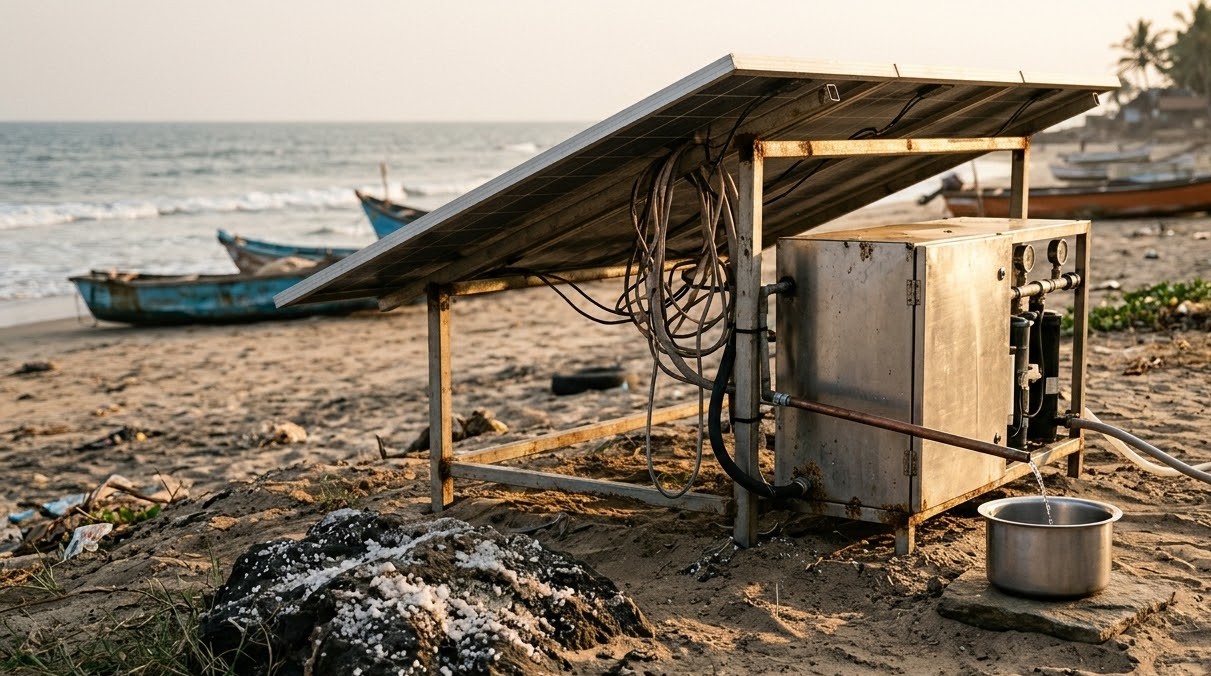
    Solar-powered desalination usually brings to mind big coastal plants. A team at BITS Pilani’s Hyderabad campus is testing something much smaller. Their unit turns salty water into drinking water and gives out cool air at the same time.

    The team holds an Indian patent for the design. It is still a lab prototype, not a product. Still, the idea speaks to two problems many coastal and island homes face together: scarce fresh water and rising heat.

    What it is

    According to Telangana Today, the system holds Indian Patent No. 558052. The patent covers a portable apparatus that desalinates water and cools a space at once. Prof Sandip S Deshmukh and Prof Santanu Prasad Datta of the mechanical engineering department lead the work. Research scholar K Sai Sandeep has worked on the later research and the prototype.

    The team built and tested the prototype on the Hyderabad campus across different seasons. Deccan Chronicle reports that the results appeared in the journal Applied Thermal Engineering in 2026.

    How solar-powered desalination works here

    The method is called humidification-dehumidification. Think of how a cold glass “sweats” on a humid day. The unit copies that effect on purpose.

    • First, air passes through a humidifier and picks up moisture from salty or brackish water.
    • Next, the system cools this moist air, so the vapour condenses into fresh water.
    • As a result, the salt stays behind, because only water vapour travels with the air.
    • Finally, the cool, dry air that leaves the unit can cool a room or a small store.

    The design also combines refrigeration and thermal energy storage in one box. On top of that, solar energy runs the whole process. That makes the unit a good fit for places with strong sun and weak grid supply.

    What the lab tests show

    The reported numbers are promising, but they come from lab conditions. Here is what the two news reports say:

    • Water: up to about 12.4 litres an hour in a double-stage setup with water heating, under high-humidity conditions.
    • Cooling: a capacity of up to 6.57 kW, with outlet air as cold as 14°C.
    • Cost: the lowest estimate during the experiments was around 30 paise a litre.
    • Design goal: roughly 200 litres of fresh water a day.

    Deccan Chronicle also describes one proposed use. A single unit could supply about 200 litres a day and keep around 50 kg of seafood cool, serving 10 families. That is a design idea, not a field result.

    Why it matters for India

    India has a long coastline and many island communities. Many villages also draw brackish groundwater. In such places, safe drinking water and cold storage are often separate struggles. Today, families buy water. Meanwhile, fishers lose catch to heat. Small clinics need both water and cooling.

    A single unit that does both jobs could cut the number of machines a village must buy and maintain. Besides, it could run where diesel is costly or the grid is unreliable. The researchers name island communities, rural settlements with brackish groundwater, small food stores and field hospitals as possible users.

    There is a wider lesson too. Climate adaptation does not always need a mega project. Sometimes it needs a small, well-designed box that a community can own and repair. In my own work on clean technology, I see that the last mile decides whether an idea helps anyone. You can read more about that work on my about page.

    Limits of solar-powered desalination today

    We should read these results with care. The researchers themselves say that output changed with the setup and the weather. For example, the 12.4 litres an hour figure needed favourable high humidity. Similarly, the 30 paise figure was the lowest estimate, and real costs will depend on location, energy needs, installation and upkeep.

    So several questions remain open. How will the unit perform in dry, hot months? What happens to the leftover brine? Who will service it in a remote village? And what will a unit cost to build at scale? The team plans field trials and wants to adapt the design to different climates. Those trials will tell us far more than lab numbers can.

    What NGOs and local bodies can do now

    You do not need to wait for a finished product to prepare. If you work with coastal or island communities, start by mapping the need. How much water does a household buy each week? What does it cost? How much catch or produce spoils for lack of cooling?

    Also, that baseline data helps in two ways. It shows whether a solar-powered desalination unit would really help. It also makes your case stronger when you approach researchers for a pilot, or a company for CSR support. Good data turns a hopeful idea into a fundable project.

    Key takeaways

    • A BITS Pilani Hyderabad team has patented a small unit that makes fresh water and cool air from sunlight.
    • It uses humidification-dehumidification, plus refrigeration and thermal storage, in one system.
    • Lab tests reported up to 12.4 litres an hour and up to 6.57 kW of cooling, under favourable conditions.
    • It is still a prototype, so field trials will decide its real value.

    I will keep tracking how this solar-powered desalination work moves from lab to village. For more stories like this, visit the blog.

    Sources