Tag: Research Funding

  • Small Grants: 4 Open Calls for Indian Changemakers

    Small Grants: 4 Open Calls for Indian Changemakers

    Small grants can help a young idea take its first real step. This week I found four small grants that Indian researchers, founders and grassroots groups can apply for. Each one comes with its own rules and dates, so please check the official page before you start.

    Ignite Field Research Enabling Grant: small grants for field biology

    The Ignite Life Science Foundation runs this call. It is also called the Ignite Ancillary Grant for Field Biology. It covers the practical gaps that often slow field work in India.

    • Who can apply: Researchers in ecology, evolution, conservation, natural history or related fields. You must work at a recognised national, state or private institute or university in India. You also need an existing field project that needs support.
    • What you get: Up to Rs 2 lakh a year for one to two years. Overheads can be at most 10%. The money can cover field staff, local travel, stay, equipment, consumables and community work.
    • Key dates: The deadline is 13 December 2026. The foundation has not published a closing time, so submit early. Info sessions: not published — check the official page.
    • How to apply: Register on the Ignite grant portal and submit from your dashboard. You will need a short proposal, details of existing funding and a budget with reasons. Read the official call document.

    D-Prize Challenge: seed money to launch a proven idea

    D-Prize funds new ventures that take a proven anti-poverty idea to more people. Its list includes water filters, reading glasses, childcare and treatment for child diarrhoea. You can also propose your own idea if evidence backs it.

    • Who can apply: Founders anywhere in the world, including India. Winners must live and work in the country where they run the venture. It mainly suits new organisations. Ventures with more than 18 months of full-time work, or more than USD 30,000 raised, usually do not qualify.
    • What you get: Up to USD 20,000 to launch.
    • Key dates: The extension deadline is 6 December 2026, midnight Pacific Time. You must register in advance for this round. The earlier rounds have closed.
    • How to apply: Round 1 needs a two-page concept note and CVs. Top entries then answer written questions, and finalists have an interview. Start at the D-Prize website.

    Allianz MoveNow Social Innovation Challenge 2026

    Allianz runs this challenge with Social Shifters. It backs youth-led ventures in three areas. These are money confidence in the digital economy, fair health systems, and climate resilience led by communities.

    • Who can apply: The founder or main leader must be 18 to 30 years old. Young people must hold at least 51% of the venture and lead its decisions. Ventures do not need to register. Registered ones must be no more than five years old. India is eligible, and entry is free.
    • What you get: A total pool of USD 90,000. Each area has one USD 10,000 award and four USD 5,000 awards. Finalists also get a business mentor from Allianz.
    • Key dates: Entries close on 18 December 2026 at 5:00 pm UTC, which is 10:30 pm IST. The organisers say they will not extend it.
    • How to apply: Submit one project in English on the official platform. If you use AI tools, you must say so. Read the full rules on the official challenge page.

    The Pollination Project Seed Grants

    The Pollination Project gives seed grants to people doing good work with their own time. It has no narrow theme. However, it does not fund political campaigns, single-use plastics or animal agriculture.

    • Who can apply: Individuals, informal groups and small nonprofits anywhere in the world. Volunteers must lead the project, with no paid staff, and it must already be running. You must be a first-time grantee. The total project budget must be under USD 10,000, or the group’s budget under USD 50,000. International applicants need a referee.
    • What you get: Amount not published — check the official page.
    • Key dates: Applications are rolling. The 2026 window closes on 30 November at 11:59 pm US Eastern time. It reopens on 1 January 2027. Decisions take about 6 to 12 weeks.
    • How to apply: Fill the online form in English. Payment comes by wire or PayPal in US dollars. See the official apply page.

    How to choose the right call among these small grants

    Not every call fits every team. So start with three plain questions.

    First, are you eligible on paper? Check age, location, registration and stage. For example, D-Prize wants new ventures, while Ignite needs a live research project.

    Second, can you meet the date with a good draft? A rushed form rarely does justice to good work. If 6 December feels too close, plan for a later round instead.

    Third, does the money match the need? A small grant can pay for one clear next step. It will not cover a full programme, so name that one step in your budget.

    Also, keep a simple folder ready. Put your one-page summary, budget, registration papers and two short impact stories in it. Then each new call takes hours, not days.

    For help with CSR proposals, my book page on CSR funding in India has more reading. You can also find past funding roundups on my blog.

    Please note: each funder sets its own eligibility, amounts and deadlines, and these can change. Always confirm every detail on the official page before you apply.

    Which of these calls fits your work best?

    Sources:
  • Grant Deadlines: 3 Calls Open to Indian Applicants

    Grant Deadlines: 3 Calls Open to Indian Applicants

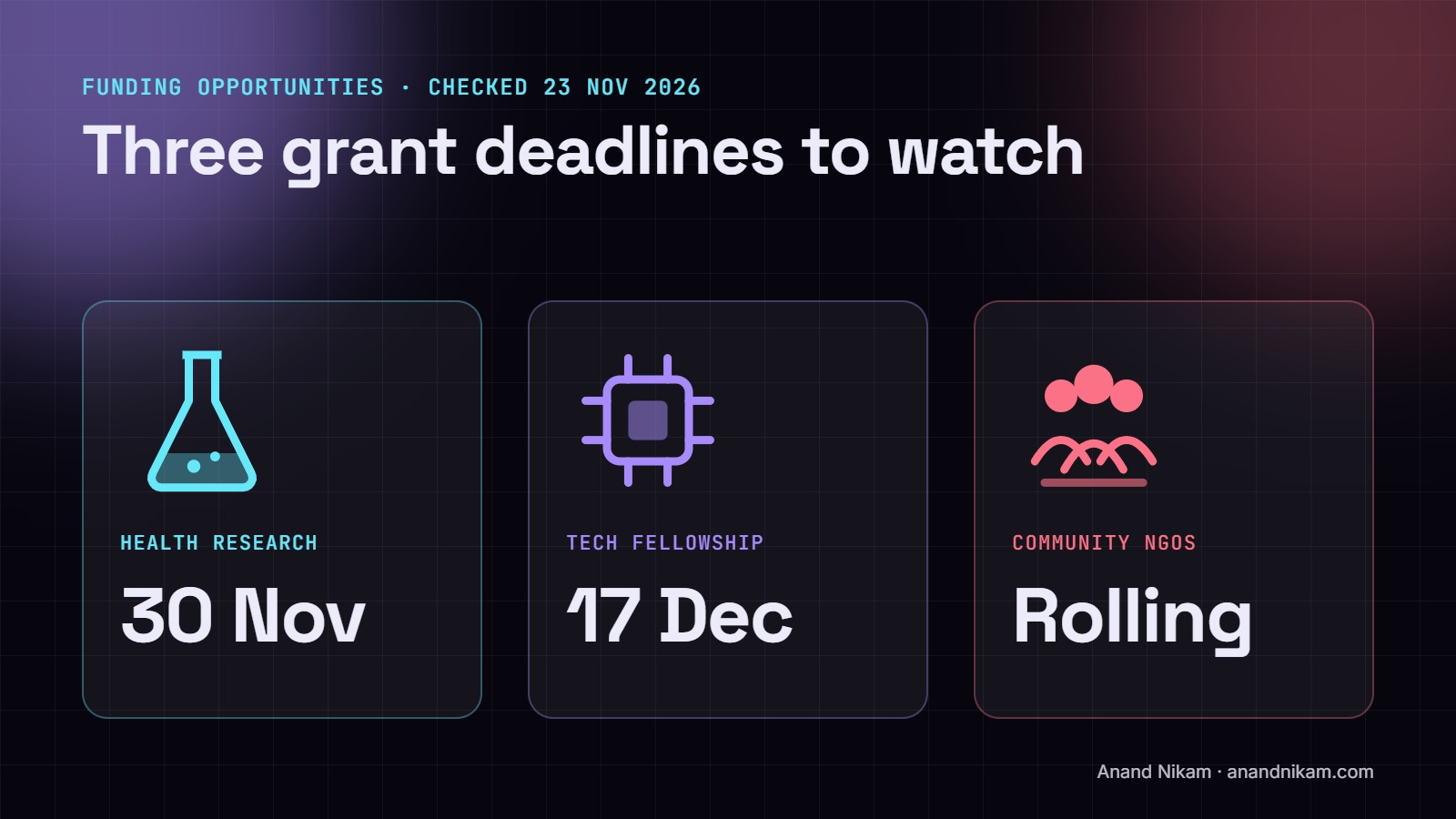
    Grant deadlines can slip past quietly, so here are three live calls worth a look this week. One closes on 30 November, one in mid-December, and one stays open all year. I checked each detail on the funder’s own page on 23 November 2026.

    Please note one thing first. Each funder sets its own rules and dates, and they can change. So always confirm on the official page before you apply.

    1. ICMR First in the World Challenge Grants (2026)

    The Indian Council of Medical Research funds “high risk, high reward” health research here. The goal is a first-of-its-kind vaccine, drug, diagnostic or intervention. Small, step-by-step gains do not qualify.

    • Who can apply: scientists at government medical colleges, universities, ICMR institutes and recognised R&D labs. DSIR-registered private institutions and NGOs can apply too, and NGOs must also be on NITI Aayog’s NGO DARPAN portal. Indian startups, MSMEs and industry are also eligible. Each proposal needs one PI and at least one Co-PI from the same institute.
    • What you get: up to Rs 1 crore for proof of concept (up to 2 years), up to Rs 4 crore for a prototype (up to 3 years), or up to Rs 8 crore for a final product (up to 4 years). Funding is released in stages, linked to deliverables.
    • Key dates: last date 30 November 2026, 5:30 PM. Results are expected on 31 December 2026, as per the call.
    • How to apply: only through ICMR’s e-PMS portal. Choose “First in the World Challenge, ICMR” under Proposal Submission. Official call page.

    With only a week left, this call suits teams that already have strong early data. ICMR also advises applicants to submit well before the last date.

    2. Mozilla Foundation Fellowship 2027–2028

    Mozilla Foundation will award 10 Fellowships for 2027–28. It backs individuals who build technology that serves people, from open AI tools to community-owned infrastructure. Focus areas include energy and compute, sovereign AI, and security tools for small organisations.

    • Who can apply: individuals only, not teams. Projects should be mainly technical, except for one Creative Advocacy spot. Selected Fellows must be able to receive funds from a US-based 501(c)(3) organisation, so read Mozilla’s eligibility guidelines.
    • What you get: Embedded Fellows receive USD 100,000 in total. Independent Fellows receive USD 125,000 in total. Both include a USD 25,000 project budget, and the Fellowship runs for 12 months from 1 June 2027.
    • Key dates: Letter of Intent due 17 December 2026, 11:59 PM Pacific (UTC-8). Shortlisted applicants hear on 16 February 2027. Full applications are due 12 March 2027.
    • How to apply: submit a Letter of Intent online. Official call page.

    Mozilla says it will not accept late entries. Also, the Letter of Intent is the main review stage, so treat it with care.

    3. Paul Hamlyn Foundation India Fund

    This UK foundation funds small Indian NGOs that work with the most vulnerable communities. It supports community-led work with groups such as tribal and Dalit communities, disabled people, women and families in extreme poverty.

    • Who can apply: local Indian NGOs with FCRA registration. The Fund does not accept prior permission. Work must be in its priority states, such as Madhya Pradesh, Chhattisgarh, Odisha, Jharkhand, Bihar and the North East, or regions like Vidarbha and Bundelkhand. Micro-level partners usually have an annual outlay under Rs 1.5 crore.
    • What you get: Rs 10 lakh to Rs 40 lakh for 1 to 2 years.
    • Key dates: rolling, with no call for proposals. Applications are assessed twice a year, in March and October.
    • How to apply: apply directly through the online portal, not through consultants. Official fund page.

    Because review happens in March, an application sent in the coming weeks has time to be ready for that round. Even so, the exact cut-off date for each round is not published — check the official page.

    How to choose the right call before grant deadlines

    Start with fit, not size. A large grant you do not qualify for wastes weeks. First, check the basics: legal status, FCRA, geography and age limits. Next, match your stage to the call. ICMR wants a clear technical leap, while Paul Hamlyn wants deep community work.

    Keep one simple tracker for grant deadlines. List the call, the last date, the time zone and the documents it needs. Then mark a personal cut-off three days earlier. Portals slow down near the last day, and late entries are rarely accepted.

    Then work back from each date. Block time for documents, budgets and sign-offs, since these often take longer than the writing. Finally, read the funder’s exclusions list. It saves more time than any template.

    Beyond grant deadlines: CSR funding

    If you are also preparing for Indian CSR funding, my guide CSR Funding in India: The Essentials covers the basics. You can find more posts on my blog.

    Disclaimer: Eligibility, amounts and deadlines are set by each funder and may change. Please confirm every detail on the official page before you apply. This post is for information only.

    Sources:

  • Social Impact Grants: 4 Calls Open to India

    Social Impact Grants: 4 Calls Open to India

    Looking for social impact grants that are still open? This week I checked four calls on their official pages. Two are research grants with an India focus, one is a global prize for young tech leaders, and one is a rolling grant for conservation. Eligibility and deadlines are set by each funder, so please confirm every detail on the official page before you apply.

    1. UTIF Research Catalyst Grants 2027–28

    The University of Toronto India Foundation and the School of Cities fund research on Indian cities. Topics include air quality, housing, water and sanitation, energy, mobility, waste and urban planning. Social science and humanities work is also welcome. Projects run from April 2027 to March 2028.

    • Who can apply: A pair of co-principal investigators. One must work for a not-for-profit Indian partner, such as a university, research centre, NGO, foundation or government body. The other must be from the University of Toronto. For-profit companies cannot apply.
    • What you get: INR 9–15 lakh per grant, with 8–10 grants planned. Admin costs are capped at 7% and equipment at 5%.
    • Key dates: Deadline 15 February 2027, 11:59 PM IST. The information webinar already took place on 27 October 2026.
    • How to apply: Find a University of Toronto co-PI first. Then download the proposal template and budget sheet, and submit through the form linked on the official UTIF call page.

    2. India–EU call on extreme climate events

    The Ministry of Earth Sciences (MoES) co-funds Indian partners in a Horizon Europe research call. The topic is understanding, modelling and predicting extreme events in a changing climate. Its EU code is HORIZON-CL5-2027-01-D1-07.

    • Who can apply: Indian academic and research institutions, private R&D bodies with at least three years of experience, and NGOs, trusts or foundations whose core mandate is research. Industry, start-ups and foreign-owned entities are not eligible. Indian teams join an EU consortium of at least three entities from three countries.
    • What you get: MoES covers 100% of approved costs for Indian partners, up to Rs 2 crore per project over three to four years. Overheads are capped at 10%.
    • Key dates: The call opened on 17 November 2026. The EU portal deadline is 4 March 2027, 17:00 CET. Indian partners must then send their documents to MoES within seven working days.
    • How to apply: Each partner registers on the EU Funding and Tenders Portal. Next, the EU coordinator submits the proposal. Finally, the Indian lead sends one consolidated PDF and a rupee budget to MoES, as the MoES call document explains. The deadline for the hard copy is not published — check the official page.

    3. Global Citizen Prize: 2027 Cisco Youth Leadership Award

    Global Citizen and Cisco reward young people who use technology to help end extreme poverty. This is a prize for individuals who already run an organisation.

    • Who can apply: People aged 18 to 35 by 31 December 2026, from any country except those under US OFAC sanctions. So Indian applicants qualify. You need a registered legal entity, such as a non-profit, for-profit or social enterprise. Only self-applications count; nominations are not accepted.
    • What you get: Three prizes of USD 250,000 each. That is USD 225,000 unrestricted plus USD 25,000 in Cisco products. Winners report every quarter for three years.
    • Key dates: Deadline 18 December 2026, 5 PM US Eastern Time. Finalists hear back around 8 February 2027. Information sessions are not published — check the official page.
    • How to apply: Create an account on the application portal. Then complete four sections, including a short pitch video and your organisation documents. Start from the official award page.

    4. Rufford Small Grants for Nature Conservation

    The Rufford Foundation funds early-career conservationists. Projects must focus on nature conservation and take place in an eligible country. India is on that list.

    • Who can apply: Early-career conservationists, mainly current master’s or PhD students and recent graduates. Undergraduates are not funded.
    • What you get: Grants of £7,000 to £18,000, in staged tiers. You can move from a first grant to a second grant, and then to Booster and Completion grants.
    • Key dates: There is no deadline, as applications are open all year. If you are unsuccessful, you can reapply after 12 months.
    • How to apply: Read the criteria, check the eligibility list, then create an account and fill in the online form on the Rufford application site.

    How to choose social impact grants that fit

    Four calls can feel like a lot. So start with fit, not size. A Rs 2 crore research grant is no use if your NGO does not do research. Similarly, a youth prize is no use if you are 36.

    Here is a quick filter I use:

    • Mission fit: Does the call fund what you already do well?
    • Eligibility: Do you meet every rule, including age, legal status and partners?
    • Capacity: Can you finish the application well before the deadline?
    • Reporting: Can you handle the reports the funder asks for later?

    Also, look at the effort-to-reward ratio. The Rufford grant has no deadline, so you can apply when you are ready. The Global Citizen award, on the other hand, closes in less than a month. If you want it, start today.

    What to prepare for social impact grants

    Most social impact grants ask for the same basics. Therefore, it pays to keep them ready in one folder:

    • Your legal registration and governance documents
    • A one-page summary of the problem you solve
    • Budget templates in INR and in one foreign currency
    • Two or three short case studies with real, verified numbers
    • CVs of your core team

    For CSR funding in India, the logic is similar, but the rules differ. If that is your next step, my guide CSR Funding in India: The Essentials explains how it works. You can also browse more calls in the blog.

    Disclaimer: I am not linked to any funder listed here. Eligibility, amounts and deadlines are set by each funder and may change, so always confirm on the official page before you apply.

    Sources: