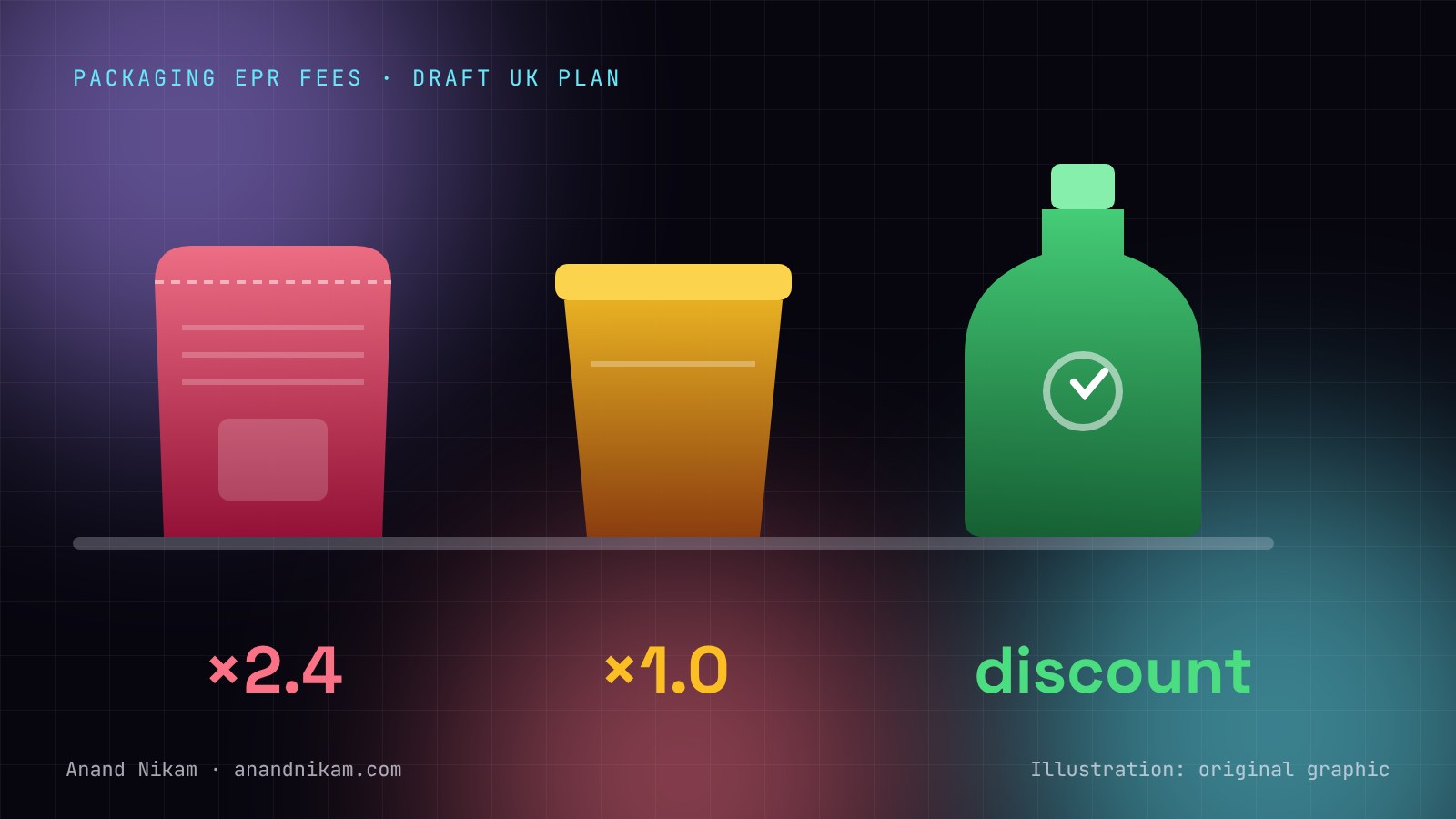
Packaging EPR fees in the UK may soon rise faster for packs that are hard to recycle. PackUK, the body that runs the UK scheme, has put out a draft plan. In short, the worst-rated packaging would pay about double the base fee from 2027-28.
What happened
On 20 November 2026, Circular Online reported a draft policy from PackUK. It changes how quickly packaging EPR fees climb for the least recyclable packs. EPR stands for Extended Producer Responsibility. Under EPR, the companies that put packaging on the market pay for what happens to it as waste.
The UK rates each pack red, amber or green. It uses a tool called the Recyclability Assessment Methodology, or RAM. Green packs are the easiest to recycle, and red packs are the hardest. Amber packs pay the base fee for their material.
Here is the core change. For red-rated household packaging, the fee is a multiple of the amber base fee:
- 2026-27: 1.2 times the base fee, the same as before.
- 2027-28: 2.0 times under the draft, up from 1.6 in the current timetable.
- 2028-29: 2.4 times under the draft, up from 2.0.
Importantly, the plan does not raise the total amount collected. Instead, the extra money from red packs funds bigger discounts for green packs. So a brand that switches to a better pack pays less. Meanwhile, a brand that keeps a poor pack pays more.
The draft also treats some medical packaging differently from 2028-29. For example, packaging that touches medicines or medical devices would pay the amber base fee, even with a red rating. In addition, PackUK plans a call for evidence in early 2027 on the future of fee changes. These are still proposals, and nothing is final yet.
Not everyone agrees. The Alliance for Fibre-Based Packaging criticised the faster timetable. Its co-chairs said ministers should work with industry on “a stable, evidence-based approach”, as Circular Online reported. They also warned that frequent changes make business planning harder.
Why packaging EPR fees matter
At first glance, this looks like a dry fee table. However, it shows how a circular economy policy can steer design choices with money. Packaging EPR fees work best when they reward good design and penalise poor design. A flat fee does neither.
There are three lessons here. First, the signal must be large enough to matter. A small gap between red and green fees rarely changes a packaging decision. A fee that doubles gets the attention of finance teams, not only sustainability teams.
Second, the signal must be fair. Because the plan keeps the total collected the same, it is a shift, not a new tax. As a result, producers who invest in better packs gain directly.
Third, the signal must be predictable. This is where the critics have a point. Businesses plan packaging changes years ahead. When fee timetables move, some firms may wait rather than act. Good EPR design balances ambition with stability.
What packaging EPR fees could mean for India
India already has EPR for plastic packaging. The guidelines came into force in February 2022 under the Plastic Waste Management Rules, 2016. That is according to a 2022 government reply in the Lok Sabha shared by PIB. They group plastic packaging into four categories:
- Rigid plastic packaging sits in Category I.
- Flexible packaging, including carry bags, sachets and pouches, is Category II.
- Multilayered packaging with at least one non-plastic layer forms Category III.
- Compostable plastic sheets and carry bags make up Category IV.
The same release lists rising recycling targets. For rigid packaging, the share rises from 50% in 2024-25 to 80% from 2027-28 onwards. For flexible and multilayered packaging, it rises from 30% to 60% over the same years. Producers who miss their targets pay environmental compensation, based on the polluter pays principle.
So India’s system sets targets and penalties. What it can learn from the UK plan is the idea of linking cost to recyclability. Multilayered sachets are among the hardest packs to recycle in India. A design-based fee signal could push brands towards simpler, single-material packs.
Of course, India’s context is different. Our recycling depends heavily on informal waste pickers and small recyclers. Any fee change must protect their income and fit how waste actually moves here. Also, India would need reliable data on which packs recyclers truly process, not just collect. Without that data, ratings can become a paper exercise.
For brands, the practical step is simple. Start mapping your packs by how easy they are to recycle today. Then ask which packs would cost you more if fees ever followed design. For NGOs and recyclers, this is a chance to share field evidence on what really gets recycled.
Key takeaways
- PackUK’s draft would make the worst-rated packs pay 2 times the base fee in 2027-28 and 2.4 times in 2028-29.
- The total collected stays the same, so green packs get bigger discounts.
- Critics warn that changing timetables can hurt business planning.
- India’s plastic EPR already sets recycling targets, and design-linked packaging EPR fees could be a useful next idea to study.
- Good EPR needs a strong, fair and stable signal, backed by honest data.
If you want to check where your own habits stand on waste, try my free SQ Test. You can also read more posts on the blog.
Sources: