Tag: NGO Funding

  • International Grants for NGOs: 4 Calls Open Now

    International Grants for NGOs: 4 Calls Open Now

    Indian applicants can apply for these international grants for NGOs right now. I checked each one on the funder’s own website on 26 November 2026. Three close within days, so read the dates first. The fourth opens on 1 January 2027 and gives you time to prepare.

    Before you apply for international grants for NGOs

    Please note one thing before you start. The funder sets the eligibility rules and deadlines, and they can change. Always confirm every detail on the official page before you apply.

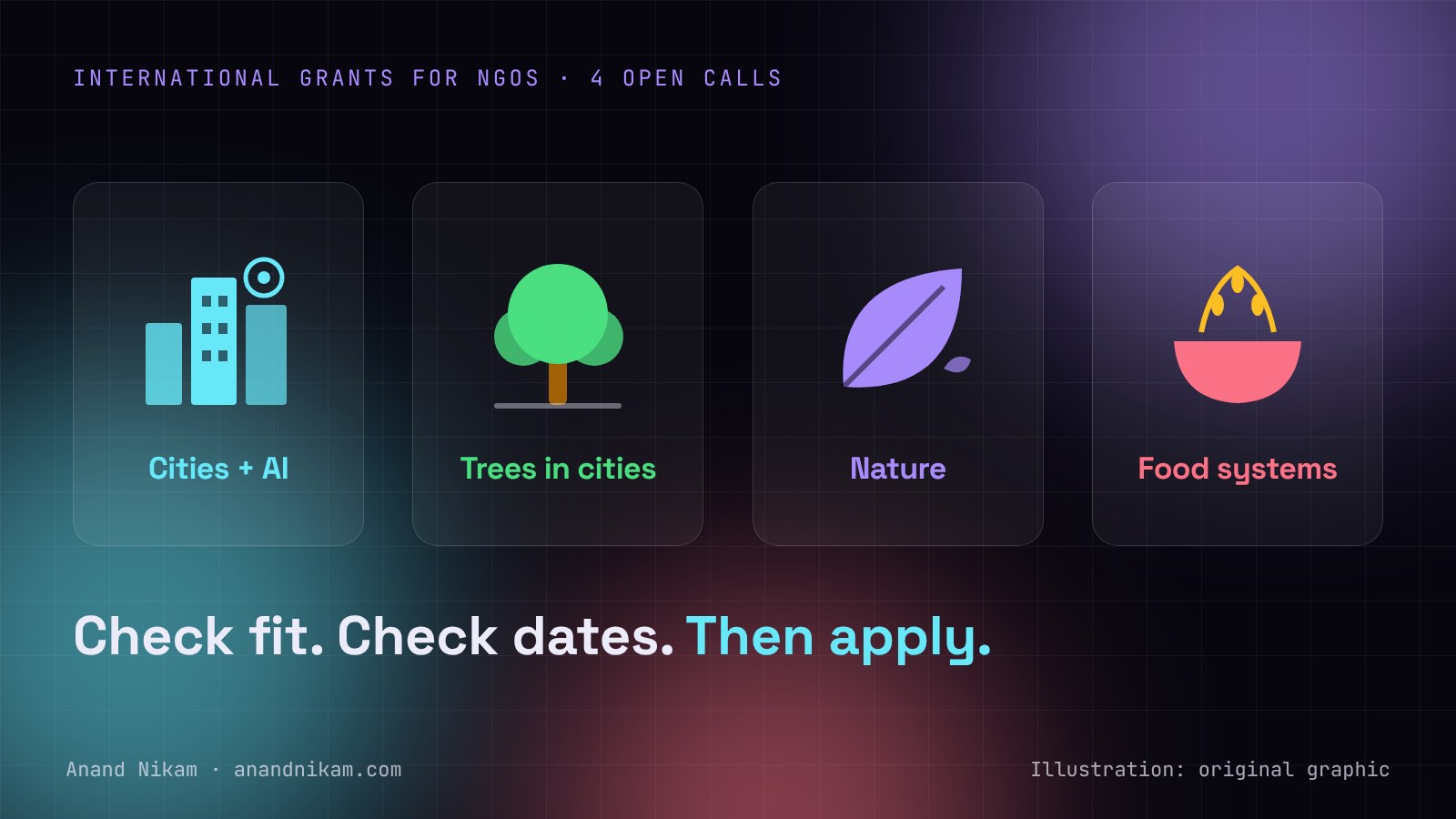
    1. Cities Deliver: AI Solutions for Public Services (The Rockefeller Foundation)

    This call funds 24-month projects that put AI to work in city services. Also, each project must work with a city government and serve underserved communities. The focus areas are public health, economic mobility, environmental resilience and civic engagement. However, the call excludes voting and elections.

    • Who can apply: a nonprofit (including university labs and fiscally sponsored groups) or a public benefit corporation. For-profits qualify only in limited cases. Governments cannot apply directly. Instead, every bid needs a city partner of at least 50,000 people, plus a letter of intent from that city. Cities in all regions are eligible.
    • What you get: Seed grants of USD 500,000 to under USD 1 million, or Scale grants of USD 1 million to 2 million.
    • Key dates: Round 1 closes on 29 November 2026 at 11:59 pm US Eastern Time (about 10:29 am IST on 30 November). Interviews follow in January 2027. Invited full proposals are due on 1 March 2027.
    • How to apply: read the FAQs and terms, then apply on the official Cities Deliver page.

    Indian NGOs should also check their FCRA status before taking any foreign grant.

    2. Terre de Femmes International Award 2027 (Fondation Yves Rocher)

    Meanwhile, this award backs women who lead nature projects. The 2027 theme is “Trees in the City”, so projects should put trees at the heart of urban life.

    • Who can apply: any adult woman, or a group of women, leading a concrete tree-related project in any country. The project must run through a non-profit that is at least one year old. All nationalities can apply.
    • What you get: two winners worldwide, each with a EUR 10,000 grant.
    • Key dates: applications close on Monday, 30 November 2026 at midnight. The page does not state a time zone, so apply early.
    • How to apply: use the “Apply now” link on the official award page.

    3. KNCF Grant Program FY2027 (Keidanren Nature Conservation Fund)

    Next, this Japanese fund supports nature and biodiversity conservation. It also values work on related social issues, the SDGs and skills. Projects should support the Kunming-Montreal Global Biodiversity Framework.

    • Who can apply: groups working mainly in developing countries in the Asia-Pacific region, or in Japan. You need legal status, or equal social credibility, and at least three years of nature conservation work. The guideline does not say clearly whether groups based outside Japan can apply, so email the fund to confirm.
    • What you get: Basic Grant A for first-time applicants, up to JPY 1 million. Standard Grants go up to JPY 10 million. Collaboration Grants for two or more NGOs go up to JPY 20 million a year.
    • Key dates: applications close on 1 December 2026 at 5 pm Japan time (1:30 pm IST).
    • How to apply: register online first, then submit through the fund’s system. Gmail addresses are not accepted. Details are on the official KNCF programme page.

    4. Seeding The Future Global Food System Challenge 2027

    Finally, this challenge looks for food system ideas, mainly for the Global South. Welthungerhilfe runs it for the Seeding The Future Foundation. A strong entry links safe, nutritious food with sustainable practice and fair access. Cutting food loss and waste also counts.

    • Who can apply: NGOs from most countries, academic and research teams, and early-stage social enterprises or companies. Individuals cannot apply alone, and the call excludes sanctioned countries.
    • What you get: up to eight Seed Grants of USD 25,000 each. There are also up to three Growth Grants of USD 100,000 and up to two Grand Prizes of USD 250,000.
    • Key dates: the call opens on 1 January 2027 and closes on 15 February 2027. However, the page gives no closing time. The funder expects to share results in June and July 2027.
    • How to apply: read the questions and criteria, then prepare your plan, budget and documents. Start on the official challenge page.

    How to choose international grants for NGOs

    First, check fit before effort. Read the eligibility list line by line, and stop if you miss a hard rule. Next, match your evidence to the funder’s focus. A tree project fits Terre de Femmes, while a food waste idea fits Seeding The Future.

    Then, plan your time honestly. A short deadline suits a team with documents ready. If you need more time, start on the February call today. Finally, keep one master file with your registration papers, audited accounts and project data. That file saves days on every application.

    International grants for NGOs often need extra steps in India, such as FCRA approval. So check your compliance early. If you also want to understand Indian corporate funding, my ebook CSR Funding in India: The Essentials is a useful next read. You can find more calls on the blog.

    Disclaimer: I am not linked to any funder listed here. Each funder sets its own eligibility, amounts and deadlines, and these may change. So confirm everything on the official page before you apply.

    Sources:

  • Fellowships and Grants: 4 Calls Open to Indians

    Fellowships and Grants: 4 Calls Open to Indians

    Fellowships and grants can give a young changemaker or a small team the time and money to test an idea. This week I checked four calls that are open now or open soon. Indian applicants can use all of them. Each one has a deadline after 1 December 2026. As always, the funder sets the rules, so confirm every detail on the official page before you apply.

    Fellowships and grants open this week

    Here are the four calls, with the India-based ones first.

    1. Ashoka-EDF Climate Corps India Fellowship (Phase II)

    The Climate Corps places fellows with organisations that run climate and sustainability projects in India. Then fellows work for three or six months between April and September 2027.

    • Who can apply: postgraduate students in fields such as business, engineering, sustainability, policy, finance or law, or early-career professionals who graduated on or after 1 July 2022. In addition, you need at least two years of relevant work experience and must be able to work full-time in India.
    • What you get: a fixed stipend of Rs 50,000 a month, plus a relocation allowance of up to Rs 30,000 paid after you complete the fellowship, against receipts.
    • Key dates: Phase II (early-career) runs from 4 December 2026 to 3 January 2027, 11:59 pm IST. However, Phase I has closed. After that, training runs from January to March 2027.
    • How to apply: apply in the phase that matches your status. However, the page does not show a portal link yet. So check it again on 4 December or write to climatecorpsindia@ashoka.edu.in.

    Official page: EDF+Business, India Fellowship programme details

    2. AIF Banyan Impact Fellowship, Service in India

    The American India Foundation runs this fully funded service fellowship. In short, it places young professionals with development organisations across India for a full programme year.

    • Who can apply: Indian citizens, US citizens or US permanent residents aged 21 to 35 by the 1 October start date, with a bachelor’s degree. Also, you must speak fluent English and serve in India for the full term.
    • What you get: a stipend, travel and health insurance. The stipend amount is not published, so check the official page.
    • Key dates: applications open on Friday, 4 December 2026 and close on Sunday, 28 February 2027. The page does not state a closing time. Then interviews follow in spring.
    • How to apply: fill in the online form with short essays, and name two recommenders. Questions go to fellowship@aif.org.

    Official page: AIF, Apply for Service in India

    3. Bayer Foundation Women Entrepreneurs Award 2027

    This award backs women-led ventures in health or food security that help low- and middle-income communities. The Bayer Foundation runs it with the Impact Hub network.

    • Who can apply: a woman founder, co-founder or senior leader with decision-making power. The venture must operate in Asia, Latin America, Africa or the Middle East, show traction and earn up to USD 1 million a year. Also, the company must have registered on or before 1 December 2025. Registered charities, sole traders and idea-stage concepts are not eligible.
    • What you get: EUR 25,000 in non-dilutive cash, a matched business advisor and a sponsored trip to Berlin in June 2027. Finally, the jury picks 15 awardees from 30 finalists.
    • Key dates: applications opened on 24 November 2026 and close on 25 January 2027 at 23:59 (CEST, as the page states). Online info sessions run on 9 December 2026 and 13 January 2027; session times are not published.
    • How to apply: apply through the grants portal linked on the award website.

    Official pages: Women Entrepreneurs Award and Bayer Foundation

    4. Conservation, Food & Health Foundation grants

    This US foundation funds applied research, pilots, training and technical help in conservation, food and agriculture, and health. Within health, it also focuses on reproductive health and family planning. It prefers issues and regions that get little funding.

    • Who can apply: local, state or regional organisations in Asia, Africa, Latin America, the Caribbean or the Middle East, including NGOs, community groups and universities. However, government bodies can join only as partners. One proposal per organisation per year.
    • What you get: there is no fixed range, but most grants fall between USD 25,000 and 50,000 a year, for one or two years. However, it does not fund overheads, buildings or general operating costs.
    • Key dates: the concept window closes on 22 December. The official page gives no year or time, because cycles repeat. A University of Colorado funding page lists it as 22 December 2026. After that, invited full proposals are due on 15 February.
    • How to apply: submit a short concept online. The How to Apply page explains the login steps.

    Official page: CFH Foundation, How to Apply

    How to choose the right fellowships and grants

    Fellowships and grants work best when they fit your stage. So start with fit, not size. A small grant that matches your work beats a big prize you barely qualify for. Next, read the eligibility list twice and tick each line. Then mark every date in your calendar, including info sessions. Finally, write a one-page summary of your project before you open any form. As a result, you will save hours.

    If you also plan to approach companies, my ebook CSR Funding in India: The Essentials explains how CSR budgets work. You can find more funding round-ups on my blog.

    Disclaimer: Eligibility, amounts and deadlines are set by each funder and can change. Always confirm on the official page before you apply. I am not linked to these funders.

    Sources:

  • Small Grants: 4 Open Calls for Indian Changemakers

    Small Grants: 4 Open Calls for Indian Changemakers

    Small grants can help a young idea take its first real step. This week I found four small grants that Indian researchers, founders and grassroots groups can apply for. Each one comes with its own rules and dates, so please check the official page before you start.

    Ignite Field Research Enabling Grant: small grants for field biology

    The Ignite Life Science Foundation runs this call. It is also called the Ignite Ancillary Grant for Field Biology. It covers the practical gaps that often slow field work in India.

    • Who can apply: Researchers in ecology, evolution, conservation, natural history or related fields. You must work at a recognised national, state or private institute or university in India. You also need an existing field project that needs support.
    • What you get: Up to Rs 2 lakh a year for one to two years. Overheads can be at most 10%. The money can cover field staff, local travel, stay, equipment, consumables and community work.
    • Key dates: The deadline is 13 December 2026. The foundation has not published a closing time, so submit early. Info sessions: not published — check the official page.
    • How to apply: Register on the Ignite grant portal and submit from your dashboard. You will need a short proposal, details of existing funding and a budget with reasons. Read the official call document.

    D-Prize Challenge: seed money to launch a proven idea

    D-Prize funds new ventures that take a proven anti-poverty idea to more people. Its list includes water filters, reading glasses, childcare and treatment for child diarrhoea. You can also propose your own idea if evidence backs it.

    • Who can apply: Founders anywhere in the world, including India. Winners must live and work in the country where they run the venture. It mainly suits new organisations. Ventures with more than 18 months of full-time work, or more than USD 30,000 raised, usually do not qualify.
    • What you get: Up to USD 20,000 to launch.
    • Key dates: The extension deadline is 6 December 2026, midnight Pacific Time. You must register in advance for this round. The earlier rounds have closed.
    • How to apply: Round 1 needs a two-page concept note and CVs. Top entries then answer written questions, and finalists have an interview. Start at the D-Prize website.

    Allianz MoveNow Social Innovation Challenge 2026

    Allianz runs this challenge with Social Shifters. It backs youth-led ventures in three areas. These are money confidence in the digital economy, fair health systems, and climate resilience led by communities.

    • Who can apply: The founder or main leader must be 18 to 30 years old. Young people must hold at least 51% of the venture and lead its decisions. Ventures do not need to register. Registered ones must be no more than five years old. India is eligible, and entry is free.
    • What you get: A total pool of USD 90,000. Each area has one USD 10,000 award and four USD 5,000 awards. Finalists also get a business mentor from Allianz.
    • Key dates: Entries close on 18 December 2026 at 5:00 pm UTC, which is 10:30 pm IST. The organisers say they will not extend it.
    • How to apply: Submit one project in English on the official platform. If you use AI tools, you must say so. Read the full rules on the official challenge page.

    The Pollination Project Seed Grants

    The Pollination Project gives seed grants to people doing good work with their own time. It has no narrow theme. However, it does not fund political campaigns, single-use plastics or animal agriculture.

    • Who can apply: Individuals, informal groups and small nonprofits anywhere in the world. Volunteers must lead the project, with no paid staff, and it must already be running. You must be a first-time grantee. The total project budget must be under USD 10,000, or the group’s budget under USD 50,000. International applicants need a referee.
    • What you get: Amount not published — check the official page.
    • Key dates: Applications are rolling. The 2026 window closes on 30 November at 11:59 pm US Eastern time. It reopens on 1 January 2027. Decisions take about 6 to 12 weeks.
    • How to apply: Fill the online form in English. Payment comes by wire or PayPal in US dollars. See the official apply page.

    How to choose the right call among these small grants

    Not every call fits every team. So start with three plain questions.

    First, are you eligible on paper? Check age, location, registration and stage. For example, D-Prize wants new ventures, while Ignite needs a live research project.

    Second, can you meet the date with a good draft? A rushed form rarely does justice to good work. If 6 December feels too close, plan for a later round instead.

    Third, does the money match the need? A small grant can pay for one clear next step. It will not cover a full programme, so name that one step in your budget.

    Also, keep a simple folder ready. Put your one-page summary, budget, registration papers and two short impact stories in it. Then each new call takes hours, not days.

    For help with CSR proposals, my book page on CSR funding in India has more reading. You can also find past funding roundups on my blog.

    Please note: each funder sets its own eligibility, amounts and deadlines, and these can change. Always confirm every detail on the official page before you apply.

    Which of these calls fits your work best?

    Sources:

  • Grant Deadlines: 3 Calls Open to Indian Applicants

    Grant Deadlines: 3 Calls Open to Indian Applicants

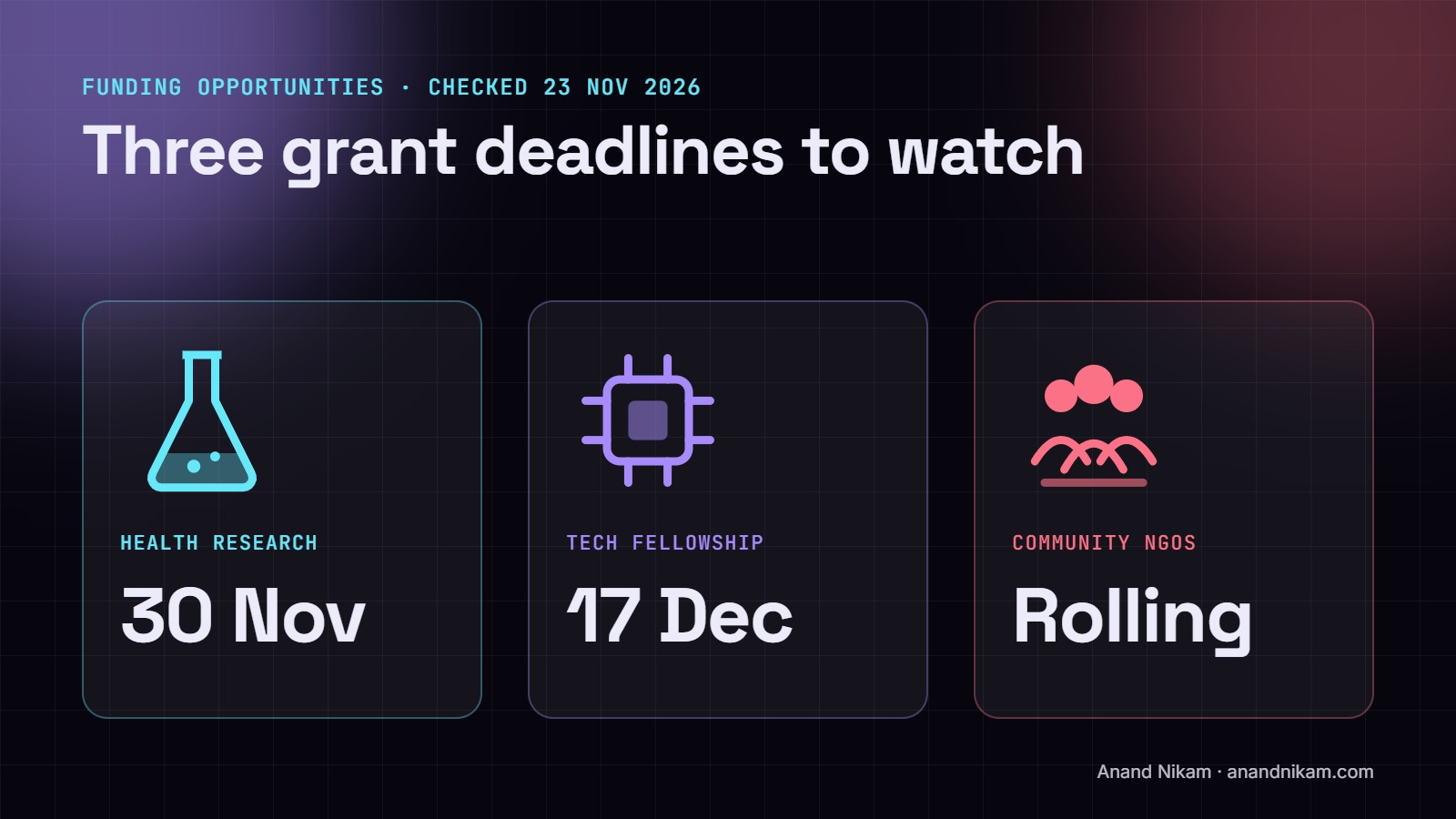
    Grant deadlines can slip past quietly, so here are three live calls worth a look this week. One closes on 30 November, one in mid-December, and one stays open all year. I checked each detail on the funder’s own page on 23 November 2026.

    Please note one thing first. Each funder sets its own rules and dates, and they can change. So always confirm on the official page before you apply.

    1. ICMR First in the World Challenge Grants (2026)

    The Indian Council of Medical Research funds “high risk, high reward” health research here. The goal is a first-of-its-kind vaccine, drug, diagnostic or intervention. Small, step-by-step gains do not qualify.

    • Who can apply: scientists at government medical colleges, universities, ICMR institutes and recognised R&D labs. DSIR-registered private institutions and NGOs can apply too, and NGOs must also be on NITI Aayog’s NGO DARPAN portal. Indian startups, MSMEs and industry are also eligible. Each proposal needs one PI and at least one Co-PI from the same institute.
    • What you get: up to Rs 1 crore for proof of concept (up to 2 years), up to Rs 4 crore for a prototype (up to 3 years), or up to Rs 8 crore for a final product (up to 4 years). Funding is released in stages, linked to deliverables.
    • Key dates: last date 30 November 2026, 5:30 PM. Results are expected on 31 December 2026, as per the call.
    • How to apply: only through ICMR’s e-PMS portal. Choose “First in the World Challenge, ICMR” under Proposal Submission. Official call page.

    With only a week left, this call suits teams that already have strong early data. ICMR also advises applicants to submit well before the last date.

    2. Mozilla Foundation Fellowship 2027–2028

    Mozilla Foundation will award 10 Fellowships for 2027–28. It backs individuals who build technology that serves people, from open AI tools to community-owned infrastructure. Focus areas include energy and compute, sovereign AI, and security tools for small organisations.

    • Who can apply: individuals only, not teams. Projects should be mainly technical, except for one Creative Advocacy spot. Selected Fellows must be able to receive funds from a US-based 501(c)(3) organisation, so read Mozilla’s eligibility guidelines.
    • What you get: Embedded Fellows receive USD 100,000 in total. Independent Fellows receive USD 125,000 in total. Both include a USD 25,000 project budget, and the Fellowship runs for 12 months from 1 June 2027.
    • Key dates: Letter of Intent due 17 December 2026, 11:59 PM Pacific (UTC-8). Shortlisted applicants hear on 16 February 2027. Full applications are due 12 March 2027.
    • How to apply: submit a Letter of Intent online. Official call page.

    Mozilla says it will not accept late entries. Also, the Letter of Intent is the main review stage, so treat it with care.

    3. Paul Hamlyn Foundation India Fund

    This UK foundation funds small Indian NGOs that work with the most vulnerable communities. It supports community-led work with groups such as tribal and Dalit communities, disabled people, women and families in extreme poverty.

    • Who can apply: local Indian NGOs with FCRA registration. The Fund does not accept prior permission. Work must be in its priority states, such as Madhya Pradesh, Chhattisgarh, Odisha, Jharkhand, Bihar and the North East, or regions like Vidarbha and Bundelkhand. Micro-level partners usually have an annual outlay under Rs 1.5 crore.
    • What you get: Rs 10 lakh to Rs 40 lakh for 1 to 2 years.
    • Key dates: rolling, with no call for proposals. Applications are assessed twice a year, in March and October.
    • How to apply: apply directly through the online portal, not through consultants. Official fund page.

    Because review happens in March, an application sent in the coming weeks has time to be ready for that round. Even so, the exact cut-off date for each round is not published — check the official page.

    How to choose the right call before grant deadlines

    Start with fit, not size. A large grant you do not qualify for wastes weeks. First, check the basics: legal status, FCRA, geography and age limits. Next, match your stage to the call. ICMR wants a clear technical leap, while Paul Hamlyn wants deep community work.

    Keep one simple tracker for grant deadlines. List the call, the last date, the time zone and the documents it needs. Then mark a personal cut-off three days earlier. Portals slow down near the last day, and late entries are rarely accepted.

    Then work back from each date. Block time for documents, budgets and sign-offs, since these often take longer than the writing. Finally, read the funder’s exclusions list. It saves more time than any template.

    Beyond grant deadlines: CSR funding

    If you are also preparing for Indian CSR funding, my guide CSR Funding in India: The Essentials covers the basics. You can find more posts on my blog.

    Disclaimer: Eligibility, amounts and deadlines are set by each funder and may change. Please confirm every detail on the official page before you apply. This post is for information only.

    Sources:

  • Social Impact Grants: 4 Calls Open to India

    Social Impact Grants: 4 Calls Open to India

    Looking for social impact grants that are still open? This week I checked four calls on their official pages. Two are research grants with an India focus, one is a global prize for young tech leaders, and one is a rolling grant for conservation. Eligibility and deadlines are set by each funder, so please confirm every detail on the official page before you apply.

    1. UTIF Research Catalyst Grants 2027–28

    The University of Toronto India Foundation and the School of Cities fund research on Indian cities. Topics include air quality, housing, water and sanitation, energy, mobility, waste and urban planning. Social science and humanities work is also welcome. Projects run from April 2027 to March 2028.

    • Who can apply: A pair of co-principal investigators. One must work for a not-for-profit Indian partner, such as a university, research centre, NGO, foundation or government body. The other must be from the University of Toronto. For-profit companies cannot apply.
    • What you get: INR 9–15 lakh per grant, with 8–10 grants planned. Admin costs are capped at 7% and equipment at 5%.
    • Key dates: Deadline 15 February 2027, 11:59 PM IST. The information webinar already took place on 27 October 2026.
    • How to apply: Find a University of Toronto co-PI first. Then download the proposal template and budget sheet, and submit through the form linked on the official UTIF call page.

    2. India–EU call on extreme climate events

    The Ministry of Earth Sciences (MoES) co-funds Indian partners in a Horizon Europe research call. The topic is understanding, modelling and predicting extreme events in a changing climate. Its EU code is HORIZON-CL5-2027-01-D1-07.

    • Who can apply: Indian academic and research institutions, private R&D bodies with at least three years of experience, and NGOs, trusts or foundations whose core mandate is research. Industry, start-ups and foreign-owned entities are not eligible. Indian teams join an EU consortium of at least three entities from three countries.
    • What you get: MoES covers 100% of approved costs for Indian partners, up to Rs 2 crore per project over three to four years. Overheads are capped at 10%.
    • Key dates: The call opened on 17 November 2026. The EU portal deadline is 4 March 2027, 17:00 CET. Indian partners must then send their documents to MoES within seven working days.
    • How to apply: Each partner registers on the EU Funding and Tenders Portal. Next, the EU coordinator submits the proposal. Finally, the Indian lead sends one consolidated PDF and a rupee budget to MoES, as the MoES call document explains. The deadline for the hard copy is not published — check the official page.

    3. Global Citizen Prize: 2027 Cisco Youth Leadership Award

    Global Citizen and Cisco reward young people who use technology to help end extreme poverty. This is a prize for individuals who already run an organisation.

    • Who can apply: People aged 18 to 35 by 31 December 2026, from any country except those under US OFAC sanctions. So Indian applicants qualify. You need a registered legal entity, such as a non-profit, for-profit or social enterprise. Only self-applications count; nominations are not accepted.
    • What you get: Three prizes of USD 250,000 each. That is USD 225,000 unrestricted plus USD 25,000 in Cisco products. Winners report every quarter for three years.
    • Key dates: Deadline 18 December 2026, 5 PM US Eastern Time. Finalists hear back around 8 February 2027. Information sessions are not published — check the official page.
    • How to apply: Create an account on the application portal. Then complete four sections, including a short pitch video and your organisation documents. Start from the official award page.

    4. Rufford Small Grants for Nature Conservation

    The Rufford Foundation funds early-career conservationists. Projects must focus on nature conservation and take place in an eligible country. India is on that list.

    • Who can apply: Early-career conservationists, mainly current master’s or PhD students and recent graduates. Undergraduates are not funded.
    • What you get: Grants of £7,000 to £18,000, in staged tiers. You can move from a first grant to a second grant, and then to Booster and Completion grants.
    • Key dates: There is no deadline, as applications are open all year. If you are unsuccessful, you can reapply after 12 months.
    • How to apply: Read the criteria, check the eligibility list, then create an account and fill in the online form on the Rufford application site.

    How to choose social impact grants that fit

    Four calls can feel like a lot. So start with fit, not size. A Rs 2 crore research grant is no use if your NGO does not do research. Similarly, a youth prize is no use if you are 36.

    Here is a quick filter I use:

    • Mission fit: Does the call fund what you already do well?
    • Eligibility: Do you meet every rule, including age, legal status and partners?
    • Capacity: Can you finish the application well before the deadline?
    • Reporting: Can you handle the reports the funder asks for later?

    Also, look at the effort-to-reward ratio. The Rufford grant has no deadline, so you can apply when you are ready. The Global Citizen award, on the other hand, closes in less than a month. If you want it, start today.

    What to prepare for social impact grants

    Most social impact grants ask for the same basics. Therefore, it pays to keep them ready in one folder:

    • Your legal registration and governance documents
    • A one-page summary of the problem you solve
    • Budget templates in INR and in one foreign currency
    • Two or three short case studies with real, verified numbers
    • CVs of your core team

    For CSR funding in India, the logic is similar, but the rules differ. If that is your next step, my guide CSR Funding in India: The Essentials explains how it works. You can also browse more calls in the blog.

    Disclaimer: I am not linked to any funder listed here. Eligibility, amounts and deadlines are set by each funder and may change, so always confirm on the official page before you apply.

    Sources:
  • Water and Climate Grants: 3 Calls Open Now

    Water and Climate Grants: 3 Calls Open Now

    Water and climate grants are open right now, and two of them close within weeks. This roundup covers three calls I checked on each funder’s official page this week. However, each one suits a different kind of organisation, so read the eligibility lines first.

    As always, the funder sets the rules and the dates. Please confirm every detail on the official page before you apply.

    1. India Pitch-Pilot-Scale Start-up Challenge (AMRUT 2.0)

    The Ministry of Housing and Urban Affairs (MoHUA) runs this challenge with MyGov. Its focus is start-up solutions to urban water problems. This year, the scope also covers urban air quality and energy use in municipal services. Street lighting, climate resilience and heat are in too.

    • Who can apply: Start-ups recognised by DPIIT. The solution must fit one of the listed thematic areas or problem statements.
    • What you get: Selected start-ups can get a grant of up to ₹20 lakh. It comes in three tranches of ₹5 lakh, ₹7 lakh and ₹8 lakh against milestones. The ministry also lists mentorship and help with scaling through urban local bodies.
    • Key dates: The call runs from 10 November to 15 December 2026.
    • How to apply: Register on Innovate India and upload your proposal. If you address a listed problem statement, quote its ID.
    • Official link: innovateindia.mygov.in/ipps-startup

    In my view, this is one of the more practical water and climate grants for start-ups in India. The problem statements come from real cities, so you can match your pilot to a stated need.

    2. FAO Award for Innovation 2027

    The Food and Agriculture Organization of the United Nations (FAO) runs this award. It recognises innovation in areas under its mandate. For example, that includes food security, nutrition and sustainable use of natural resources.

    • Who can apply: FAO describes the award as open to a broad range of awardees, including Members and non-state partners. Applicants must be 18 or older. Importantly, every application must come from, or carry an endorsement from, an FAO Representative or an FAO Director.
    • What you get: A scroll describing the achievement and a cash prize of USD 10,000.
    • Key dates: Submit by 31 December 2026.
    • How to apply: Fill in the nomination form on the FAO site, or email it to the address given there. Attach the FAO endorsement.
    • Official link: fao.org/fao-awards/innovation/apply-now

    Because the endorsement step takes time, start early. Also, the form asks how you would spend the prize money, so plan that answer before you write.

    3. IKI Medium Grants 2026 (Germany)

    The International Climate Initiative (IKI) of the German environment ministry funds climate and biodiversity projects in developing and emerging economies. Now it has opened the seventh round of its Medium Grants.

    • Who can apply: Non-profit civil society organisations, academic institutions and non-profit companies. The lead applicant must have a permanent establishment in Germany by the first payment. It must partner with one or two local implementing organisations in the project country. So an Indian NGO can take part as a local partner. Country eligibility: not published on the main page — check the official funding announcement.
    • What you get: Between EUR 300,000 and EUR 800,000 per project, for two to three years.
    • Themes this year: Green skills for local climate action, and digital and practical solutions for coastal and marine ecosystems.
    • Key dates: The ideas competition closes on 12 January 2027 at 11:59 am CET.
    • How to apply: Submit a project outline through the IKI site. Shortlisted applicants then submit a full proposal.
    • Official link: IKI Medium Grants 2026

    If your NGO works on green skills or coasts, this is the time to talk to German partners. A strong local partner can make the outline far more credible.

    How to choose the right water and climate grants

    First, check the legal form each call needs. The AMRUT challenge needs a DPIIT-recognised start-up. The IKI call needs a German lead partner. The FAO award needs an FAO endorsement. Therefore, these three calls rarely compete for the same applicant.

    Next, match the size of the money to your stage. A ₹20 lakh milestone grant suits a pilot. On the other hand, a EUR 300,000 project needs a team that can run a multi-year programme.

    Then, count backwards from the deadline. Endorsements, partner letters and budgets always take longer than writing. As a rule, keep at least a week for review.

    Finally, write for the reviewer. For instance, use the funder’s own words for the problem. Then show one clear result you can measure. Also, explain how the work continues after the grant ends.

    What to prepare this week

    Before you open any form, collect these basics in one folder:

    • Registration documents and your latest audited accounts.
    • A one-page summary of the project, with one clear number on reach or results.
    • A simple budget with each major cost explained.
    • Letters from partners, if the call needs them.
    • Two or three photos of your work in the field.

    With this folder ready, each new application takes hours instead of weeks. If your work also depends on company CSR budgets, my ebook CSR Funding in India: The Essentials explains how CSR law works and how to position a project. You can also browse more roundups on the blog.

    Key takeaways on water and climate grants

    • Three water and climate grants are open now. They close on 15 December 2026, 31 December 2026 and 12 January 2027.
    • The AMRUT 2.0 challenge offers up to ₹20 lakh to DPIIT start-ups, paid against milestones.
    • The FAO award offers USD 10,000 but needs an FAO endorsement.
    • IKI Medium Grants fund EUR 300,000 to 800,000 projects led by Germany-based organisations with local partners.

    Disclaimer: each funder sets its own eligibility, amounts and deadlines, and these can change. Always confirm on the official page before applying. This post is information, not a promise of funding.

    Sources:

  • Top CSR Spenders in India: What FY 2024-25 Data Means for NGOs

    Top CSR Spenders in India: What FY 2024-25 Data Means for NGOs

    Indian companies spent a record ₹40,794 crore on CSR in FY 2024-25. That is 17% more than the ₹34,909 crore spent a year earlier. So who are the top CSR spenders in India, and what does the data mean for an NGO or impact startup looking for a partner? Here is a plain reading of the latest numbers.

    The headline numbers

    The figures below come from the Bharat CSR Performance Report 2026 by research firm Fulcrum, which is based on Ministry of Corporate Affairs (MCA) filings.

    • Total CSR spend: ₹40,794 crore, up 17% year on year
    • Companies reporting CSR: 29,546, including 1,012 newly covered by the law
    • Projects: 72,233, up 21%
    • Total since FY 2014-15: more than ₹2.61 lakh crore

    In other words, CSR in India is no longer small change. It is a steady, legally required flow of money into social programmes every year.

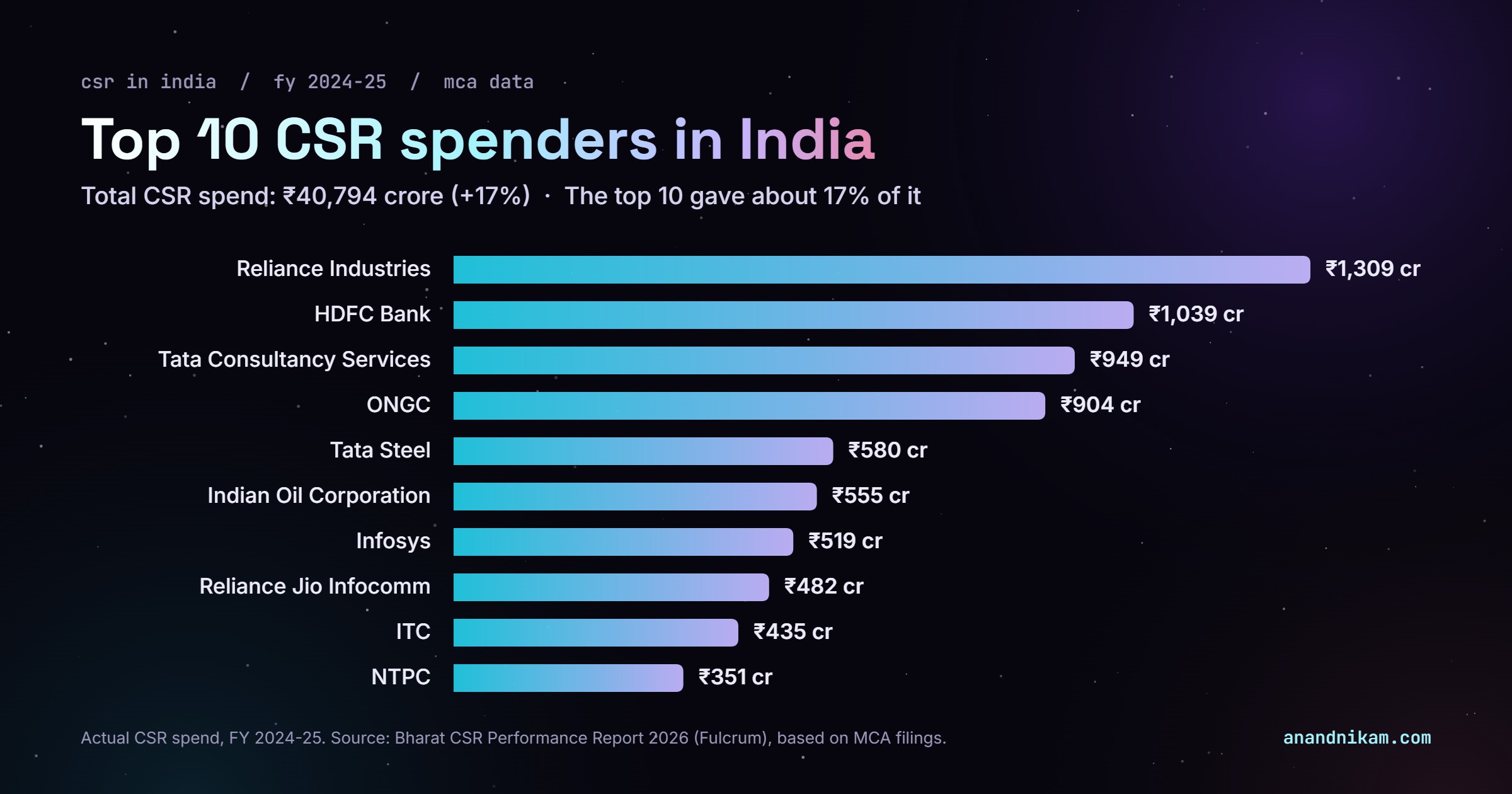
    Top 10 CSR spenders in India, FY 2024-25

    RankCompanyActual spend (₹ crore)Prescribed obligation (₹ crore)
    1Reliance Industries1,3091,048
    2HDFC Bank1,0391,060
    3Tata Consultancy Services949953
    4ONGC904908
    5Tata Steel580580
    6Indian Oil Corporation555574
    7Infosys519540
    8Reliance Jio Infocomm482482
    9ITC435461
    10NTPC351383
    Top 10 total7,1236,989

    Together, these ten companies spent ₹7,123 crore, or about 17% of the national total. Reliance Industries spent ₹261 crore more than its prescribed amount. Three public sector companies (ONGC, Indian Oil and NTPC) made the list, contributing about a quarter of the top-10 total.

    Two cautions apply. First, a figure below the obligation is not automatically a breach. The law lets companies move eligible unspent money to an Unspent CSR Account or a government fund. Second, numbers differ by source. Some reports use group-level or foundation spending, so you may see higher figures for the same company. For example, another tally of NSE-listed companies puts HDFC Bank at ₹1,068 crore and TCS at ₹960 crore. Always check the company’s own annual report before you quote a number in a proposal.

    Where the money goes: sectors

    Education and healthcare still take more than half of all CSR money, according to the same national data.

    SectorFY 2024-25 (₹ crore)Share
    Education13,87734%
    Healthcare8,53121%
    Environmental sustainability3,3978%
    Livelihood enhancement2,5486%
    Rural development2,4776%

    The fastest mover is environmental sustainability, which grew 40% in one year. For climate, waste and clean-air projects, that is a useful signal.

    Where the money goes: states

    The top 10 states and union territories received 74% of all CSR spending, up from 61% a year earlier. Maharashtra led with ₹8,631 crore, followed by Gujarat (₹4,549 crore), Karnataka (₹3,395 crore), Delhi (₹2,753 crore) and Tamil Nadu (₹2,738 crore).

    However, part of that jump may be about how spending is recorded. An analysis of MCA’s Lok Sabha replies notes that spending tagged as “PAN India” fell from ₹7,066 crore to about ₹663 crore in a year. Some of it now shows up under individual states instead. So read state rankings with care.

    What this means for NGOs and impact startups

    1. Look beyond the top 10

    The ten biggest spenders get the most attention. Yet roughly ₹33,671 crore, about 83% of the total, came from the other 29,500-plus companies. They averaged about ₹1.14 crore each. Many of these mid-sized companies have no foundation of their own, so they need reliable implementing partners.

    2. Match the company’s footprint

    Section 135 asks companies to give preference to the local areas where they operate. Therefore, start with companies that have plants, offices or customers near your project.

    3. Fit a Schedule VII theme

    Your project must clearly sit under a Schedule VII activity, such as education, health, sanitation or environmental sustainability. A vague “general welfare” pitch is hard for a CSR committee to approve.

    4. Be compliance-ready before you pitch

    Implementing agencies need Form CSR-1 registration with the MCA, and generally 12A and 80G. In addition, companies with an average CSR obligation of ₹10 crore or more must commission impact assessments for projects of ₹1 crore or more. If you can show measurable outcomes, you make that job easier for them.

    5. Use public data to build your list

    The MCA’s National CSR Portal shows company-wise spending by state and sector. Company annual reports also list their CSR projects and partners. Together, they tell you who funds what, and where.

    A note on viral CSR charts

    CSR rankings are popular on social media, but many charts mix up companies, years and figures. Before you use any ranking in a proposal, verify it against MCA data or the company’s annual report. A wrong number in your first email can cost you credibility.

    Key takeaways

    • India’s CSR spending reached a record ₹40,794 crore in FY 2024-25, up 17%.
    • Reliance Industries, HDFC Bank and TCS were the top three spenders.
    • The top 10 companies gave about 17%; the rest came from more than 29,500 others.
    • Education and healthcare took 55%, while environmental sustainability grew fastest.
    • NGOs do best when they match a company’s location, Schedule VII theme and compliance needs.

    Frequently asked questions

    Who was the top CSR spender in India in FY 2024-25?

    Reliance Industries, with ₹1,309 crore, according to the Bharat CSR Performance Report 2026 based on MCA filings. HDFC Bank (₹1,039 crore) and TCS (₹949 crore) followed.

    How much did Indian companies spend on CSR in FY 2024-25?

    ₹40,794 crore in total, a 17% rise over FY 2023-24, across 72,233 projects.

    Which sector receives the most CSR money?

    Education, with ₹13,877 crore or 34% of the total. Healthcare is second at ₹8,531 crore.

    If you want a structured way to prepare your organisation, I cover the law, project positioning and the 10 red flags that get proposals rejected in my book, CSR Funding in India: The Essentials. It is an educational guide and does not guarantee funding. Which company would you approach first, and why?

    Sources:
    India CSR, 22 Jul 2026: CSR Spending: Top 10 Companies Invest ₹7,123 Cr (Bharat CSR Performance Report 2026, Fulcrum)
    India CSR, 18 Jul 2026: India’s CSR Spending Rises 17% to Rs. 40,794 Crore in FY 2024-25
    Asianet Newsable: CSR spending by NSE-listed firms jumps 23% to Rs 22,212 cr in FY25 (PrimeInfobase)
    Oquilia Data Audit: CSR PSU and private split, PAN India spending (Lok Sabha replies, 20 Jul 2026)
    Ministry of Corporate Affairs: National CSR Portal

  • Impact Funding Opportunities: 4 Open Calls (Dec–Jan)

    Impact Funding Opportunities: 4 Open Calls (Dec–Jan)

    Looking for impact funding opportunities that are open right now? I checked each of these four calls on the funder’s own website on 18 November 2026. They cover new NGO founders, schools, climate projects and experienced change leaders.

    Before you apply for impact funding opportunities

    Please note one thing first. Eligibility, amounts and deadlines are set by each funder, and they can change. Always confirm on the official page before you apply.

    1. Azim Premji Foundation Social Startups Programme

    This programme backs people who want to start a new civil society organisation in India. It suits you if you have field experience but have not yet registered an organisation.

    • Who can apply: Applicants up to 40 years (under 35 preferred) with a graduate degree and at least three years of full-time work in the development sector. You must not already run a registered organisation. You must intend to register a new one and relocate to one chosen geography: Bengaluru, Eastern Uttar Pradesh, Odisha or the Northeast.
    • What you get: An eight-month honorarium phase, then conversion to a two-year grant. Amounts: not published — check the official page.
    • Key dates: Applications close 31 December 2026. The page lists an in-person panel in December 2026 and the honorarium and grant phase from January 2027.
    • How to apply: Check the eligibility page, then fill the online form on the official programme site.

    2. Global Schools Prize 2027

    The Varkey Foundation runs this prize for schools that go beyond the usual to deliver quality education. Indian schools, both government and private, can take part.

    • Who can apply: Government-run and privately funded schools that teach students up to the age of 18, in every country, subject to local laws. A school can apply directly or be nominated.
    • What you get: Ten category winners receive US$50,000 each. One of them receives the overall prize of US$500,000 to scale its impact.
    • Key dates: Applications close 16 December 2026 (time not published — check the official page). The top 50 finalists are due in March 2027 and the winner in May 2027.
    • How to apply: Use the Apply or Nominate buttons on the official Global Schools Prize page.

    3. Keeling Curve Prize 2027

    Climate Curve runs this prize for climate projects. The official portal says a project must reduce, remove or replace greenhouse gases.

    • Who can apply: Projects that reduce, remove or replace greenhouse gases. Detailed criteria: listed on the funder’s eligibility page — check it before you start.
    • What you get: Prize amount: not published on the portal pages I checked — check the official page.
    • Key dates: Applications close 15 January 2027 at 11:59 PM IDLW (UTC-12), or earlier if the cap of 500 applications is reached.
    • How to apply: Request an account on the official Keeling Curve Prize portal, complete each tab, then press Submit. Saved drafts do not count.

    4. Atlantic Fellows for Social and Economic Equity

    This funded fellowship sits at the International Inequalities Institute of the London School of Economics. It suits experienced people who work on inequality.

    • Who can apply: People with at least seven years of experience who meet LSE English language rules. The residential track also needs you to qualify for the MSc in Inequalities and Social Science. Country rules: not published — check the official page.
    • What you get: A funded fellowship. Amount: not published — check the official page.
    • Key dates: The deadline is 11 January 2027, 5.00 pm UK time. Interview notices follow in mid-March 2027, and final decisions in mid-April 2027.
    • How to apply: Apply online through the LSE Graduate Application System with two referees. Start on the official AFSEE apply page.

    What to prepare for impact funding opportunities

    Most applications ask for similar basics. So getting them ready early saves stress near the deadline. For example, here is a simple checklist you can adapt to each call.

    • A one-page summary: the problem, who you serve, what you do and what changes because of it.
    • Evidence: a few clear numbers from your work, with dates and the method you used to count them.
    • Documents: registration papers, recent accounts and any compliance papers the funder lists.
    • People: short profiles of your team and two referees who know your work well.

    Also, keep these files in one folder. Then you can reuse and update them for every new call.

    How to choose impact funding opportunities

    Start with fit, not size, when you compare impact funding opportunities. A large prize you do not qualify for wastes weeks. So read the eligibility list first and tick each line honestly.

    Next, check your evidence. Most funders want proof of results, a clear budget and a simple theory of change. If you lack one of these, fix it before you write the application.

    Then plan backwards from the deadline. Give yourself time for references, documents and a final review. Also, note the time zone. A deadline in UK time or UTC-12 falls at a very different hour in India.

    Finally, keep a simple tracker of the impact funding opportunities you plan to apply for. For more on Indian CSR funding, my ebook CSR Funding in India: The Essentials is further reading. You can also find earlier funding round-ups on my blog.

    Disclaimer: This post is for information only. Eligibility, amounts and deadlines are set by each funder and may change. Please confirm every detail on the official page before you apply.

    Sources:
    Azim Premji Foundation Social Startups Programme
    Global Schools Prize, Varkey Foundation and eligibility and criteria
    Keeling Curve Prize application portal
    Atlantic Fellows for Social and Economic Equity, LSE: Apply

  • Funding Opportunities for NGOs: 4 Open Calls (Nov 2026)

    Funding Opportunities for NGOs: 4 Open Calls (Nov 2026)

    Good funding opportunities for NGOs and impact startups are easy to miss, and deadlines move fast. I checked each call below on the funder’s own website on 17 November 2026. All four were open or about to open, with deadlines still ahead.

    A quick note before you read on. Each funder sets its own rules and dates, and these can change. So please confirm every detail on the official page before you apply.

    1. ICMR SMALL / ANVESHAN Extramural Grants 2027

    The Indian Council of Medical Research (ICMR) funds investigator-led health research for India. Projects can cover discovery, development (such as devices or diagnostics), delivery and descriptive studies. A follow-on track builds on leads from earlier ICMR grants.

    • Who can apply: Regular employees of recognised Indian institutions can be the lead investigator. This includes medical and research institutes, universities, colleges, R&D labs, government bodies and NGOs with proof of recognition (for example, a DSIR certificate). Contract faculty can lead only under set conditions. ICMR’s own scientists cannot be the lead. At least one co-investigator must come from the same institute.
    • What you get: A budget of at least ₹10 lakh and under ₹2 crore, for up to three years.
    • Key dates: Submissions open 20 November 2026. The deadline is 20 January 2027, 5:00 pm IST. Review runs from February to April 2027, and results are expected around August 2027 (tentative).
    • How to apply: Apply online on the ICMR ePMS portal (epms.icmr.org.in). Read the official call document first.

    2. BIRAC Femtech Call

    The Biotechnology Industry Research Assistance Council (BIRAC) has an open call for women-led startups in women’s health. Focus areas include maternal care, menopause, diagnostics, women’s cancers, digital health and mental health.

    • Who can apply: Startups with an Indian woman founder, co-founder or CXO. The company must be an Indian entity that meets the DPIIT startup definition. Indian citizens must hold at least 51% of the shares.
    • What you get: The guidelines mention investment opportunities plus market and technology links. The amount is not published — check the official page.
    • Key dates: The deadline is 23 November 2026, so time is short. The closing time is not published — check the official page.
    • How to apply: Read the guidelines, then apply through the official BIRAC call page.

    3. IKI Small Grants: 8th Call (Nature-based Solutions)

    Germany’s International Climate Initiative (IKI) funds local projects that use nature-based solutions. Projects must address climate mitigation, adaptation, forest carbon sinks or biodiversity. Multi-country projects are not eligible.

    • Who can apply: Local organisations registered in ODA-eligible countries, and India is on that OECD list. You need average yearly revenue of EUR 60,000 to 500,000 over the last three years, plus at least three years of work. Not-for-profits qualify, as do private firms with non-profit project goals. Government bodies, public universities and consortia cannot apply.
    • What you get: EUR 60,000 to 200,000 in total, and not more than your average yearly revenue. Projects run 12 to 24 months and start in Q2 2028 or later.
    • Key dates: The call opened on 15 November 2026. Eligibility registration closes on 8 January 2027 (time not published). Results of that stage come by 2 February 2027. Invited groups then submit full proposals by 16 March 2027.
    • How to apply: Register on the IKI online portal (oap.iki-small-grants.de), in English. See the official funding page and the funding information PDF.

    4. Nexa Lighthouse: Climate and Health

    Grand Challenges Canada and AVPN, with several foundation partners, back proven innovations that help health systems in Asia-Pacific cope with climate risks. These include mosquito-borne disease, extreme heat and poor air quality. There are two tracks: early warning systems and climate-ready patient care.

    • Who can apply: Incorporated organisations from listed Asia-Pacific countries. India is listed, and it is also a priority country. Your innovation must be at least community-linked. Individuals, UN agencies and past Lighthouse grantees cannot apply.
    • What you get: About USD 250,000 to 2,000,000 per innovation, mostly as grants, for up to 24 months.
    • Key dates: The deadline is 8 December 2026, 2:00 pm ET (12:30 am IST on 9 December). Screening runs from December 2026 to March 2027. Invited applicants then send full proposals in March and April 2027.
    • How to apply: Apply only through the Grand Challenges Canada Fluxx portal (gcc.fluxx.io). Read the official call page and the RFP.

    How to choose the right call

    Not all funding opportunities for NGOs suit every team. Start with the hard rules. If a call needs incorporation, a woman founder or a set revenue band, check that first. Then match the call to your stage, because a pilot idea and a proven model need different funders.

    Next, count back from the deadline. Leave at least a week for documents, sign-offs and portal hiccups. Also think about reporting. A large grant often brings heavy reporting, so plan your team’s time.

    Finally, apply where your evidence is strongest. Funding opportunities for NGOs will keep coming, so a focused, honest application beats five rushed ones.

    If you work on CSR proposals in India, my ebook CSR Funding in India: The Essentials covers the basics as further reading. You can also browse more posts on my blog.

    Disclaimer: Eligibility, amounts and deadlines are set by each funder and may change. Always confirm on the official page. This post is for information only and does not promise funding.

    Sources: