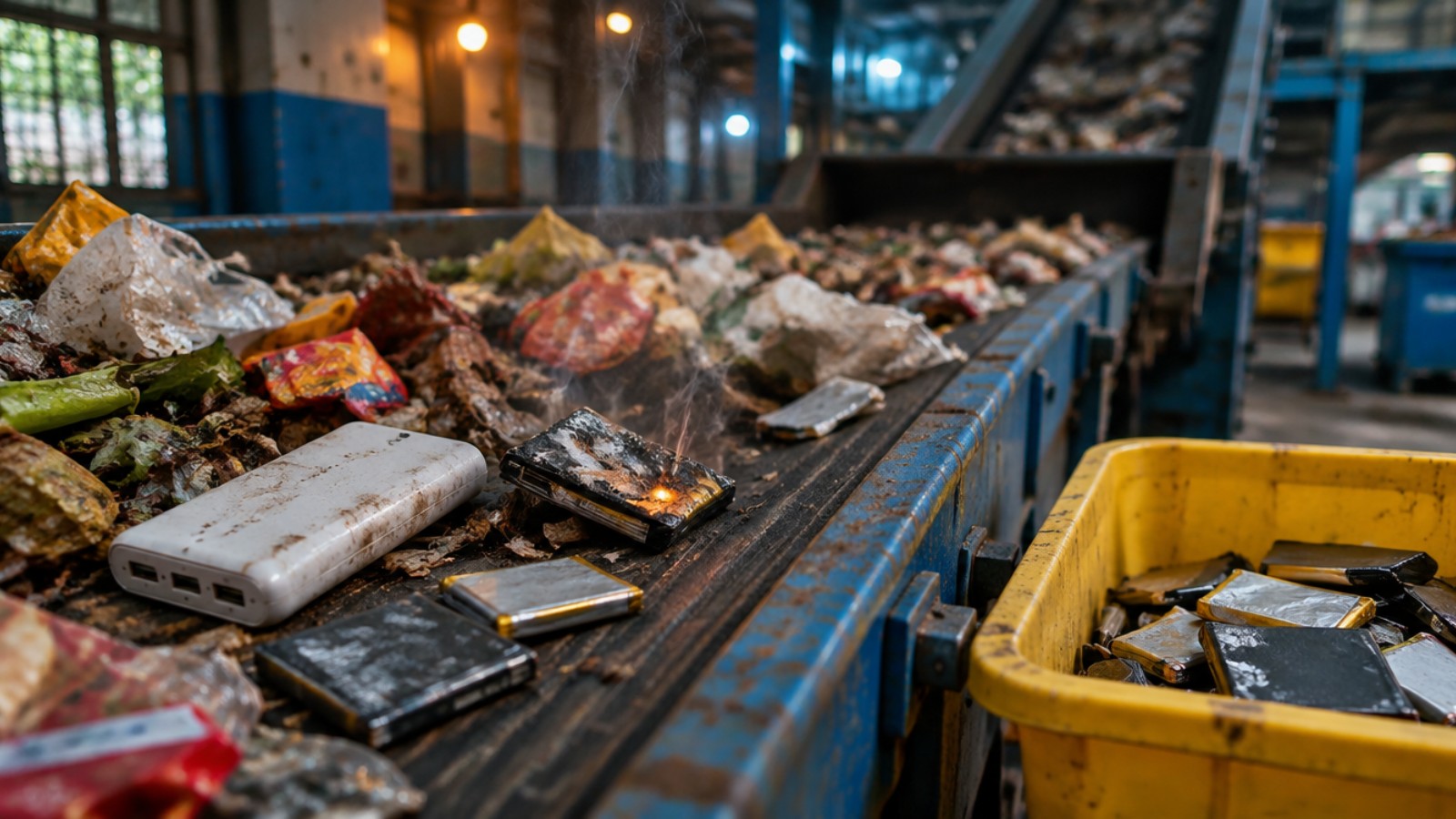
Battery fires in waste are now a measurable cost, not a rare accident. New research from the UK puts a price on the problem: about £2.37 billion a year. For India, where small rechargeable gadgets are everywhere, the lesson is simple and urgent.
What happened: the UK counts the cost of battery fires in waste
On 18 November 2026, Circular Online reported new estimates from Material Focus. Material Focus is a non-profit that runs the Recycle Your Electricals campaign in the UK.
The research estimates 2,839 battery fires in the UK waste system in 2025. That is 135% more than in 2023/24. Bin lorries accounted for 26% of these incidents, up from 19% in the earlier period.
To get there, the team surveyed 97 local authorities, about a quarter of UK councils. Then they scaled the answers using regional population figures. Of the councils that responded, 91% said battery fires are a growing challenge.
Moreover, the £2.37 billion figure covers more than burnt trucks. It includes damage to facilities, disrupted services, diverted waste and emergency response. According to the report, a single replacement bin lorry can cost nearly £540,000.
Why battery fires in waste keep rising
In fact, the cause is not a mystery. Lithium-ion batteries can catch fire when something crushes, pierces or damages them. That is exactly what happens inside a compactor truck or a shredder.
Today, these batteries sit inside many small products. Think of electric toothbrushes, power banks and wireless earphones. Yet most of us do not notice that these items carry a battery.
Once a fire starts, it spreads through the dry waste around it. It can also restart even after it looks finished. As a result, collection crews, plant workers and firefighters face real danger. One fire safety lead quoted in the report called many of these incidents “easily preventable”.
In short, the problem sits at one point: the moment a person drops a battery into the wrong bin.
Why this matters for the circular economy
A circular economy depends on clean material streams. After all, recyclers need sorted inputs to recover value. However, a single hidden battery can damage a sorting line and stop it for days.
So battery fires in waste hurt circularity in two ways. First, they destroy equipment that recovers materials. Second, they waste the battery itself, which holds lithium, cobalt, nickel and copper that recyclers could recover.
In addition, fires push up insurance costs for waste operators. In turn, higher costs make recycling less viable, especially for small players.
What it means for India
India already has a legal framework for this. The Ministry of Environment, Forest and Climate Change published the Battery Waste Management Rules, 2022 on 24 August 2022.
Here is what those rules set out, as per the government’s release:
- The rules cover all battery types: electric vehicle, portable, automotive and industrial.
- They work on Extended Producer Responsibility (EPR). So producers, including importers, must collect and recycle waste batteries.
- Landfill and incineration of waste batteries is not allowed.
- An online portal lets producers and recyclers trade EPR certificates.
- Recyclers must recover a minimum share of materials, and new batteries must use some recycled content.
Still, rules on paper need habits on the ground. The UK data shows that even a mature system struggles when households mix batteries with general waste. Therefore, India can learn from this before the volume of small devices grows further.
Here, I see three practical gaps worth closing:
- Awareness at home. Most families do not know a power bank needs separate disposal. Simple labels and messages at the point of sale can help.
- Easy drop-off points. People use collection points when they are close and visible. Housing societies, schools and offices can host them.
- Safety for waste workers. Informal workers often handle mixed waste by hand. They need training on how to spot and isolate damaged batteries.
Meanwhile, municipal bodies can add battery questions to their waste segregation drives. Also, CSR teams could support collection and awareness work. Of course, it must fit the activities Schedule VII allows.
What you can do this week
Luckily, you do not need a policy role to help. Start with your own home and workplace.
- Collect used batteries and small electronics in one box, away from heat.
- Tape the terminals of loose lithium batteries before storing them.
- Never put a swollen or damaged battery in the household bin.
- Ask your housing society or office to set up a clearly marked drop-off box.
- Hand old devices to an authorised e-waste or battery collector, not the general waste stream.
Want to check how far your own habits support a circular economy? Then try my free SQ Test. It is a self-assessment, not a rating, but it shows where to start.
Key takeaways
- Battery fires in waste cost the UK an estimated £2.37 billion a year, according to Material Focus.
- Estimated incidents rose 135% to 2,839 in 2025, with bin lorries involved in about a quarter.
- The root cause is simple: lithium-ion batteries thrown into general waste.
- India has the Battery Waste Management Rules, 2022, built on EPR and a ban on landfilling.
- Rules work best with daily habits: separate storage, easy drop-off points and trained waste workers.
In the end, the fix is cheap compared with the cost of one fire. A separate box at home might be the most useful circular economy tool you own. For more stories like this, visit the blog.
Sources:
- Circular Online, “Battery fires in UK waste system cost £2.37bn a year, research estimates”, 18 November 2026: https://www.circularonline.co.uk/news/battery-fires-in-uk-waste-system-cost-2-37bn-a-year-research-estimates/
- Press Information Bureau, “Government notifies Battery Waste Management Rules, 2022”, 25 August 2022: https://pib.gov.in/PressReleasePage.aspx?PRID=1854433