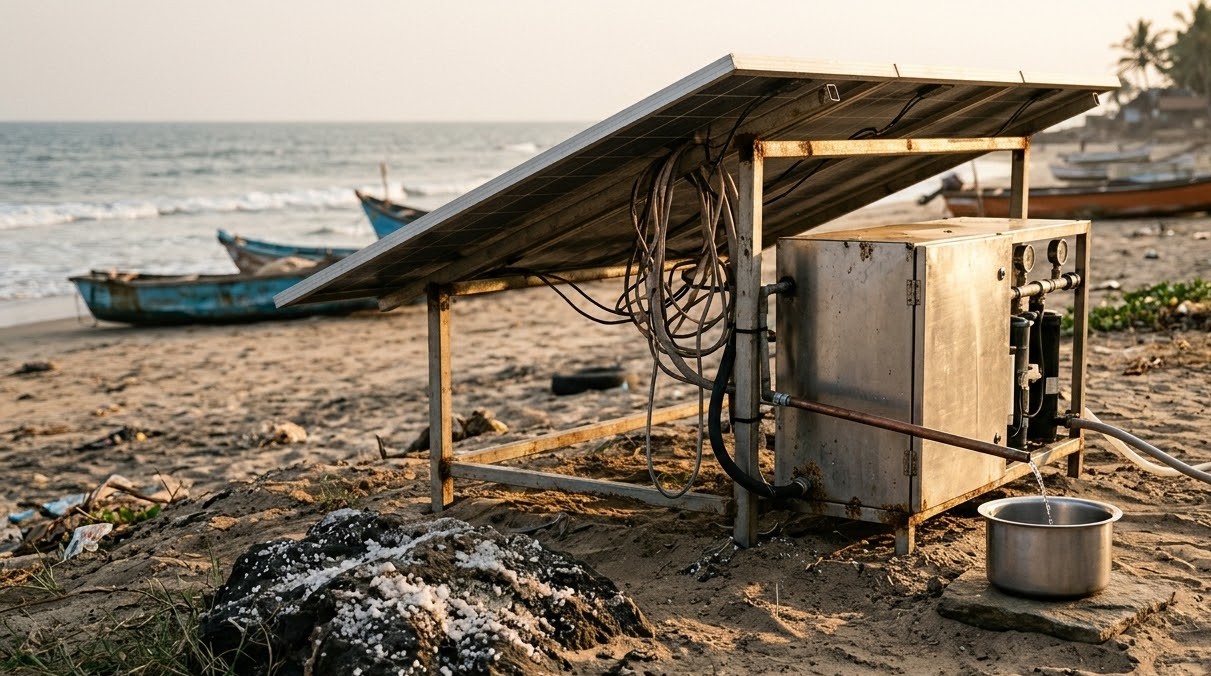
Solar-powered desalination usually brings to mind big coastal plants. A team at BITS Pilani’s Hyderabad campus is testing something much smaller. Their unit turns salty water into drinking water and gives out cool air at the same time.
The team holds an Indian patent for the design. It is still a lab prototype, not a product. Still, the idea speaks to two problems many coastal and island homes face together: scarce fresh water and rising heat.
What it is
According to Telangana Today, the system holds Indian Patent No. 558052. The patent covers a portable apparatus that desalinates water and cools a space at once. Prof Sandip S Deshmukh and Prof Santanu Prasad Datta of the mechanical engineering department lead the work. Research scholar K Sai Sandeep has worked on the later research and the prototype.
The team built and tested the prototype on the Hyderabad campus across different seasons. Deccan Chronicle reports that the results appeared in the journal Applied Thermal Engineering in 2026.
How solar-powered desalination works here
The method is called humidification-dehumidification. Think of how a cold glass “sweats” on a humid day. The unit copies that effect on purpose.
- First, air passes through a humidifier and picks up moisture from salty or brackish water.
- Next, the system cools this moist air, so the vapour condenses into fresh water.
- As a result, the salt stays behind, because only water vapour travels with the air.
- Finally, the cool, dry air that leaves the unit can cool a room or a small store.
The design also combines refrigeration and thermal energy storage in one box. On top of that, solar energy runs the whole process. That makes the unit a good fit for places with strong sun and weak grid supply.
What the lab tests show
The reported numbers are promising, but they come from lab conditions. Here is what the two news reports say:
- Water: up to about 12.4 litres an hour in a double-stage setup with water heating, under high-humidity conditions.
- Cooling: a capacity of up to 6.57 kW, with outlet air as cold as 14°C.
- Cost: the lowest estimate during the experiments was around 30 paise a litre.
- Design goal: roughly 200 litres of fresh water a day.
Deccan Chronicle also describes one proposed use. A single unit could supply about 200 litres a day and keep around 50 kg of seafood cool, serving 10 families. That is a design idea, not a field result.
Why it matters for India
India has a long coastline and many island communities. Many villages also draw brackish groundwater. In such places, safe drinking water and cold storage are often separate struggles. Today, families buy water. Meanwhile, fishers lose catch to heat. Small clinics need both water and cooling.
A single unit that does both jobs could cut the number of machines a village must buy and maintain. Besides, it could run where diesel is costly or the grid is unreliable. The researchers name island communities, rural settlements with brackish groundwater, small food stores and field hospitals as possible users.
There is a wider lesson too. Climate adaptation does not always need a mega project. Sometimes it needs a small, well-designed box that a community can own and repair. In my own work on clean technology, I see that the last mile decides whether an idea helps anyone. You can read more about that work on my about page.
Limits of solar-powered desalination today
We should read these results with care. The researchers themselves say that output changed with the setup and the weather. For example, the 12.4 litres an hour figure needed favourable high humidity. Similarly, the 30 paise figure was the lowest estimate, and real costs will depend on location, energy needs, installation and upkeep.
So several questions remain open. How will the unit perform in dry, hot months? What happens to the leftover brine? Who will service it in a remote village? And what will a unit cost to build at scale? The team plans field trials and wants to adapt the design to different climates. Those trials will tell us far more than lab numbers can.
What NGOs and local bodies can do now
You do not need to wait for a finished product to prepare. If you work with coastal or island communities, start by mapping the need. How much water does a household buy each week? What does it cost? How much catch or produce spoils for lack of cooling?
Also, that baseline data helps in two ways. It shows whether a solar-powered desalination unit would really help. It also makes your case stronger when you approach researchers for a pilot, or a company for CSR support. Good data turns a hopeful idea into a fundable project.
Key takeaways
- A BITS Pilani Hyderabad team has patented a small unit that makes fresh water and cool air from sunlight.
- It uses humidification-dehumidification, plus refrigeration and thermal storage, in one system.
- Lab tests reported up to 12.4 litres an hour and up to 6.57 kW of cooling, under favourable conditions.
- It is still a prototype, so field trials will decide its real value.
I will keep tracking how this solar-powered desalination work moves from lab to village. For more stories like this, visit the blog.