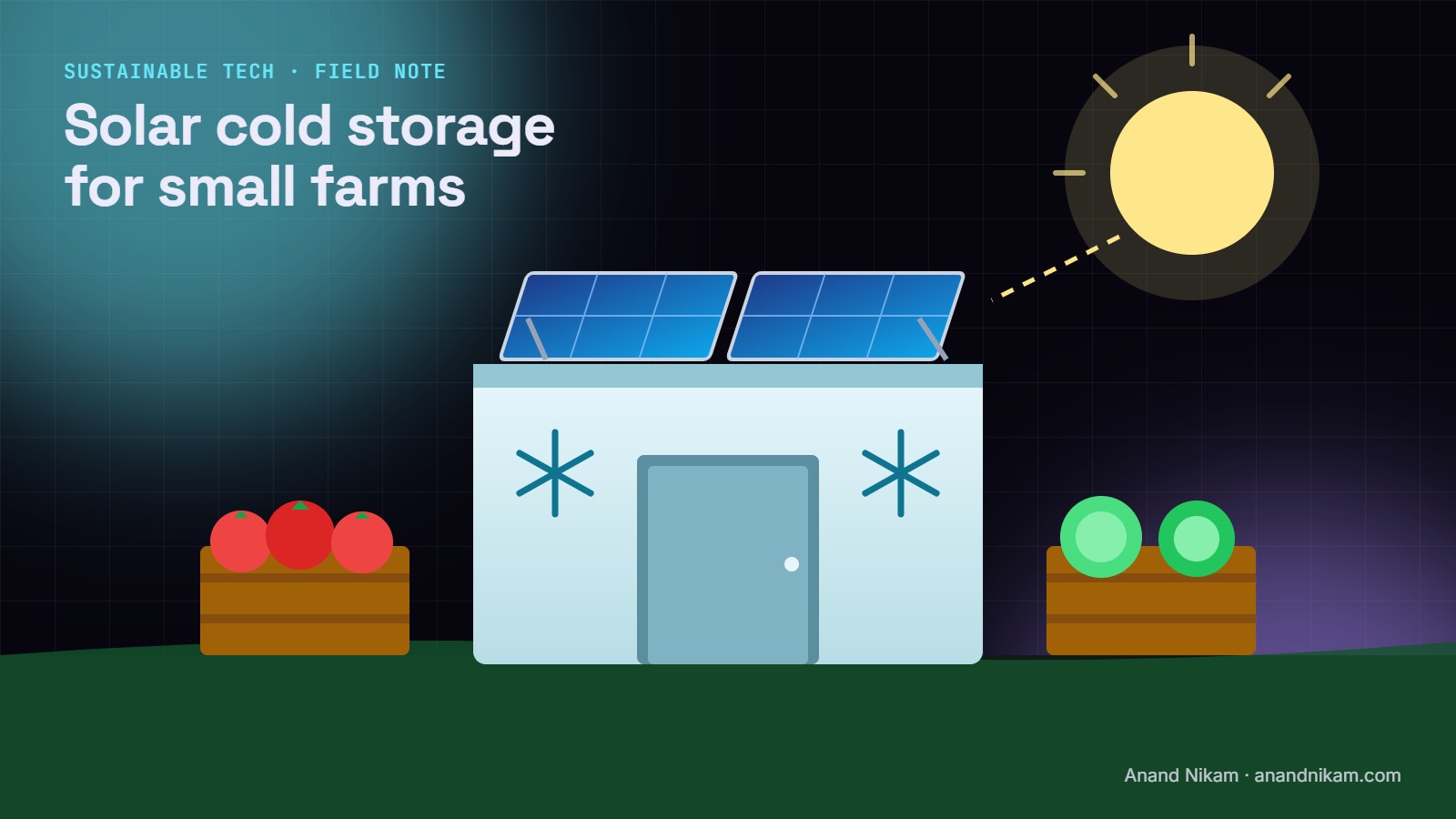
Solar cold storage is now reaching small farms in India, and a new unit in south Kashmir shows why it matters. A farmer in Pulwama has set up a 10-tonne mini cold store that runs on solar power. As a result, 30 growers can now hold their vegetables until prices improve.
This post explains what the unit is, how solar cold storage works, and why it matters for India. It also looks at the limits, because one unit is a start, not a solution.
What it is: a 10-tonne solar cold storage unit in Pulwama
Farooq Ahmad lives in the Tahab area of Pulwama district. According to a KNO report published by Kashmir Thunder on 7 November 2026, he turned his orchard land back into vegetable fields. He also brought 29 other farmers into a Farmers Interest Group (FIG).
The key step is a 10-metric-tonne mini cold storage unit on his farm. An organic foundation provided it free of cost, says the report. It runs on solar energy, and locals call it the first such facility in the area.
The idea is simple. Instead of selling the whole harvest on the day it is picked, group members can store it. Then they can release it when demand and prices are better, especially in the off-season.
How solar cold storage works
The report does not give the technical design of this unit. So here is how such systems work in general. Solar panels on or near the store make electricity during the day. That power runs a cooling unit, much like a large fridge.
The sun does not shine at night, of course. For this reason, most designs store the cold, not just the power. Some use batteries. Others use thermal storage, such as ice or a special liquid that freezes during the day and keeps the room cool after sunset. Thick insulation helps the room hold its temperature.
Small units like this one sit close to the field. That matters. Fresh vegetables start to lose quality soon after harvest. Therefore, a cold room a few steps away is worth more than a big one far away on a highway.
Why it matters for India
India loses a real share of its food after harvest. A study commissioned by the Ministry of Food Processing Industries and done by NABCONS (2022) measured these losses. As PIB reported in August 2024, losses ranged from 4.87% to 11.61% for vegetables. For fruits, the range was 6.02% to 15.05%.
Some crops lose even more. The same table shows an average loss of 11.61% for tomato and 8.15% for cabbage. In contrast, milk showed a loss of just 0.87%, partly because the dairy sector has a strong cold chain.
Price is the other side of the story. When every farmer sells on the same day, prices fall. Farooq said the unit will help growers supply markets “when demand and prices are favourable.” In short, storage gives a small farmer time, and time gives bargaining power.
Solar power adds a third benefit. Many villages face power cuts, and diesel generators are costly and polluting. A solar cold store can run where the grid is weak. It also avoids the fuel bill that often makes small cold rooms hard to run.
Government support already exists for cold chains. For example, the Mission for Integrated Development of Horticulture offers a credit-linked subsidy of 35% of project cost in general areas. In hilly and scheduled areas, the rate is 50%, according to the same PIB release. The Agriculture Infrastructure Fund also offers loans for post-harvest projects.
Limits and open questions
We should be honest about what we do not know. The report gives no figures for cost, power use, or how many days the produce stays fresh. It also does not say which foundation supplied the unit, or who will pay for repairs.
Maintenance is the big test. Panels need cleaning, batteries wear out, and cooling parts fail. Many rural assets stop working because nobody owns the repair plan. A group of 30 farmers will need clear rules on who uses how much space, and how they share the costs.
Storage alone also does not fix markets. Farmers still need transport, buyers, and fair price information. Kashmir’s winters bring their own challenge, since cold weather changes how much cooling a store needs. Finally, a single unit is a pilot. We will only know its value after a full season of real use.
Key takeaways on solar cold storage
- A 10-tonne solar cold storage unit now serves a 30-member farmer group in Pulwama, J&K.
- The aim is to let growers hold produce and sell when prices are better.
- Official data shows vegetable losses of 4.87% to 11.61% after harvest in India.
- Existing schemes offer 35% to 50% subsidy support for cold storage.
- Repair plans, fair sharing rules and market links will decide if it lasts.
I write about practical sustainability ideas like this every week. You can read more on my blog, or check your own habits with the free SQ Test.
Sources: